
On a Swiss merchant, a dealer in Kyoto, and the long patience of a man who never stopped refining.
“He came to Japanese sword fittings through Ceylon.”
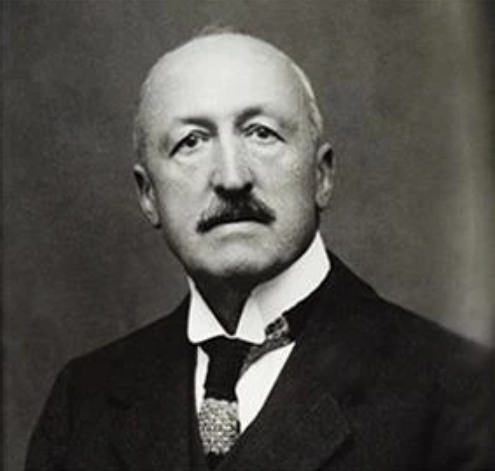
This requires a small explanation. Alfred Baur was born on 7 June 1865 in Andelfingen, a village in the Swiss canton of Zurich. After completing commercial studies in Winterthur, he joined a trading company and was posted to Colombo. In 1897 he established his own business there — a company manufacturing organic fertilisers, A. Baur & Co., which would outlast its founder by nearly half a century. When he returned to Geneva in 1906 to settle permanently, he was forty-one years old, prosperous, and attentive to the kind of objects that a man with an eye, time, and means begins to notice when he has spent years moving through Asia’s markets.
Museum of Far Eastern Art
His first purchases of Japanese art date from 1907. They were made through Thomas Bates Blow, an English collector and connoisseur who had come into his orbit in Ceylon through common acquaintances and who, by the time Baur reached Geneva, was living in Kyoto. Blow was a versatile figure — ardent photographer, botanist, Fellow of the Linnean Society, gardener, motorist, Chevalier of the Légion d’Honneur for his service to the French Red Cross during the Great War. But what mattered most for Baur’s purposes, as B. W. Robinson observes in the introduction to the 1980 catalogue of the collection, was that Blow counted among his acquaintances Joly, Behrens, Tomkinson, Edmunds, and Ransom — the remarkable circle of English collectors and connoisseurs active during the first quarter of the twentieth century, and was thus able, on occasion, to have pieces specially made and decorated to Mr Baur’s taste.
The early relationship was productive but diffuse. Blow supplied sword fittings alongside netsuke, inro, Satsuma ware, cloisonné, prints, bronzes, and Chinese objects; the files bulge, Robinson notes, with long letters and lists in Blow’s peculiarly large and uncouth handwriting. Baur’s main interests at that stage appear to have been elsewhere, and much of what he acquired through Blow was eventually sold off in 1928 when his criteria became more exacting. What the early period gave him was not a settled collection but an education — the prolonged handling of many different kinds of objects until he understood, with the precision of someone who had built a successful company from the ground up, what he was actually looking for.
The real turning point came in 1920, when Baur expressed to Blow his increasing and focused interest in sword fittings. And then, more decisively, in 1924, when he and his wife Eugénie made the journey to Japan.
They went armed with an introduction from Blow to Tomita Kumasaku, a dealer based in Kyoto. The two men hit it off immediately. Before Baur returned to Europe he had purchased some 700 objects from Tomita at a cost of £12,350, over 400 of which were sword fittings. The scale of a single transaction is striking enough; what is more striking is what Tomita wrote to Baur shortly afterward: that in the Japanese art dealers’ circle, the critical consensus was that Baur had made a selection of exceptional quality. The record for any foreigner’s selection in Japan, Tomita suggested, had been set. This was not the courtesy of a dealer flattering a client. By 1927, Tomita was writing to describe the collection not as a “collection” but as a “selection” — a distinction that says something about what he saw Baur doing.
The correspondence that followed sustained the collection through its most productive years. Consignments arrived from Tomita regularly until around 1949, when Baur’s interest in sword fittings began to ease. Tomita’s final consignment of sword-furniture was invoiced on 24 June 1949 — thirty-two pieces of the highest quality, work by Natsuo, Ichijō, Ikkin, Shōmin, and others. He was by then still providing magnificent material, operating out of Kyoto at the age of nearly eighty. The relationship between the two men had lasted twenty-five years.
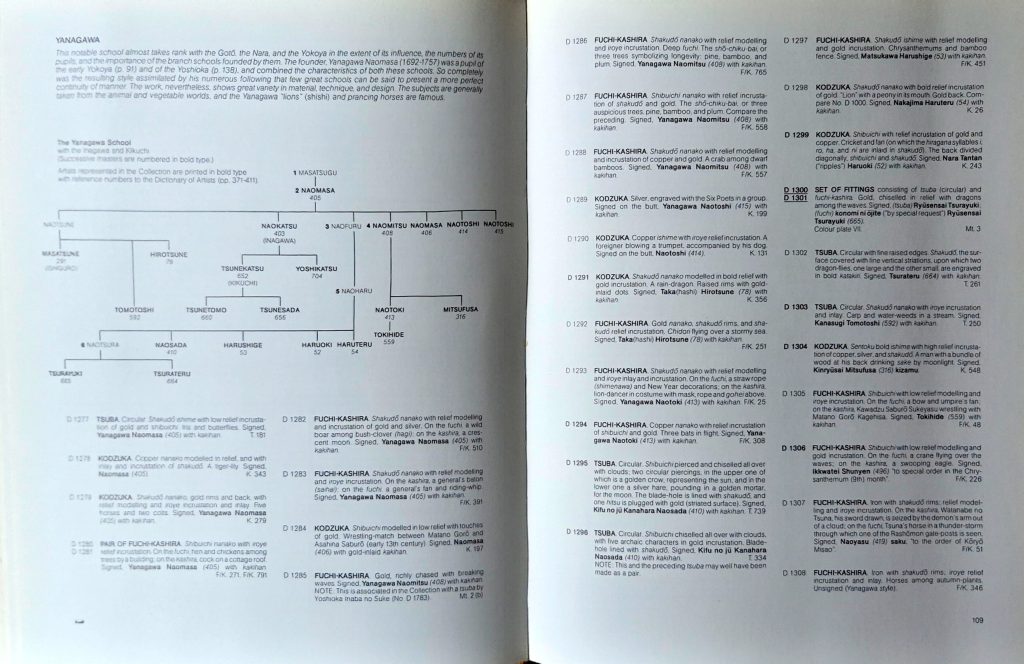
What it produced was a collection of nearly 2,600 pieces, including signed work by over 800 different craftsmen. Robinson, writing the introduction to the 1980 catalogue as a man who had spent decades examining the great British collections — Hawkshaw, Naunton, Behrens, Church — was unequivocal about its standing: among the largest and most distinguished in the world, the quality often rising to the superlative, the range fully representative. The collection was not built around a single aesthetic preference in the manner of Behrens, who turned his back on the elaborate work of the eighteenth century, or even of Halberstadt, whose particular consistency of eye shaped a holding of remarkable homogeneity. Baur’s approach was the opposite: comprehensive, systematic, oriented toward quality across the full range of the tradition. The signed work of the great kinko masters — Ishiguro, Hamano, Mito, the Goto lineage — was there in depth, alongside the iron guards that a different kind of collector would have valued above everything else.
Robinson makes the collecting taste precise. Baur keenly appreciated, he writes, the superb technique and finish and the complete mastery of materials displayed by the Japanese craftsman at his best. The Zen-tinged mystique of rough old iron held no particular appeal for him. He and Blow before him had representative examples of such pieces, but once a satisfactory sampling had been achieved, the resumed pursuit was for the finest productions of the inlay masters. This was not ignorance of the iron tradition — it was a clear aesthetic position, arrived at after years of handling. Baur understood what he was choosing not to collect, and he chose deliberately.
The collection grew alongside everything else Baur was doing. Chinese ceramics entered the collection in 1928 and became a dominant interest — 756 pieces spanning the Tang to the Qing dynasties, assembled with the same demand for coherence and quality that shaped the sword fittings. Japanese lacquerware came too, nearly eight hundred pieces, and netsuke, and prints, and jade. The full collection eventually ran to nearly 9,000 objects. It was the work of a man who collected not as a specialist in a single field but as someone who understood, from years in business, what it meant to assess quality across different categories and maintain consistent standards across all of them.
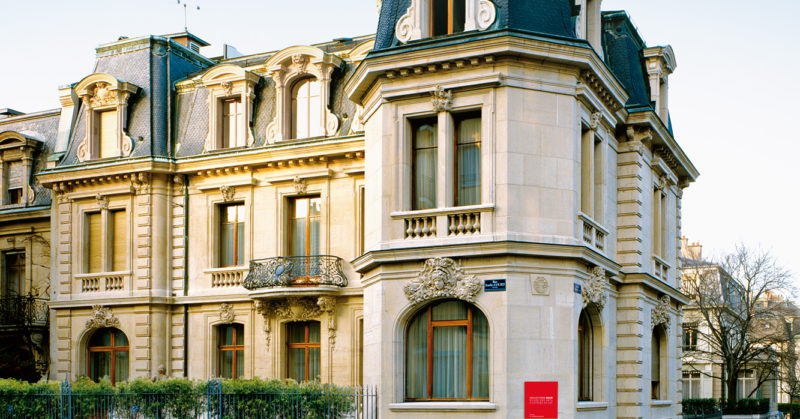
Shortly before his death in 1951, Baur purchased a townhouse on the Rue Munier-Romilly in Geneva with the specific intention of turning it into a museum. He wanted visitors to have the impression not of a museum but of a private home — rooms where objects could be examined at leisure, without the distance that institutional presentation tends to impose. He died that same year. The Fondation Alfred et Eugénie Baur-Duret opened to the public on 9 October 1964. The sword fittings are displayed on the upper floor, alongside netsuke and tea ceremony objects, in rooms that preserve something of the atmosphere Baur had in mind.
What distinguishes Baur from the collectors in this series who worked in the earlier generation — from Oeder, from Brinckmann, from the British figures around the Burlington Fine Arts Club — is the arc. He collected from 1907 to 1949: forty-two years, without fashionable interruption, without the catastrophic dispersals that ended so many European collections of the period. The Baur collection was not auctioned. It was not lost in the chaos of two world wars. It was not donated under pressure, as Halberstadt’s was, or scattered through the auction rooms as Behrens’s and Vever’s were. It was kept, refined, and given a permanent address. Tomita called it a selection rather than a collection. The distinction matters. A collection is what accumulates; a selection is what remains after the accumulation has been tested, refined, and kept only at its best. Baur spent forty years making that distinction real.
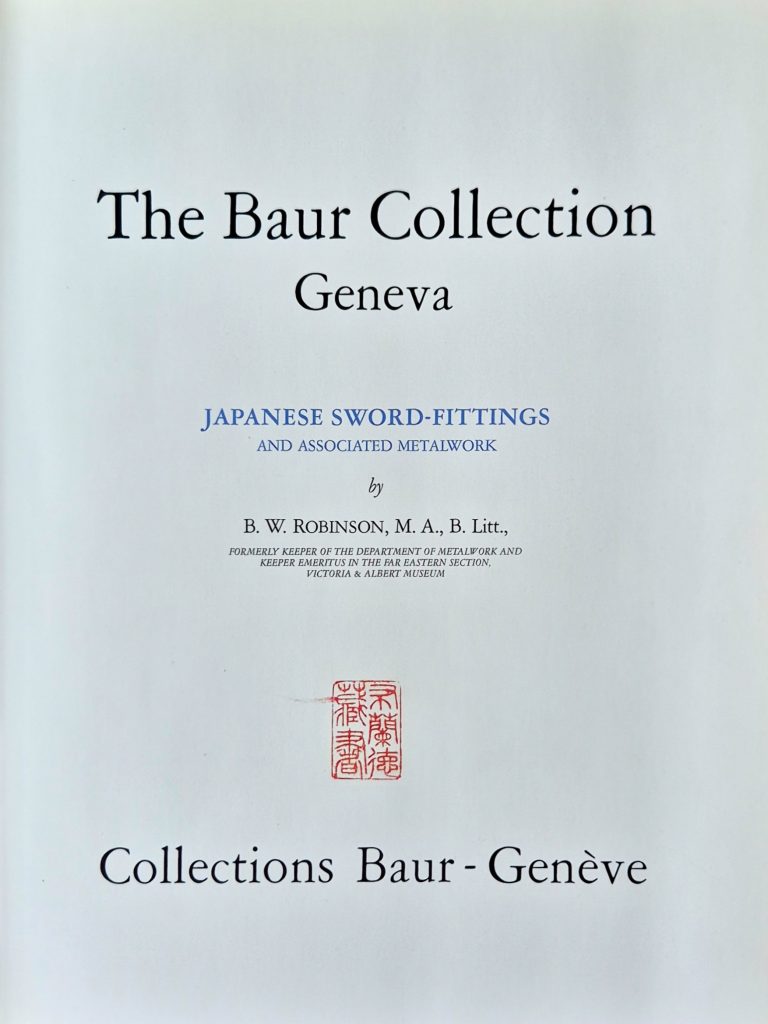
The 1980 catalogue, written by B. W. Robinson and published by the Baur Foundation with a preface by Pierre-Francis Schneeberger as Keeper of the Collection, remains the standard reference for the holdings. Robinson describes it as a mine for future scholars to work — a document of extraordinary labour that is not a vehicle for the cataloguer’s own views but a structured record for those who will come after. That modesty suits the catalogue and suits the collection. Baur himself was not a theorist, not a polemicist in the manner of Behrens, not a scholar in the manner of Jacoby. He was a merchant who understood quality across categories, who found in Tomita a partner as exacting as himself, and who built, over four decades in a Geneva townhouse, one of the most substantial and coherent collections of Japanese sword fittings ever assembled outside Japan.
Sources:
- Robinson, B. W. Introduction to The Baur Collection, Geneva: Japanese Sword-Fittings. Geneva: Collections Baur, 1980. — The primary catalogue of the collection; Robinson’s introduction provides the essential biographical and collecting history used throughout this essay.
- Fondation Baur. “Alfred Baur.” (fondation-baur.ch/en/alfred-baur) — The museum’s own account of Baur’s biography, the Colombo years, the return to Geneva, and the Tomita relationship.
- Wikipedia contributors. “Alfred Baur.” Wikipedia, the Free Encyclopedia. — Summary biography drawing on multiple institutional sources