
Das Blatt, das dem Herrn gehörte
Mumei · Tetsu · Bushu Ito-Schule (zugeschrieben) ·
Edo-Zeit
Aoi Bushu Tsuba
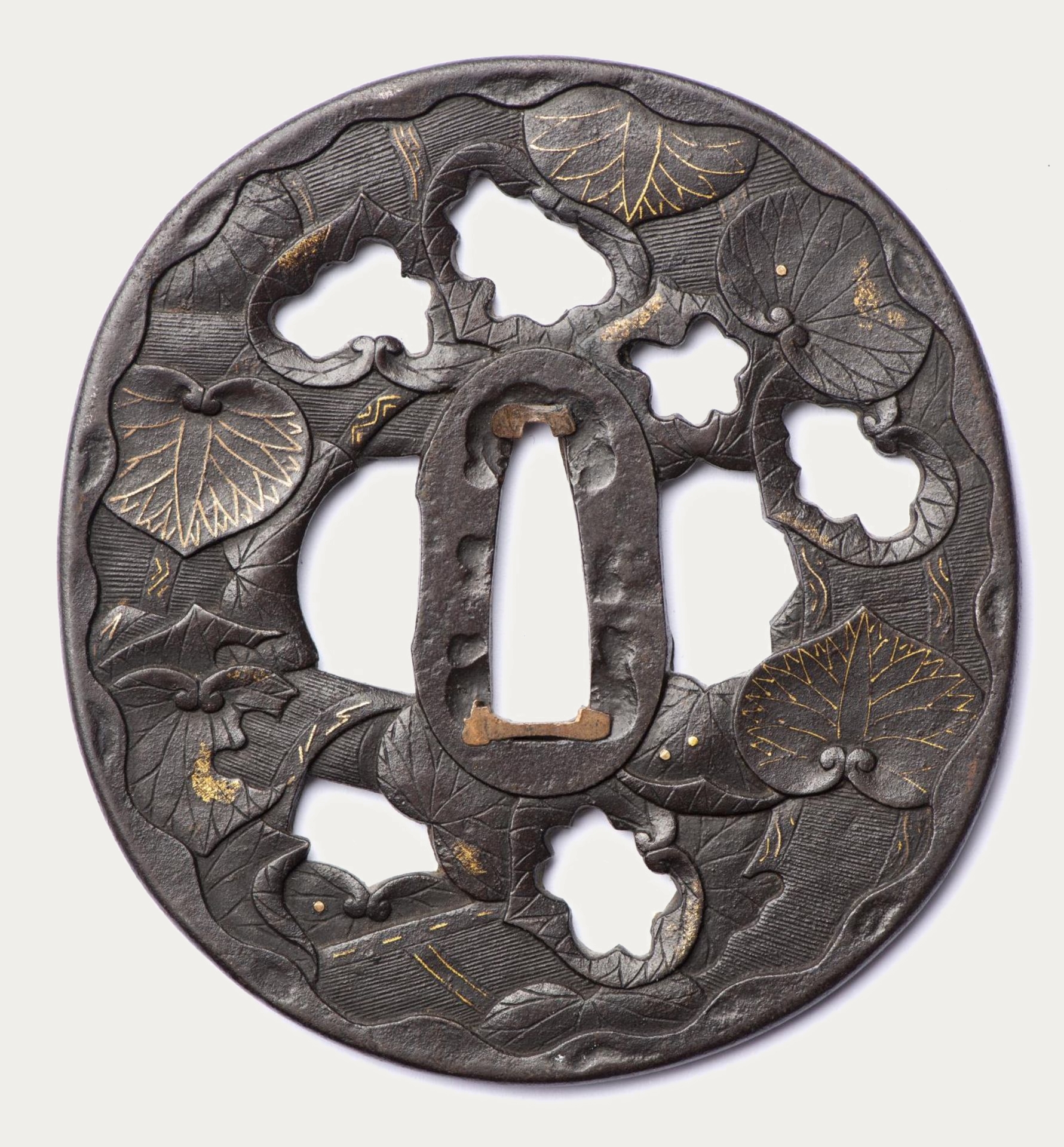
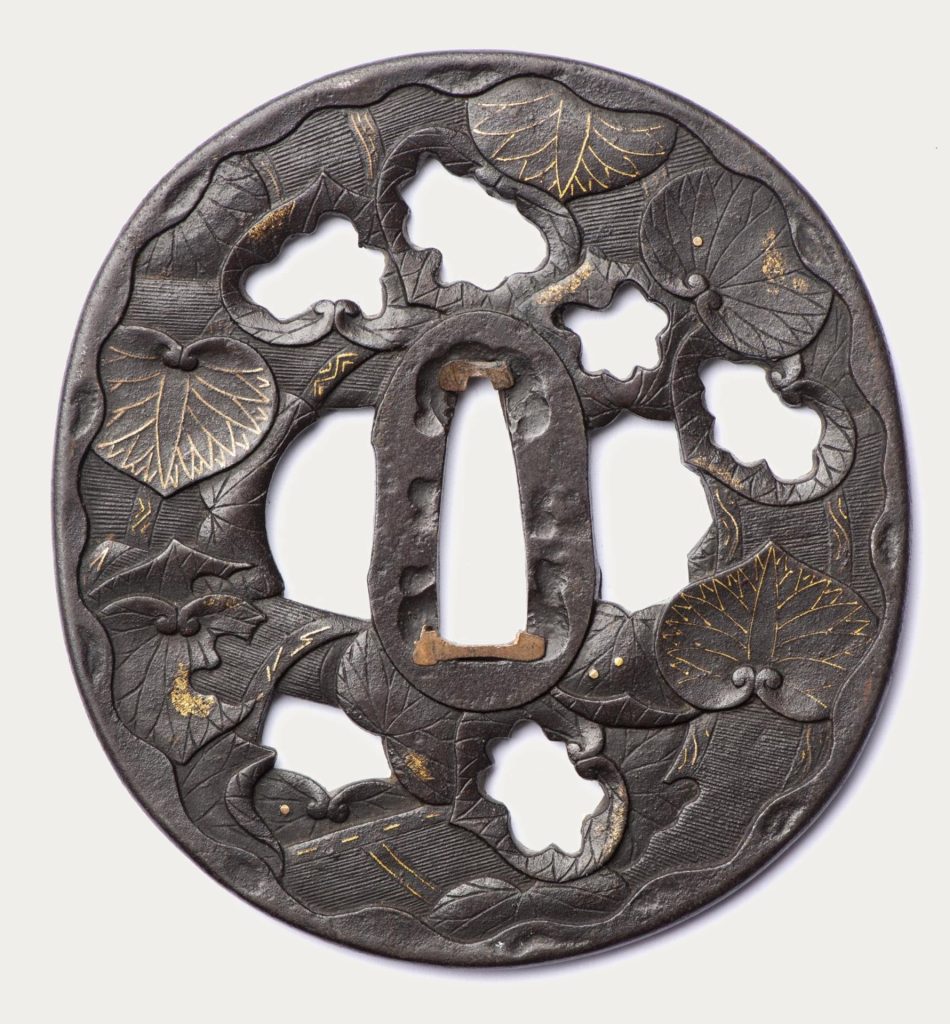
The leaves are aoi. Once you see it, nothing else makes sense. That rounded, heart-based form with its palmate venation, the stems attaching at the center of each leaf’s base, the slightly scalloped edge — this is the futaba-aoi, the wild ginger plant whose form the Tokugawa clan had turned into the most politically charged leaf in Japan. By the mature Edo period, no one depicted aoi carelessly. Every maker and every owner understood what the plant meant.
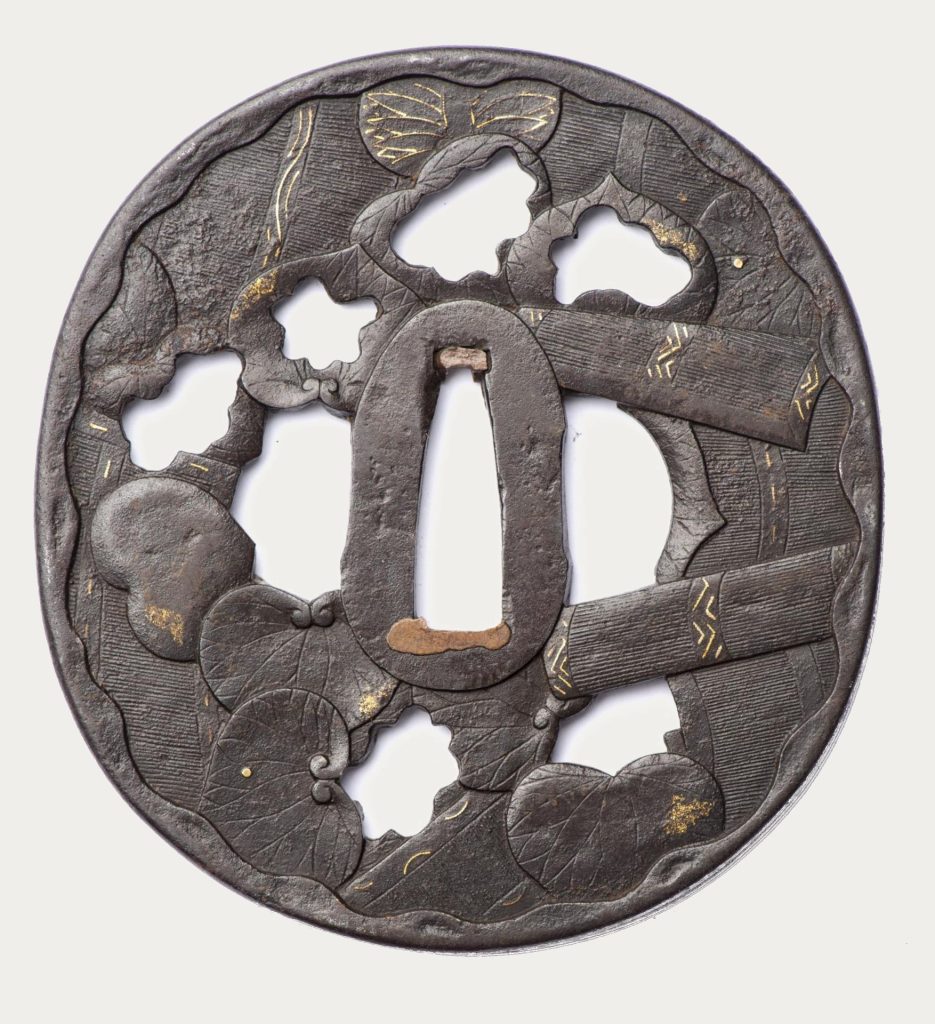
Between and beneath the leaves, rafts: flat boards rendered in careful parallel engraving, their joints marked with gold chevron inlay. The aoi leaves drift above them, or rest upon them, or surround them — the relationship is deliberately fluid. Four sukashi openings of organic, cloud-like shape pass light through the plate. The plate is large, over 85 mm, worked thin, with iron of genuine quality and a patina that has deepened across centuries.
Das Aoi und die Tokugawa
The aoi-mon is designed in the motif of the futaba-aoi. Initially it was not a special crest, but other families gradually started to avoid using the aoi-mon when the Tokugawa family became shogun and monopolized it, though permission to use it was occasionally given to some clans such as the Honda clan. To wear aoi without authorization was a political statement of the wrong kind. To wear it with authorization announced the wearer’s position within the Tokugawa system.
Aoi was also believed in Heian times to have the power to ward off thunderstorms and earthquakes — giving the crest a depth that pure heraldry could not provide. The plant was not simply a marker of lineage. It was a claim of divine protection.
Rafts und Wasser
The ikada, the raft, is one of the oldest presences in Japanese poetry. The combination of aoi leaves and rafts on water produces a motif of considerable resonance. The leaves of the shogun’s emblem, carried on the current, distributed across the water’s surface. This could be read as a celebration of the Tokugawa order’s natural spread — or more melancholically, the aoi going where the water takes it, beautiful and abundant but subject to conditions beyond its control. Both readings were available to any literate viewer. The Bushu Ito school’s founder Masanaga worked on a hereditary basis for the shogunate. A tsuba of this school depicting aoi with gold nunome zogan details would be an appropriate accessory of a Bakufu retainer of officer’s rank. The iron is the color of authority. The gold does not announce itself. The leaves are unmistakable to anyone who needed to recognize them.
Aoi Tsuba
Tsuba. Mumei. Tetsu, nikubori, sukidashi-bori, iroe kin-zogan. Maru-gata. Aoi ni ikada no zu. Bushu Ito-Schule (zugeschrieben). Edo-Zeit. Derzeit zur NBTHK Tokubetsu-Hozon-Shinsa. Privatsammlung, erworben in Europa. Auktionshaus in der Schweiz. Derzeit zur NBTHK Tokubetsu-Hozon-Shinsa.