Der Gott des Krieges traegt ein Buch
Tsuneshige · Tsuba · Sentoku · Mokko-gata · Mittlere Edo-Zeit
Guan Yu Tsuba by Tsuneshige
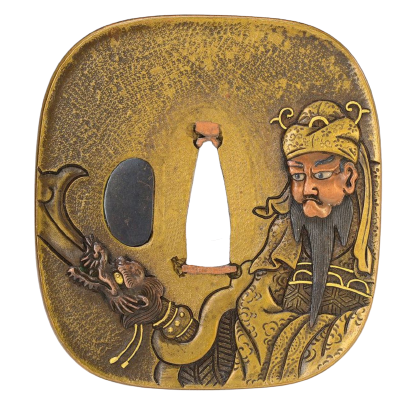
He is unmistakable. The long beard, the stern expression, the elaborate robes and headdress: this is Kan’u, the Japanese name for Guan Yu, the Chinese general of the Three Kingdoms period who was deified across East Asia as the god of war, of justice, and of righteousness. His weapon, the Green Dragon Crescent Blade, extends across the lower left of the plate, its shaft terminating in a dragon head. He does not raise it. He holds it at rest, almost casually. The weapon is simply part of who he is. What makes this representation distinctive is what Guan Yu is not doing. He is not fighting, not charging, not posed in martial display. He is present, still, monumental.
Kan’u in Japan
Both Zhuge Liang and Guan Yu are prominent figures of the Records of the Three Kingdoms. Chinese classics were included in the curriculum of Japanese warrior education, and relevant motifs frequently found on sword fittings. The Sangokushi, the Japanese transmission of this history, was not merely entertainment for the samurai class. It was curriculum. Guan Yu in particular resonated: a warrior who was also a scholar, whose loyalty to his lord was absolute even under extreme pressure, whose personal code of honor could not be purchased or bent by an enemy’s generosity.
Das Objekt
The material is sentoku, a brass alloy with warm golden tone. The ishime ground — that fine, stone-textured surface worked across the entire plate — absorbs light rather than reflecting it. Against this the figure of Guan Yu rises in iroe takazogan of considerable complexity: the face in copper alloy capturing warmth and gravitas, the long beard in shakudo of deepest black, the robes in gold with dark patterned borders, the headdress decorated with floral inlay. The form is mokko-gata.
Die Rueckseite
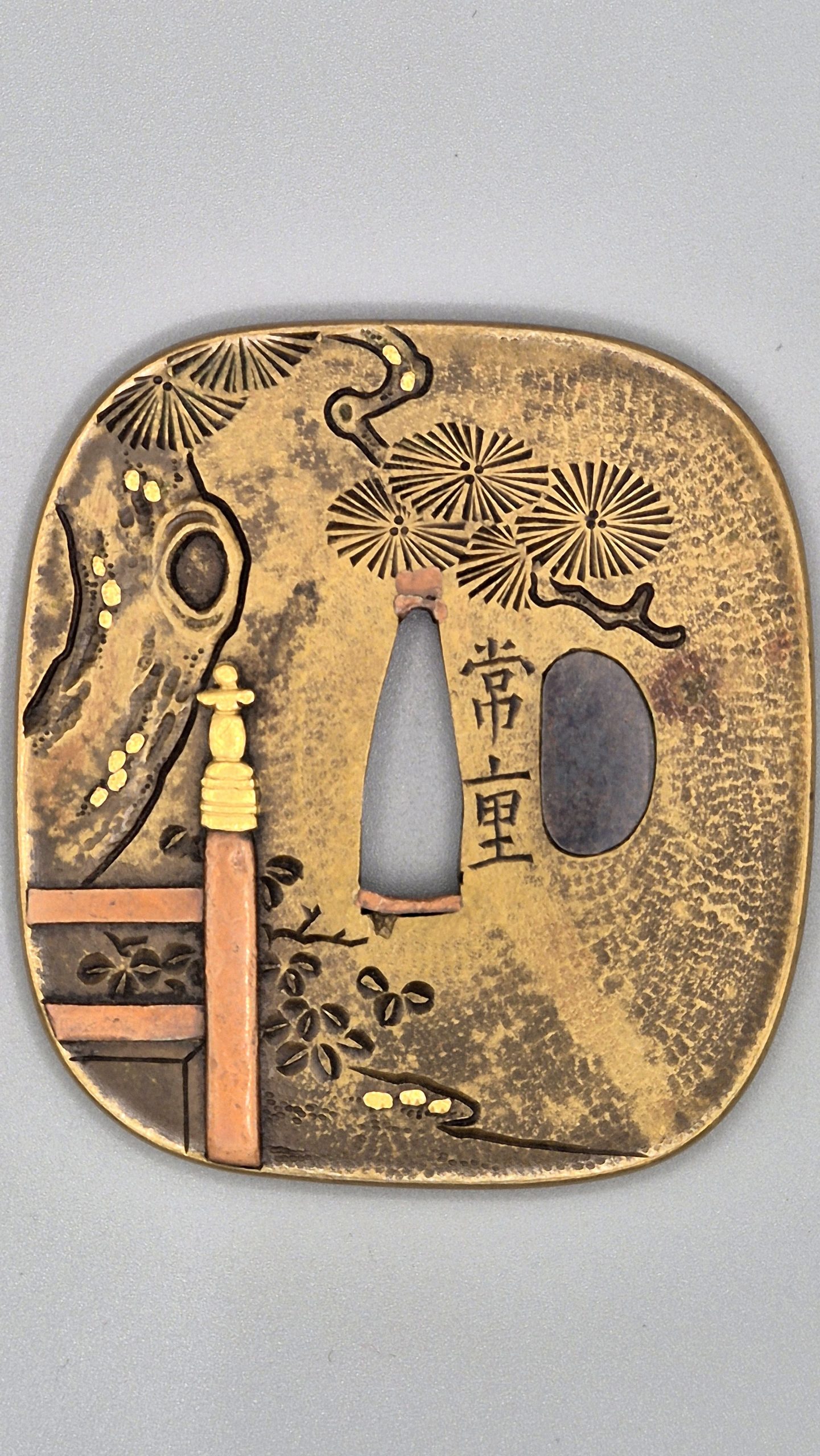
The ura is a different world entirely. A garden or shrine precinct: a pine tree in the upper register, its needle clusters rendered in fine kebori, the branches reaching across the plate. To the left, a stone lantern in gold. A wooden gate or pillar in copper-red. Scattered small flowers across the lower ground. The atmosphere is quiet and contemplative — the garden that belongs to the figure on the other side, the place of study and reflection that the warrior returns to when the weapon is at rest. Between the nakago-ana and the right hitsu-ana: 常重. Tsuneshige.
The tsuba that carries Guan Yu on its face and a quiet garden on its reverse is a statement about what kind of person uses such a weapon. The warrior who studies. The scholar who fights. Tsuneshige understood this. He placed the garden behind the god of war and called it one object.
Tsuneshige’s Guan Yu Tsuba
Tsuba. Tsuneshige. Sentoku ishime-ji, iroe takazogan. Mokko-gata. Kan’u zu / Matsu ni toro no zu. Edo-Zeit. Signiert (常重). Privatsammlung, erworben in Europa.