
Der Glueckssgott lacht.
Hamano Toshihiro · Tsuba · Sentoku · NBTHK Hozon · Spaete Edo-Zeit
Hamano Toshihiro Hotei Tsuba
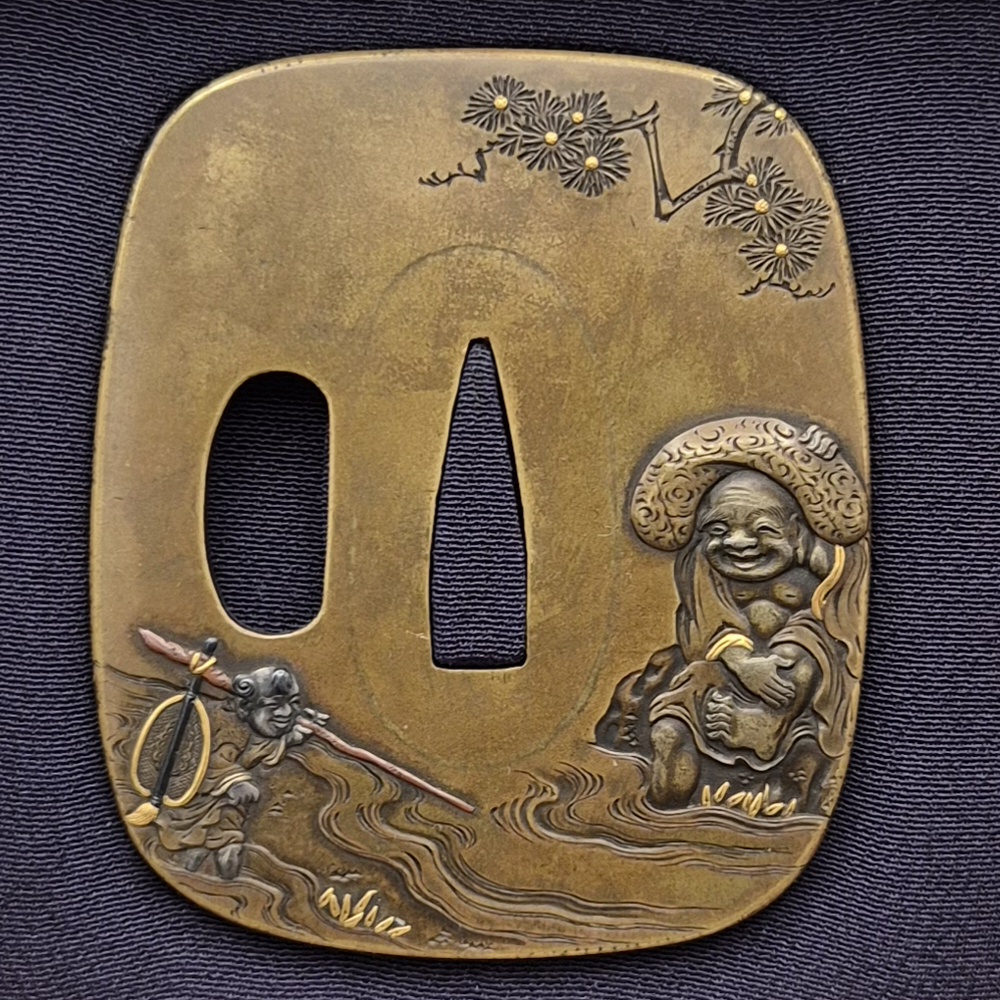
He is laughing. Not politely, not symbolically, but with the whole body — the belly forward, the shoulders back, the face completely open. Hotei, the god of contentment, does not do restraint. He sits on his enormous sack beside the water, one of the Seven Gods of Fortune and the only one who appears to be genuinely enjoying the role, watching a boy in the river below him with the uncomplicated delight of someone who has decided that this particular moment is sufficient.
The boy is not watching back. He is occupied. He wades in the stream to the left, reaching with a pole that has a hoop or net at its end, his whole body angled toward whatever he is trying to catch. He is entirely absorbed. This is childhood rendered without sentimentality: the concentration of someone for whom the present task is the whole world.
Above both of them, a pine branch extends from the upper right in fine engraving with small gold accents at each needle cluster center. A moon, rendered as a subtle disc in the upper plate, floats in the space between the tree and the scene below. The plate itself — warm sentoku, broad and rectangular with softly rounded corners — gives the composition room that a smaller tsuba could not provide.
Hotei
Hotei is a legendary priest in ancient China, and often depicted with karako because it is said that he loves children. He is a member of the Shichifukujin, the Seven Gods of Good Fortune. In Japanese culture he became the most beloved of the seven: approachable, embodied, his happiness visible in his form rather than requiring explanation. Where other gods carried symbols of their attributes, Hotei carried a bag — the oibukuro — said to contain all the treasures of the world, or simply everything he needed, which amounts to the same thing.
The karako design is said to represent happiness, family prosperity, and the longevity and health of children. The pairing of Hotei and karako is therefore doubly auspicious: the god of contentment watching over the emblem of familial happiness. It is the kind of composition that a samurai might choose for a child’s birth, a marriage, or simply as a daily reminder of what martial life was supposed to protect.
But Hamano Toshihiro has done something more specific than a conventional Hotei scene. The boy is not simply playing. He is working at something, reaching into the water with focused effort. And Hotei is watching not with patronizing benevolence but with genuine engagement. This is a scene of shared attention — the god who has everything watching a child who wants one thing and is going after it — and that specificity lifts it beyond iconographic convention.
Die Rueckseite
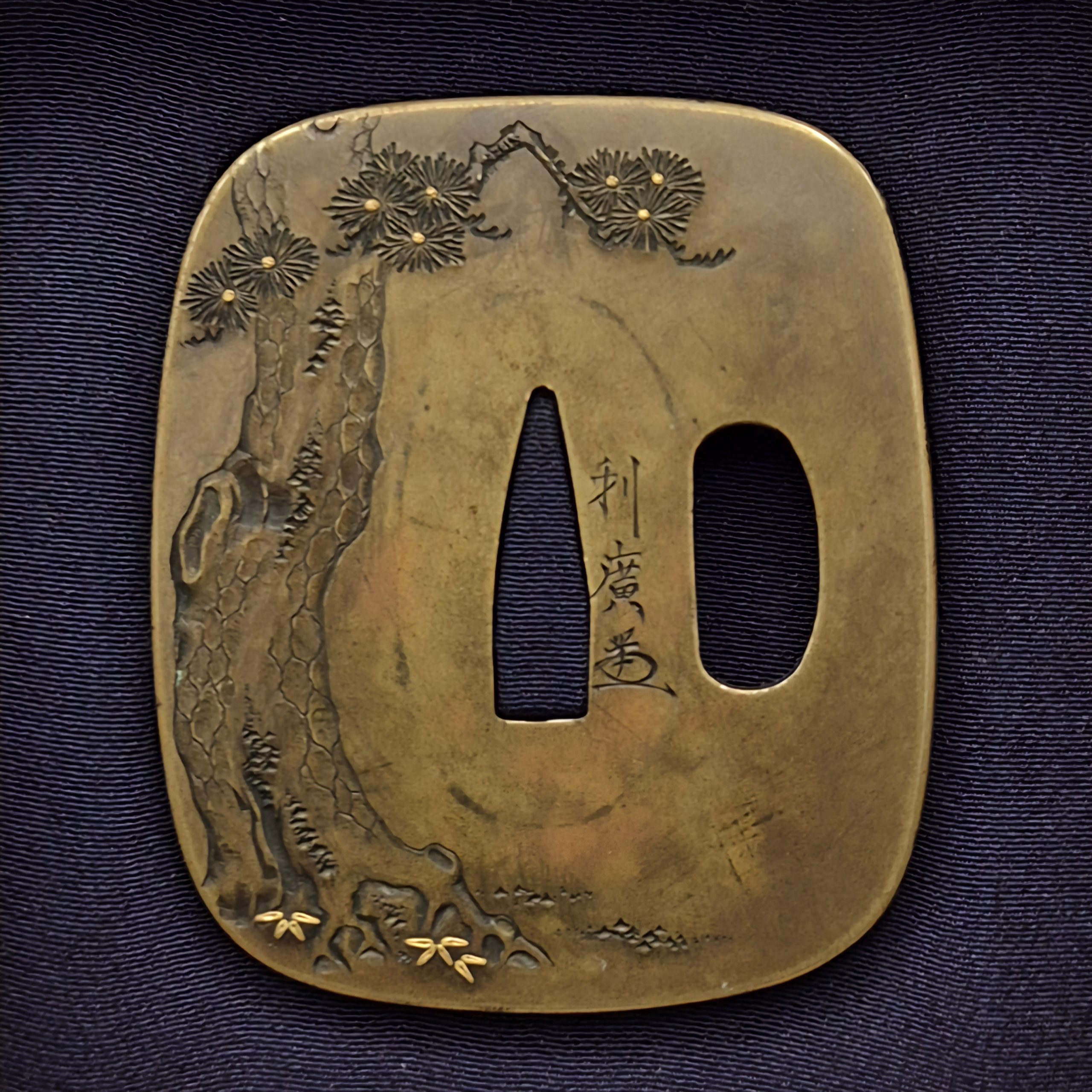
The ura is a statement of a different kind. A single pine tree, rendered with extraordinary care, fills the left side of the plate. The trunk rises from the lower left in a sweeping arc, its bark worked in deep nikubori with a honeycomb-like cellular texture that is entirely tactile — this is not engraving but sculpture, the surface of aged bark reproduced in metal with a fidelity that goes well beyond decorative convention. The roots spread at the base. The branches reach upper left, their needle clusters carrying the same gold dot accents as the omote.
At the lower right, small gold bamboo or grass shoots punctuate the ground. The signature, Toshihiro-zo — sits between the nakago-ana and the right hitsu-ana, clearly engraved, the final character meaning “made by,” the maker’s declaration of authorship.
The contrast between the two faces is intentional and achieved. The omote is warmth, laughter, water, childhood, the gods who approve of ordinary happiness. The ura is time, permanence, the old tree that has outlasted everything that has passed beneath it. Same maker, one object, two readings of a life well spent.
Die Hamano-Schule & Toshihiro
The Hamano school produced four main generations alongside numerous other artists working within the tradition. The primary line ran from Shozui through Kaneyuki, Nobuyuki, and Noriyuki, each generation refining the school’s characteristic approach to narrative in sentoku and related materials. Beyond the main line, other artists of the Hamano school worked in the same tradition across the late Edo period.
Hamano Naoyuki, resident of the province of Musashi, was a student of Hamano Noriyuki and represented the school’s final major generation. Artists signing in the Hamano manner in the late Edo period suggest that the school’s influence extended into a broad network of practitioners working in its style and technical tradition.
Toshihiro, signing 利廣造, belongs within this late Edo orbit. The naming convention of the school — where a student of a named master would adopt a character from the master’s name — places Toshihiro’s signature within the school’s established practice. The quality of the work argues for a maker of real training: the pine bark on the ura alone represents a level of nikubori skill that is not achieved without sustained practice within a serious workshop tradition
Eine letzte Bemerkung
The face of Hotei on this tsuba is worth returning to. It is not a conventional rendering of the god’s conventional expression. The carver has given him something specific: the laugh of someone who is not performing happiness but experiencing it. The eyes are slightly narrowed. The mouth is fully open. He has found the boy in the stream genuinely funny, or genuinely delightful, or simply right. There is no distance between Hotei and what he is watching.
For a samurai who carried this tsuba, that image would have been available every time the sword was drawn or cleaned or simply held. The laughing god, the boy in the water, the pine that outlasts them both. It is a complete world in the dimensions of a hand.
Hotei Tsuba
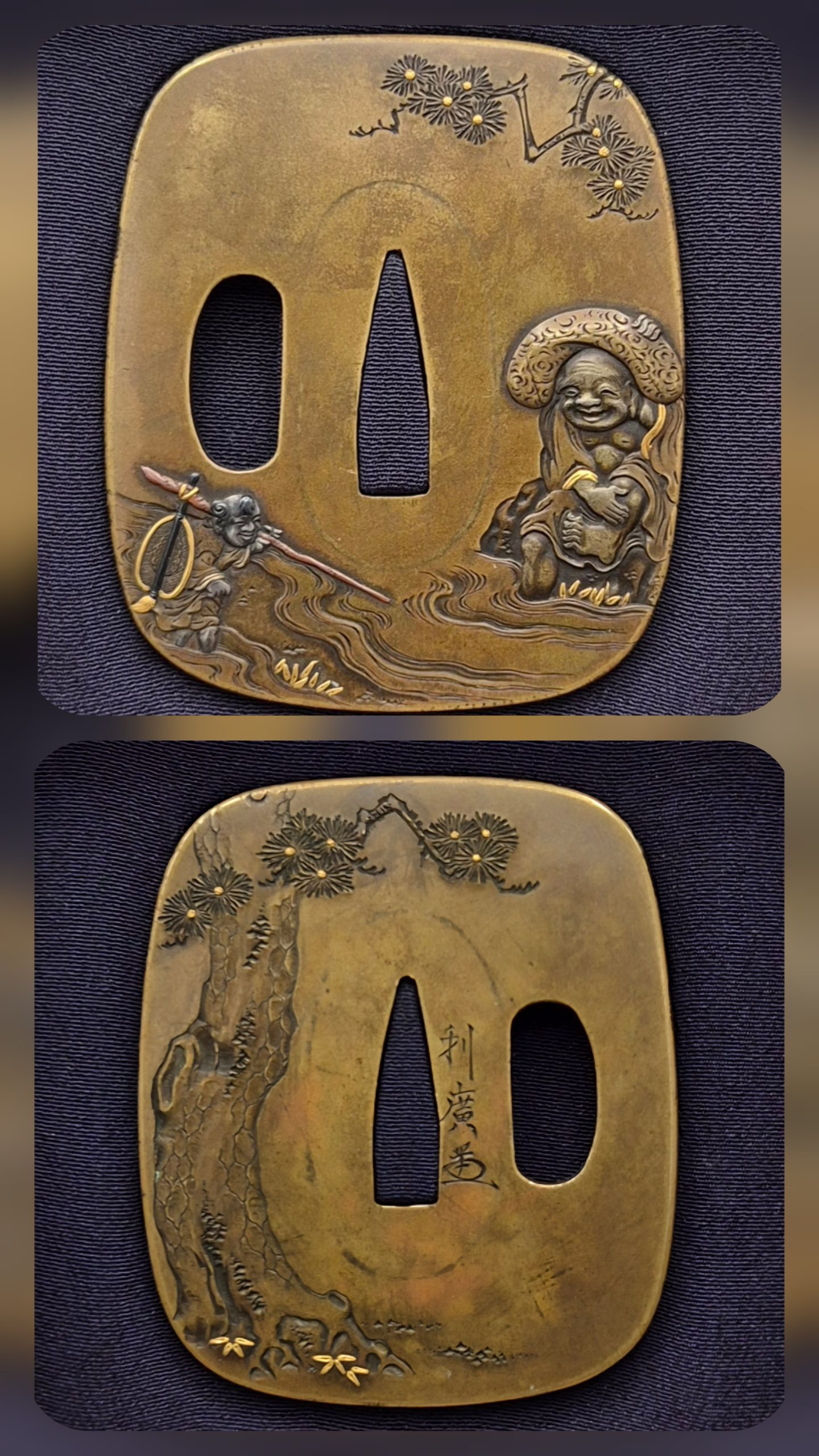
Tsuba. Hamano Toshihiro. Sentoku, iroe takazogan, nikubori. Kakugata mit gerundeten Ecken. Hotei to karako zu / Matsu no zu. NBTHK Hozon. Spaete Edo-Zeit. Signiert: 利廣造. Privatsammlung, erworben in Deutschland.