
Der Unsterbliche und seine Kroeten
Nara-Schule (zugeschrieben) · Tsuba · Tetsu · Iroe takazogan · Edo-Zeit
Gama Sennin Tsuba by Nara Artist
He dances. One leg raised, arms extended, a small object held aloft in one hand: A peach, or a flower, or something the frogs want badly enough to follow him across the lower ground of the plate. His robes are elaborate: gold cloud-and-floral patterns worked in takazogan, silver face and limbs, the whole figure rendered with the kind of technical investment that the Nara school brought to subjects it considered worthy. He is laughing. He is always laughing.
Below him, two frogs. They scatter, or they approach, or they simply exist in his vicinity with the uncomplicated purposefulness of creatures that have nowhere else to be. And in the right light — when the angle is exactly right — the back of one frog shimmers blue-green, a quality that no photograph fully captures and that the maker intended precisely.
Gama Sennin
The Japanese legend of Gama Sennin, the Toad Immortal, is based upon the Chinese immortal Liu Hai, a fabled 10th-century alchemist who learned the secret of immortality from the Chan Chu, the Three-legged Money Toad. He is a benign sage with great magical knowledge about pills and drugs. He is always accompanied by a toad and he can assume the shape of a toad.
Gama’s spirit was able to leave his body to wander and once returned to find the body unfit. He put his spirit into the nearest creature, which was a frog. This is the origin of his permanent companionship with toads: not as a master with a pet, but as a being whose identity has become intertwined with the creature to the point where the boundary between them has grown uncertain.
Chinese prototypes of this theme sometimes represent the immortal sitting on or resting his foot on the animal and holding a string of gold coins, with which he is supposed to have lured the toad from its hiding place in a well. The dancing posture on this tsuba combines the coin-luring gesture with the physical exuberance that Japanese artists brought to this subject across every medium: netsuke, lacquer, tsuba, screen painting. Gama Sennin does not sit quietly. He moves, he laughs, he coaxes. The three-legged frogs associated with him represent good fortune and financial success.
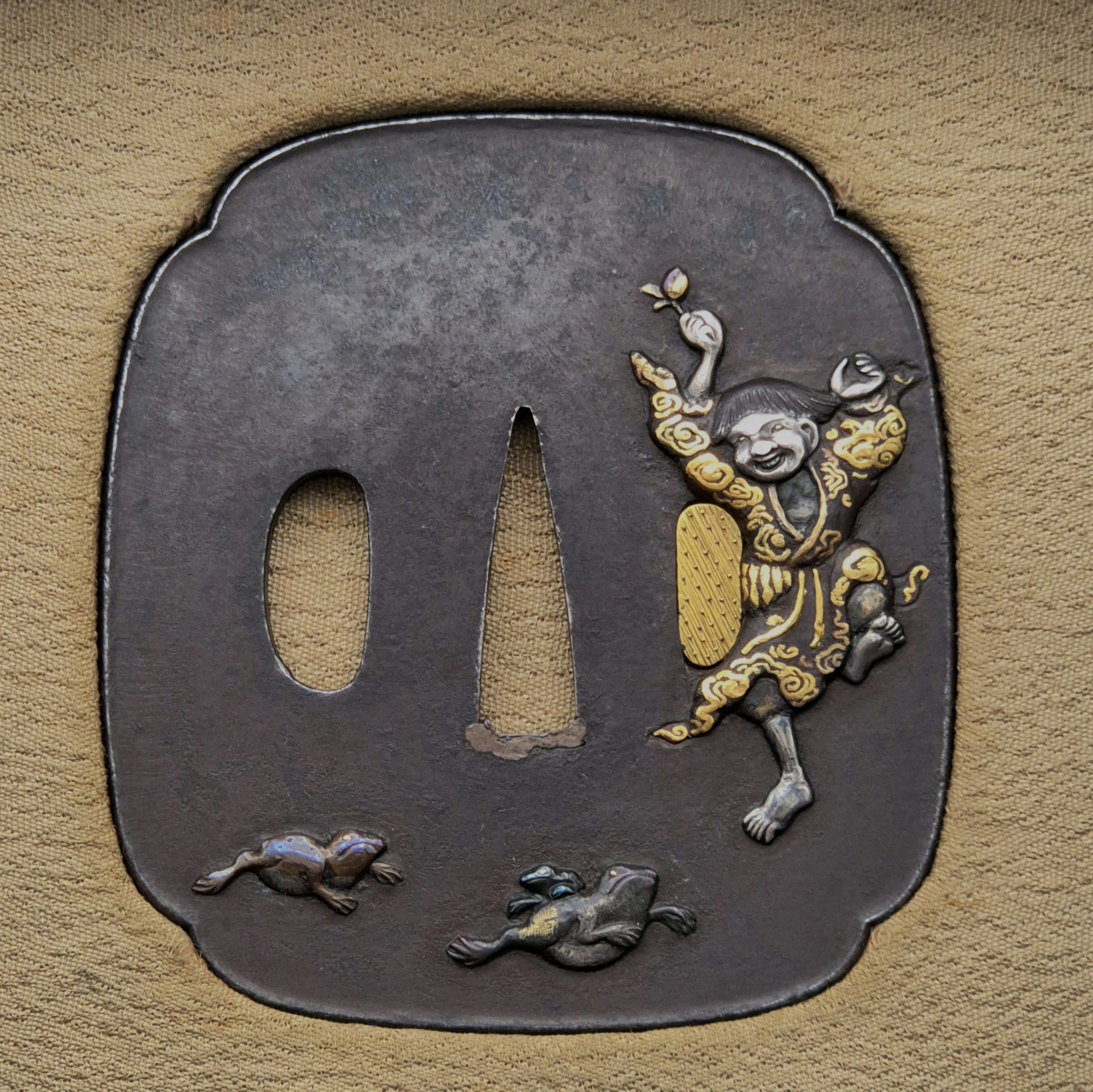
Das blaue Schimmern
The blue-green iridescence on the frog’s back is not accidental and not simply the product of age. The Nara school and related late Edo kinko makers used different copper alloys deliberately to achieve color effects impossible with a single material. A frog rendered in suaka, pure copper, develops a verdigris patina over time — the deep blue-green of oxidized copper that, in the right light, recalls the iridescent skin of certain amphibians with an accuracy that purely worked shakudo cannot achieve.
It is possible the maker chose this material specifically for this reason: to give the toad a quality of supernatural aliveness, a shimmer that exceeds what mere carving can provide. A toad that glows blue-green is not simply an ornament. It is a creature whose material announces its magical nature. The maker of this tsuba understood that the subject demanded something the eye could not quite settle on.
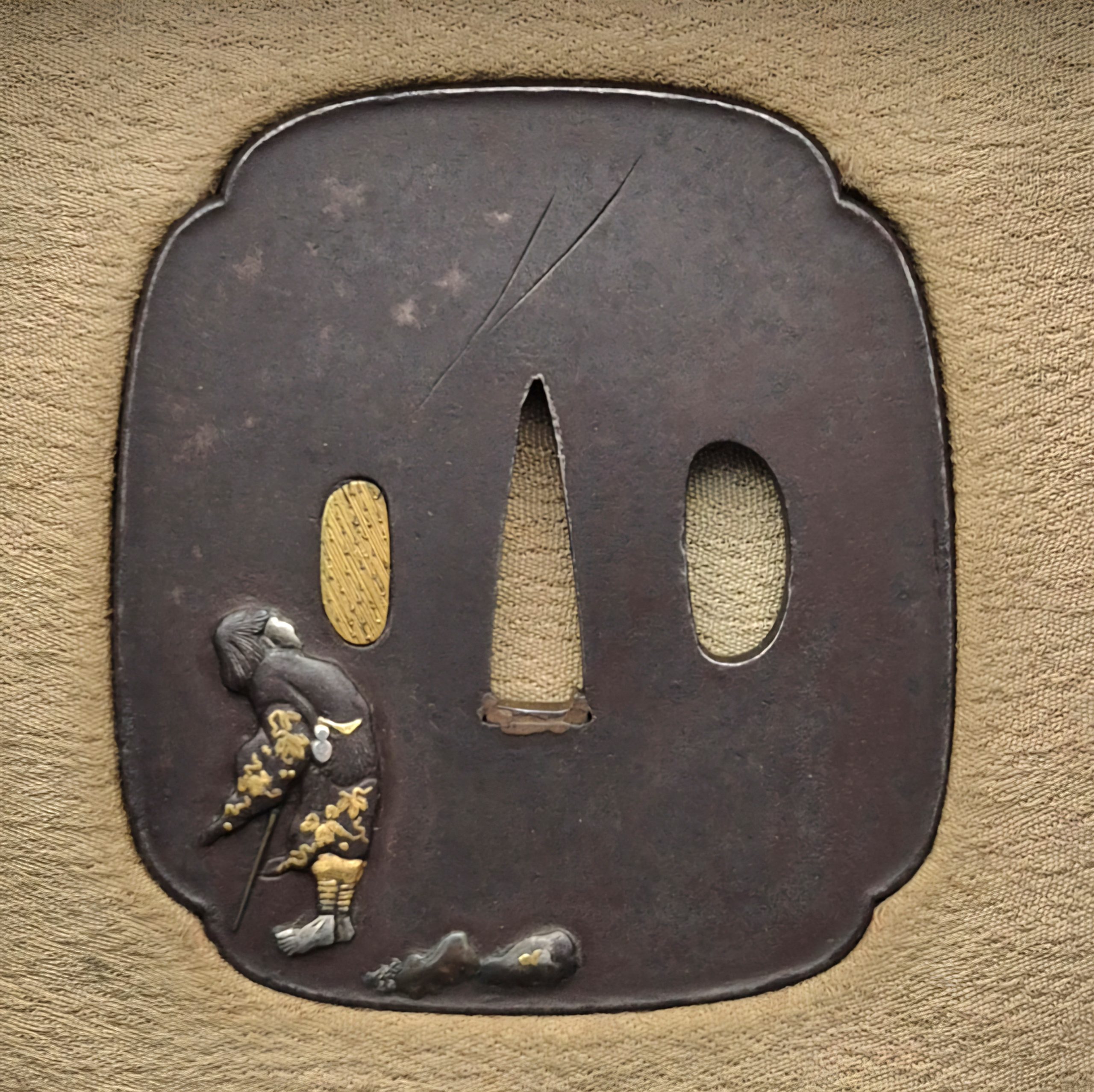
Die Rueckseite
The ura presents a different moment in the same story. A figure, now bent, crouching, the posture of someone working quietly rather than dancing: head bowed, one hand on a staff or rod, the robes still elaborate but the energy entirely different. Below, a single frog at his feet. Above the left hitsu-ana, a gold plug worked in a fine basketwork texture, a detail of considerable refinement that frames the composition. Three fine diagonal lines are engraved in the upper field of the ura — rain, falling light, or the kind of abstract environmental suggestion that the Nara school used when it wanted to indicate atmosphere without depicting it directly. The two faces together present a complete portrait of the immortal: the ura his quiet, private self — crouching with his toad companion in some unspecified moment of concentration or rest. The omote his public and mythological self — dancing, laughing, performing the magic that defines him. Same figure, two registers of existence.
Die Nara-Schule
The Nara school emerged in Edo around 1700, its three founding masters — Yasuchika, Toshinaga, and Joi, the so-called Nara sansaku — establishing an approach to kinko work that prioritized sculptural three-dimensionality, narrative intelligence, and the use of multiple metals to achieve effects unavailable in a single material. Where the Goto school worked within strict conventions of shakudo and nanako, the Nara masters competed on the basis of imaginative invention and technical ambition. The school’s characteristic iron or shibuichi ground with multiple iroe inlay elements, the relief carving that gives figures genuine sculptural presence, and the deliberate use of material differences to suggest color and texture — all of this is consistent with what this tsuba demonstrates. The attribution to the Nara school deserves proper paper confirmation, but the visual argument is clear.
Nara Tsuba with Frogs
Tsuba. Nara-Schule (zugeschrieben). Shibuichi, iroe takazogan in kin, gin und do. Kakugata mit gerundeten Ecken. Gama Sennin zu. Edo-Zeit. Privatsammlung, erworben in Europa.