
Omori Hikoshichi und der Daemon im Wasser
Kozuka · Mumei · Shibuichi · Edo-Zeit
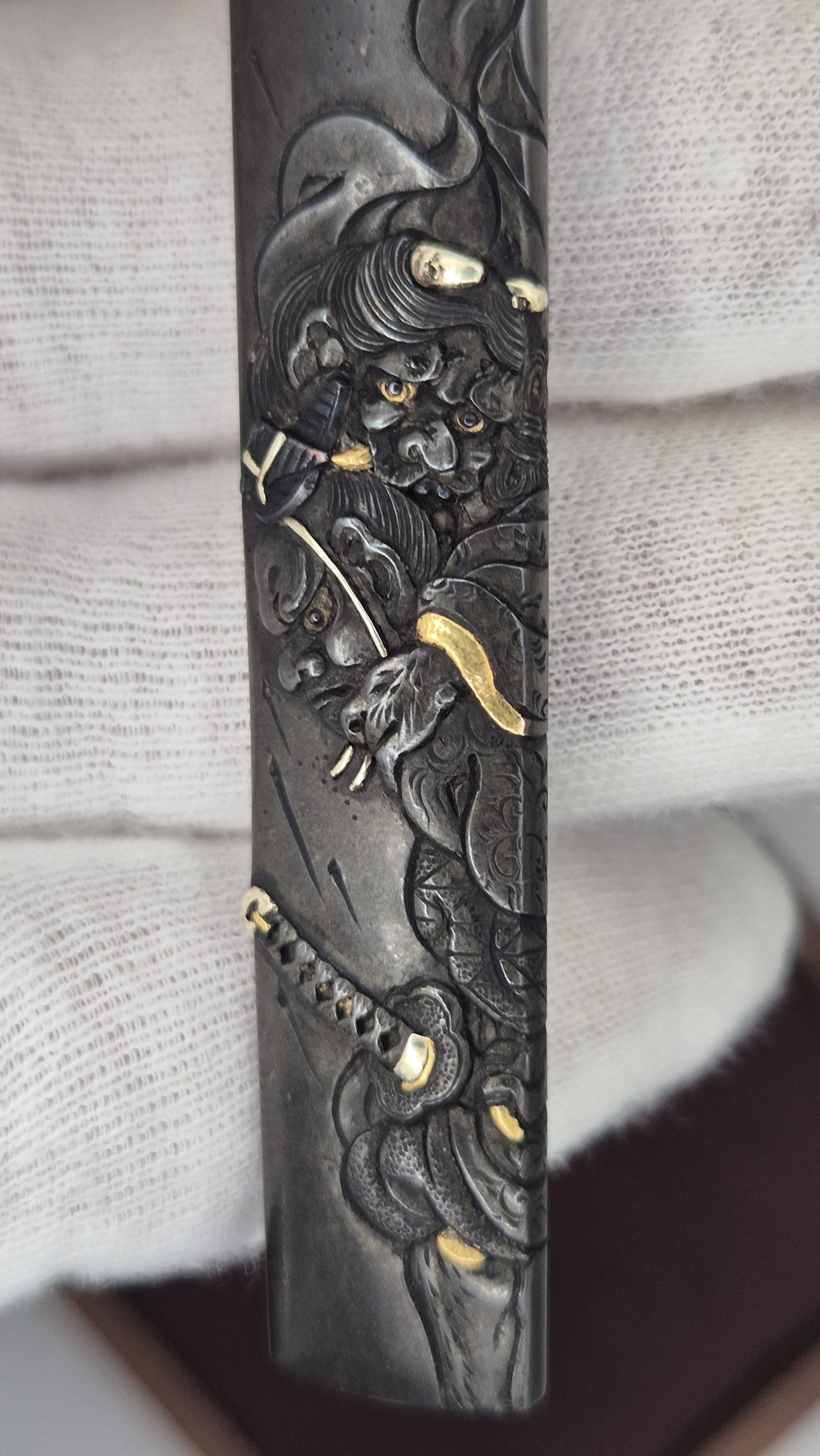
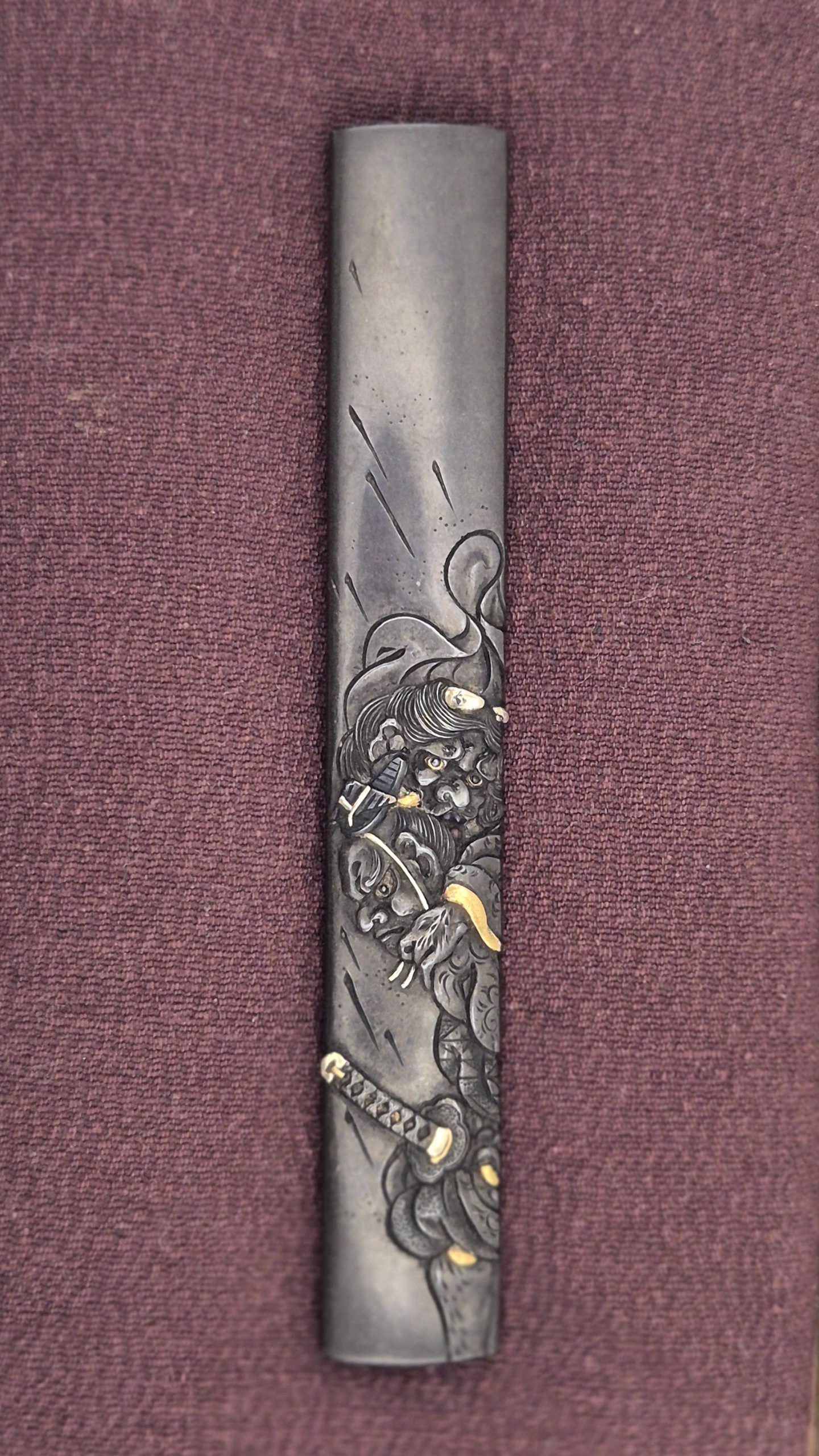
Kozuka with Omori Hikoshichi
There is a moment before understanding, when the eye moves across an object and something tightens. Not recognition exactly, but attention. This kozuka produces that moment. Small enough to rest in a closed fist, dense with carving that resolves only slowly, and then all at once.
The material is shibuichi, a copper-silver alloy that patinates into grey registers no single word quite names. Not silver, not pewter, not storm. The gold accents do not shine so much as surface, like light reaching something underwater. Against this ground, a figure bends forward under the weight of a woman on his back. He is Omori Hikoshichi, a warrior in the service of Ashikaga Takauji. She is the danger he has not yet identified.
Die Geschichte
The story exists in two versions, and both are worth holding. In the first: Omori comes across a beautiful woman near a river crossing and offers to carry her. He looks down at the water, sees her reflection, and the reflection does not show a woman. He acts before she can. In the second, which is richer and stranger: after the Battle of Minatogawa, Takauji arranges a Noh performance. A girl arrives carrying a hannya mask, the face of a jealous, consuming female spirit. She is the daughter of Kusunoki Masashige, the enemy just defeated. She attacks Omori as he carries her across a stream, but he is not surprised. When she explains that she wanted to avenge her father’s death, he listens. He tells her how her father died, and that he died with dignity. He gives her Masashige’s own dagger and lets her go.
Both versions end in the same gesture: a warrior who reads a situation correctly and chooses his response with precision. What the kozuka maker chose to preserve is the suspended instant before that response. The woman on the back, the water below, the horns in the reflection not yet acted upon. Yoshitoshi returned to this story in 1886. It later became Noh, then Kabuki. The makers of tosogu were working from the same material.
Das Objekt
The carving occupies the full face of the kozuka with a confidence that refuses the object’s small scale. The bodies are rendered in relief that casts shallow shadow at close viewing distance, which is the only distance that matters. Gold appears where the eye should pause: detail that is not decoration but punctuation. The reverse carries the smooth, unworked surface that kozuka often bear. There is no signature. Mumei does not diminish. Much of the finest work from this period went unsigned, either from modesty, from convention, or because the work was considered sufficient. Shibuichi was the material of choice for scenes that needed atmosphere rather than brightness. Its grey depth absorbs the subject rather than displaying it. Omori and the demon exist inside the metal, not on top of it.
Eine Anmerkung zur Zugaenglichkeit
Objects like this one remain findable. Not inexpensive in absolute terms, but genuinely accessible when measured against comparable narrative quality in other collecting fields. A kozuka of this character, with this subject, in this material, occupies a position in the market that has not yet fully reflected what it carries. That gap is part of what makes tosogu interesting to pursue seriously.
Kozuka Omori Hikoshichi
Kozuka. Mumei. Shibuichi mit Goldinlays. Edo-Zeit. Alte Privatsammlung, Düsseldorf.