
Eine Welt auf neun Zentimetern
Hosono Sozaemon Masamori · Kozuka · Shibuichi · Hira-zogan · Genroku-Ara (1688–1703)
Hosono Sozaemon Masamori (細野惣左衛門政守)
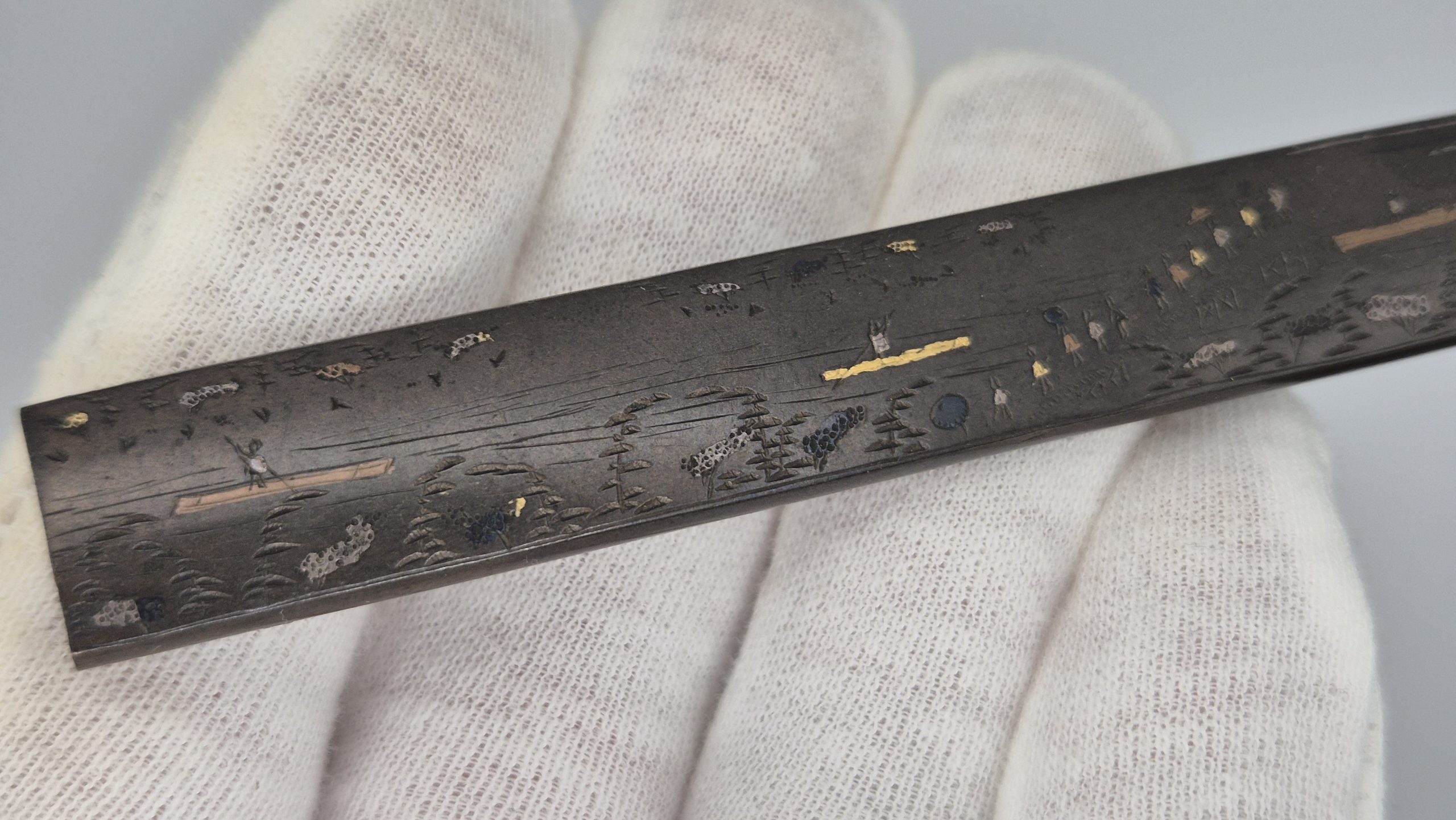
It cannot be fully seen in a photograph. This is not a failure of photography. It is the nature of the object. Henri Joly, cataloguing Masamori’s work for the Red Cross Loan Exhibition of 1915, noted that “the minute work of Hosono Sozaemon Masamori has been extensively imitated; genuine pieces almost defy photographic reproduction.” He wrote this before the digital age. The observation has only become more accurate since.
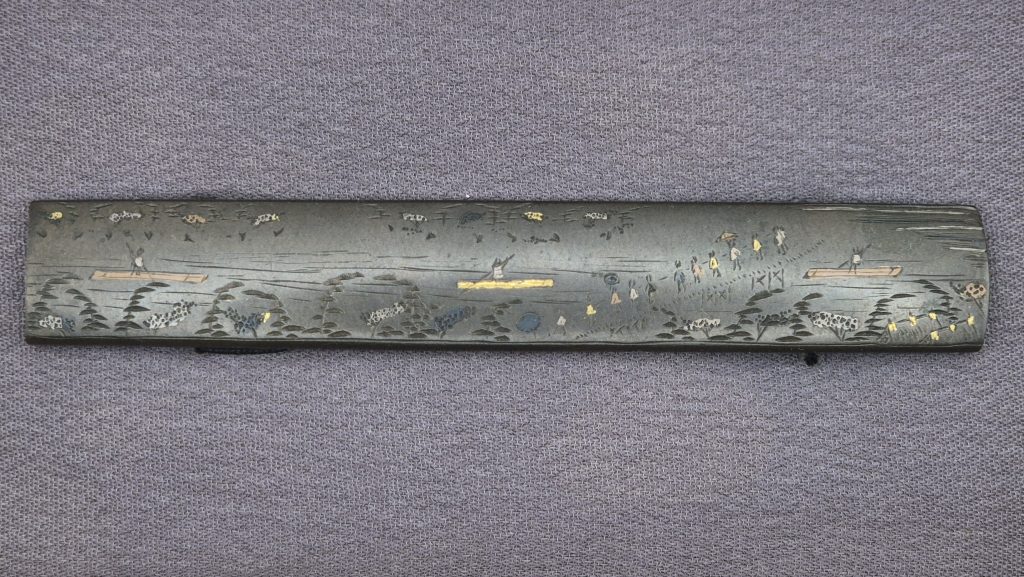
What the photograph shows is a complete world: horizontal lines of mist or fog reading across the upper register, a long bridge spanning both landscape and river with dozens of tiny figures crossing it, boats on water, trees and grasses along the banks, small gold and copper and silver and shakudo elements placed with a precision the eye cannot fully process from a distance. What the photograph cannot show is that these figures are human: That each one, at two or three millimeters of height, has posture and direction and implied relationship to the figures beside it. To see this kozuka properly, you hold it close and move it slowly. Then the world inside it opens.
Hosono Sozaemon Masamori
Masamori worked in Odawara in Sagami province and was still working at the age of seventy. There is a Masamori tsuba dated Genroku yon nen (1691) in the Imperial Museum in Tokyo. He was active during the Genroku era, that extraordinarily productive cultural moment when the Tokugawa peace had been in place long enough for the merchant class to develop its own aesthetic ambitions. B.W. Robinson cites Masamori’s portrait between those of Iwamoto Ryokan and Furukawa Genchin in the Sanko ni-ju-hachi kisho — Portraits of 28 Metal Workers — as an indication of the esteem in which Masamori’s distinctive work was held. To be included in that group of twenty-eight is a significant designation.
His signed work depicts scenes along rivers and roads in shibuichi with flat inlay of gold, copper, silver, and shakudo. The Brooklyn Museum and Museum of Fine Arts Boston both hold signed Masamori kozuka. A typical Masamori design shows a riverscape with many people and architectural elements — a complete world reduced to the dimensions of a knife handle.

Die Bruecke im Nebel
The composition is organized around a bridge. It runs nearly the full width of the kozuka face, crossing the river in a long horizontal arc, figures moving across it in procession. Above, horizontal bands of mist or fog — not rain — rendered in fine parallel lines that dissolve the sky into atmosphere. This is not rain. Rain falls at an angle and carries urgency. What these horizontal lines describe is something slower and more pervasive: the morning mist that settles over rivers and does not lift until the sun has been up for hours.
Masamori’s signed work includes travellers crossing bridges, and the long bridge over a misty river crowded with figures is one of his most characteristic subjects. The great bridges of the Edo-period road network were not merely infrastructure but landmarks. At this scale, the bridge becomes the act of crossing itself: all these tiny figures, each one moving from one side to the other, in mist, in company with others they may or may not know. Masamori understood what a bridge meant. He put one on a knife handle, covered it in mist, and filled it with people.
Die Technik
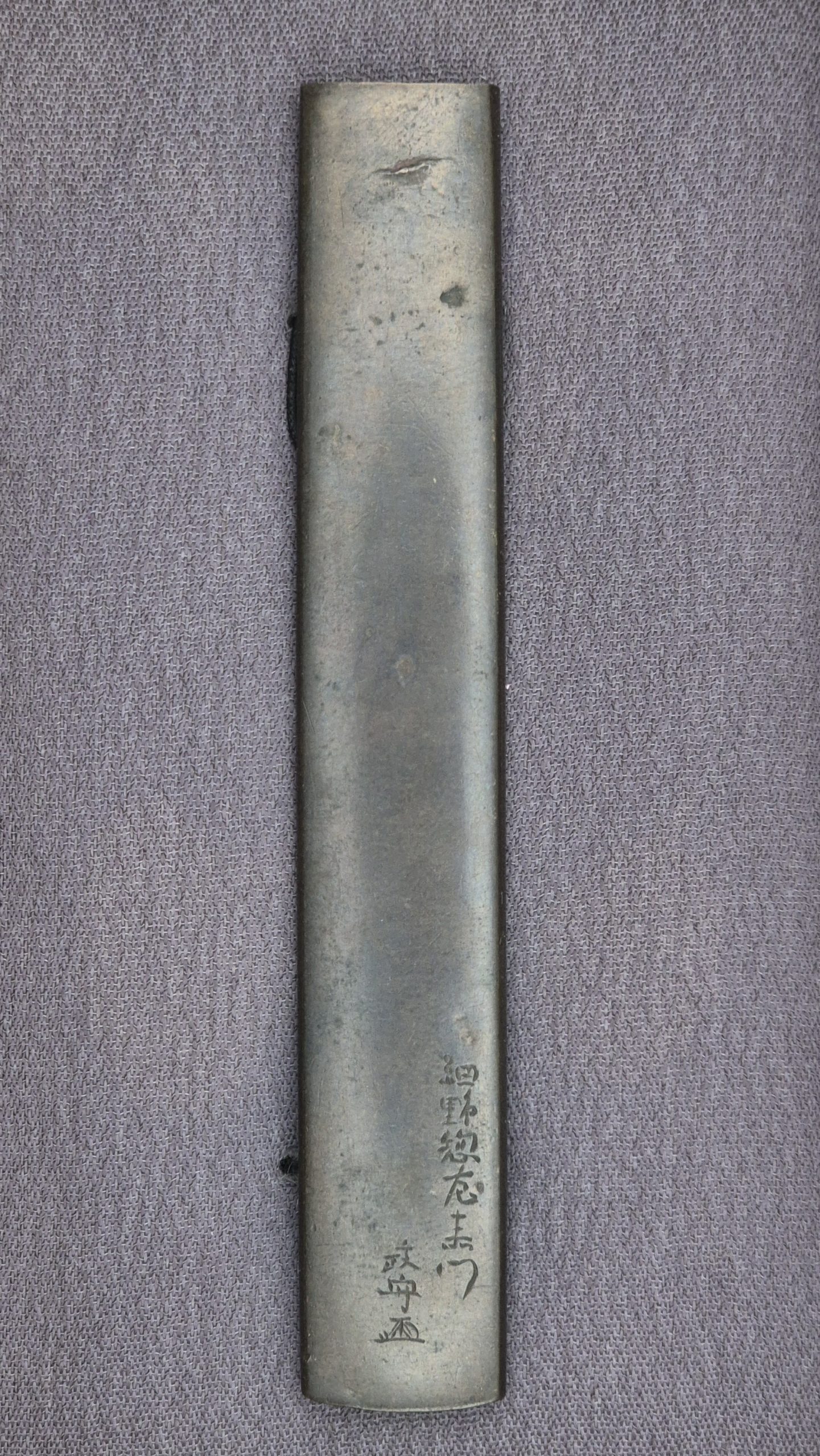
The technique is hira-zogan — flat inlay — in which small elements of gold, copper, silver, and shakudo are hammered into recesses cut into the shibuichi ground and filed flush with the surface. Each figure required the maker to cut the precise outline of a two-millimeter human form into the metal. The mist lines are likely kebori, fine engraving rather than inlay. The reverse carries the signature Hosono Sozaemon Masamori with kao, and an inscription identifying the subject.
Eine Bemerkung zur Echtheit
Joly’s 1915 observation that Masamori’s work “has been extensively imitated” remains relevant. What the genuine pieces share — beyond the signature — is exactly the quality that photographs cannot transmit: the humanity of the tiny figures, the specific weight of the inlay in the ground, the sense that what you are holding contains a world rather than a representation of one. That quality is either present or it is not. In this piece, it is present.
Kozuka Bridge in the Fog
Kozuka. Hosono Sozaemon Masamori (細野惣左衛門政守). Shibuichi migaki-ji, hira-zogan und kebori in kin, gin, do und shakudo. Hashi ni kasumi no kotsu zu. Genroku-Ara (1688–1703). Signiert mit kao. Privatsammlung, erworben in Japan.