
Tausend Jahre sind genug
Yokoya Somin (II) · Kozuka · Shibuichi · Katakiribori · Mittlere Edo-Zeit
Somin Kozuka with Jurojin
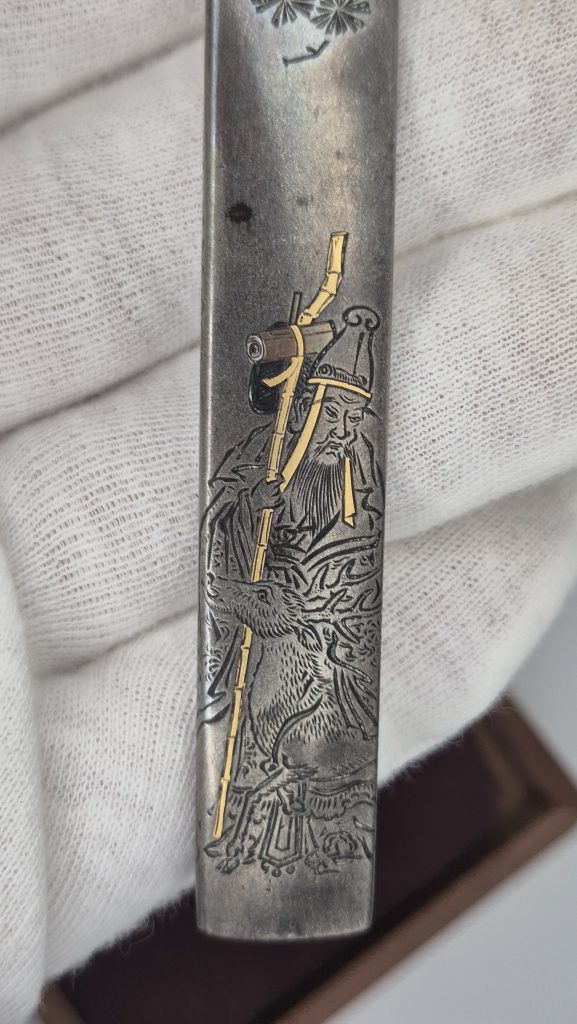
He walks without hurry. The staff supports him, not because he cannot stand without it, but because a man who has lived for centuries understands that there is no advantage in moving faster than the world requires. His beard is long, his robes simple, his expression that of someone who has resolved everything that needed resolving and now simply continues. Above him, a pine branch extends in fine engraving. Somewhere nearby, his deer. This is Jurojin, the Old Man of Longevity. He is always exactly this: present, unhurried, entirely at ease with the passage of time.
Jurojin
Jurojin is one of the Seven Gods of Fortune, the Shichifukujin. He is the god of longevity. Jurojin originated from the Chinese Taoist god, the Old Man of the South Pole. He is known as the immortal of the Northern Song dynasty (960–1127). People believe he had lived in the world for 1,500 years. He is the god of learning and longevity, carrying a shaku — a sacred baton — with an attached scroll containing the wisdom of the world. He has a white beard and is in the company of a crane and a white stag, symbolic of contentment in old age.
The stag that accompanies him is not incidental. The deer lives for a thousand years in Japanese and Chinese tradition, and its presence beside Jurojin compounds the already extraordinary longevity the god embodies. Two creatures, each ancient beyond normal reckoning, occupying the same landscape without particular urgency. Neither ages visibly. Neither hurries.
Zwei Gesichter, eine Stimmung
The omote carries Jurojin himself: the long-bearded figure with his staff, rendered in katakiribori directly into the shibuichi, the gold accents on the staff catching what the grey ground does not. The pine branch above him is fine and precise. The ura continues the scene from a different angle: the pine now dominates, a full tree rendered in the same katakiribori with gnarled trunk sweeping from lower right upward, branches extending across the face. The stag stands at the base of the tree, looking upward. Together the two faces form a single landscape: the sage walking through a pine forest with his deer companion, the pine present on both sides as the unifying element.

Das Material und die Yokoya-Linie
The ground is shibuichi, its cool grey surface polished to migaki-ji. The katakiribori lines of Jurojin’s beard and robes, the abbreviated clusters of the pine needles, the compact form of the deer — all rendered in the same technique but requiring a different relationship with the chisel for each. Somin I created an entirely new style, the influence of which spread far and wide — he was followed by a succession of Soyo’s and Somin’s extending into the second half of the 19th century. Yokoya Somin III, born in 1795, produced a number of sword fittings in the classic Yokoya style. The signature 宗珉 with kao on the reverse places this kozuka within the school’s profilic linage: Somin II.
Jurojin is the god that a samurai in the Edo period might choose for reasons that have nothing to do with battle. He is the god of what comes after: the long life that the martial training was supposed to make possible, the years of study and reflection and slow walking through pine forests. He does not conquer anything. He simply continues. To carry him in the scabbard was to carry that aspiration daily. The pine is always there. The deer is always nearby. Nothing hurries.
Somin Kozuka with Jurojin
Kozuka. Yokoya Somin (II. Generation). Shibuichi migaki-ji, katakiribori, kin-zogan. Jurojin ni matsu no zu / Matsu ni shika no zu. Mittlere Edo-Zeit. Signiert: 宗珉 mit kao. Privatsammlung, erworben in Japan.