Der Wächter des Nordens und sein Bote
Bishamon and the Centipede
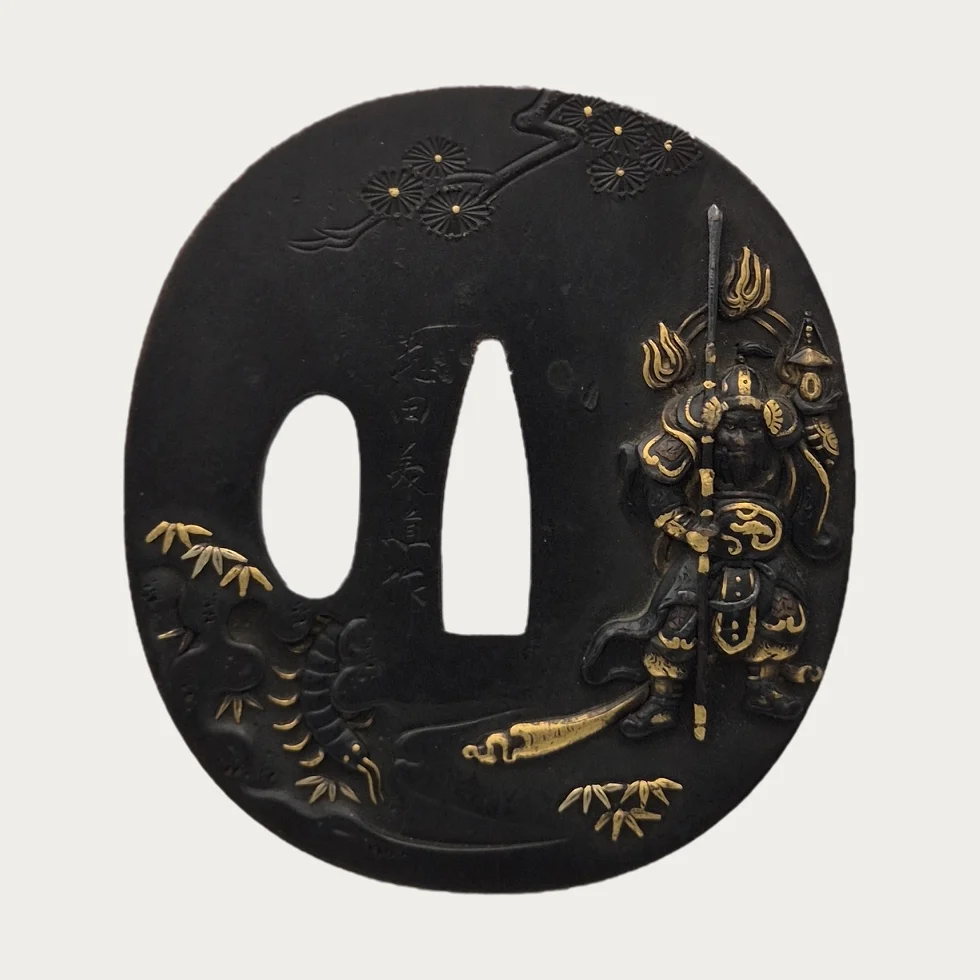
An oval Bishamon tsuba of dark shakudo. The god stands at the right, in full armour, his head framed by a ring of gold flames. In one hand he holds a long halberd upright, in the other a small pagoda raised to the height of his shoulder. At the lower left a centipede crawls out of the water among blades of gold bamboo grass. A pine branch with gold-dotted needles crosses the top.
Das Objekt
The figure is raised in high relief and touched with gold, silver and copper: the armour plates, the belt, the flames and the pagoda each have their own colour. The centipede is gold, segment by segment. The pine is engraved into the ground. To the left of the tang opening runs the signature, five characters cut in a single line.
Die Rückseite
The back leaves the god behind. A trunk rises along the left edge, and ivy climbs it with small leaves on a thin gold stem. At its foot a waterfall comes down over rocks in fine parallel lines. Gold bamboo grass grows along the bank, and the pine returns at the top.
Bishamon
JAANUS, the dictionary of Japanese art terms, describes Bishamonten as Tamonten when he stands among the Four Heavenly Kings, the guardian of the north. He wears armour, usually holds a pagoda in one hand and a halberd or a staff in the other. From the Muromachi period on he was also worshipped as a god of good fortune, and later counted among the Seven Gods of Fortune.
The Metropolitan Museum of Art, describing a mandala from Mount Kurama, shows him with a centipede, which came to be recognized as his divine messenger. The Museum of Fine Arts, Boston, holds another guard of the early nineteenth century that pairs the two.
Die signierte Seite
The signature reads Tobita Yoshimichi saku, made by Tobita Yoshimichi. The placement in the Mito school is the collection’s own, from its own research.
Eine Korrektur
An earlier version of this page wrote the signature 忠田義道作 and read the leaves on the back as autumn maple. The first character is 飛, and the leaves are ivy.
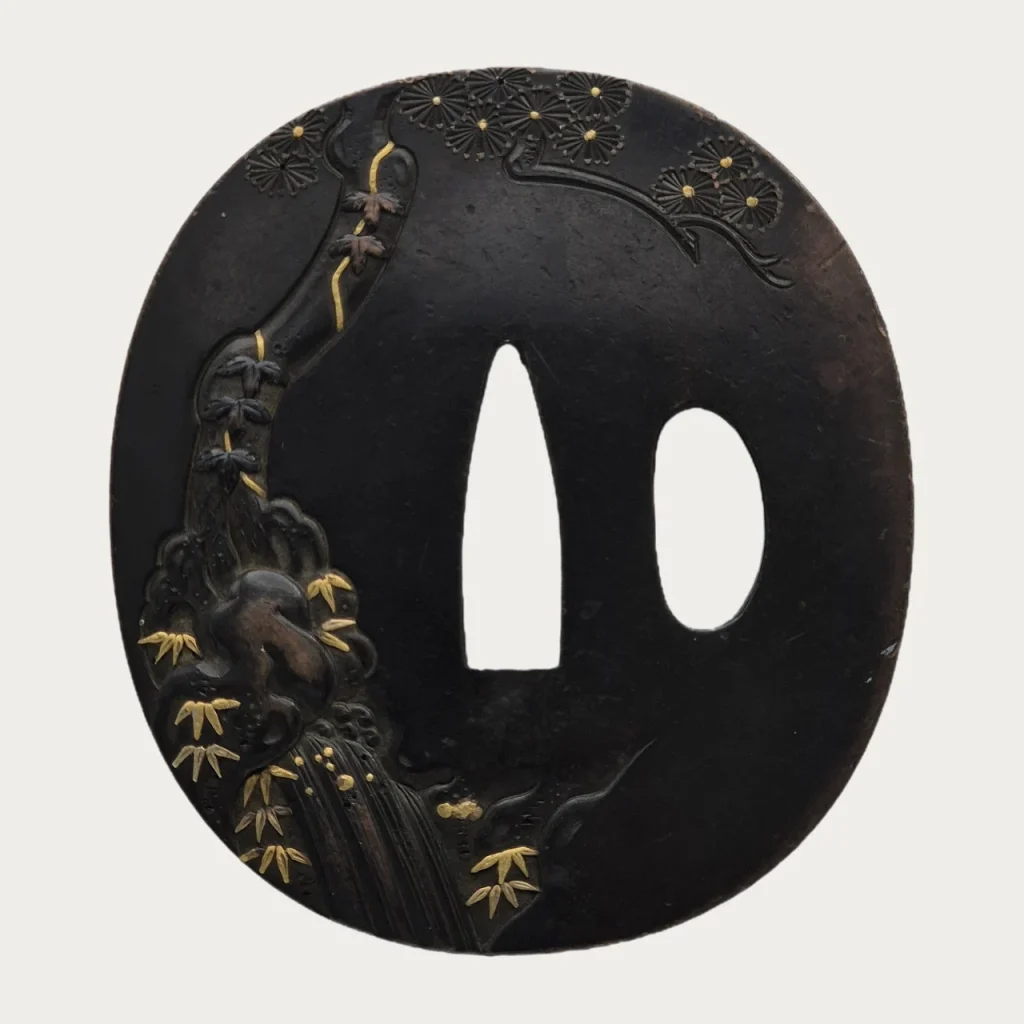
Tobita Yoshimichi’s Bishamon Tsuba
Tsuba. Signiert Tobita Yoshimichi saku. Shakudo, takabori mit iroe in kin, gin und akagane, kebori. Naga-maru-gata, zwei Hitsu-ana. Bishamon to mukade-zu; Rückseite Wasserfall und Efeu. Edo-Zeit. Privatsammlung, erworben in Europa.
In the collection
- Type
- Tosogu › Tsuba
- School
- Mito
- Period
- Edo-Zeit
- Material
- Shakudo
- Motif
- Götter und Glücksbringer