
Der ewige Baum
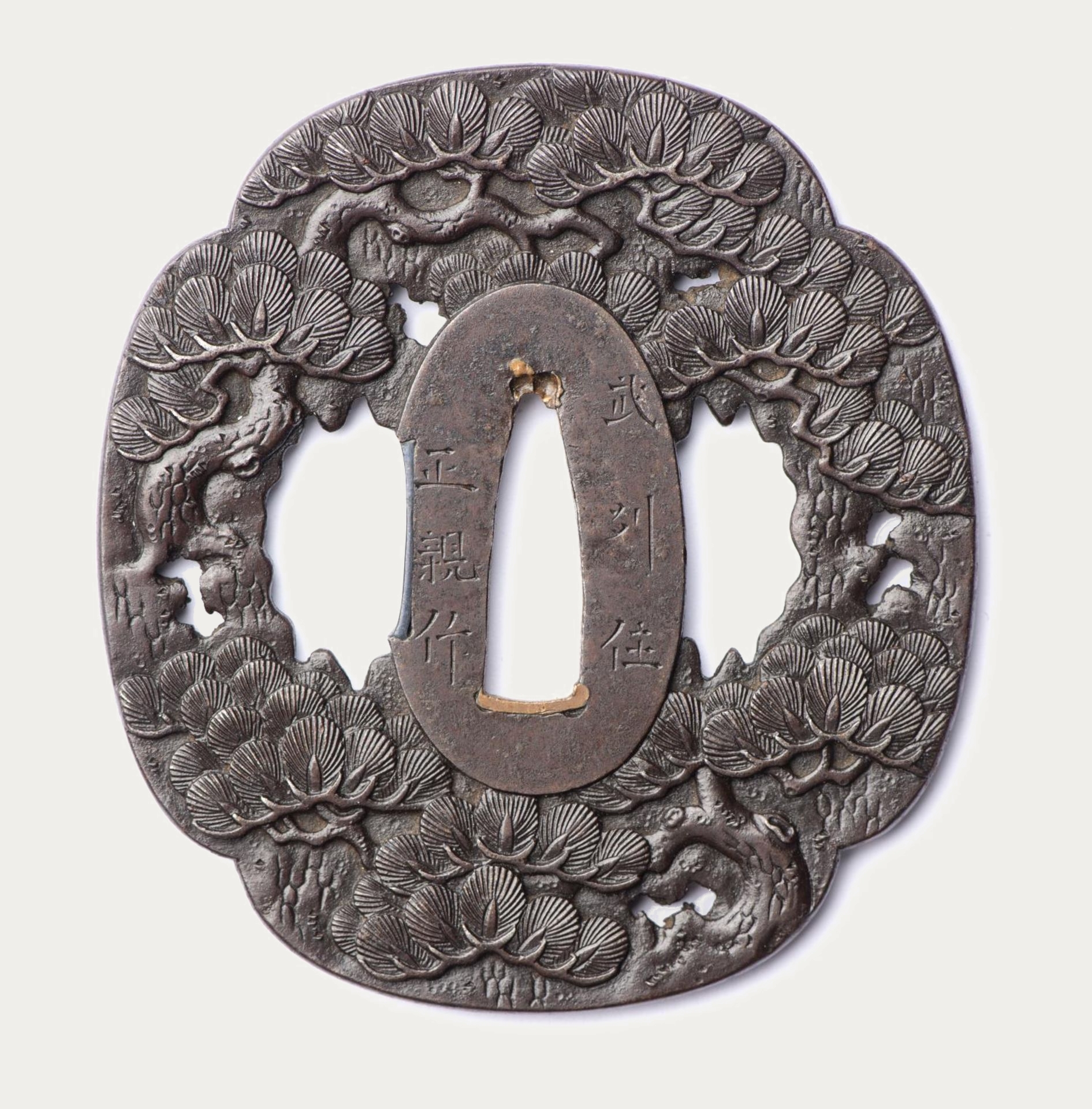
Bushu Masachika · Tsuba · Tetsu · Ito-Schule · Edo-Zeit · um 1774
Bushu-ju Masachika Tsuba
Pine trees do not have a season in the Japanese aesthetic vocabulary. They have something more useful: they have permanence. They grow on exposed rock, survive storm and drought, keep their needles through the winter when everything else has surrendered. To carve a pine tree onto iron is to put two kinds of endurance into conversation with each other.
Das Objekt
The form is mokko-gata. The entire face is covered in pine: branches extending outward from gnarled trunks, individual needle clusters rendered with a precision that becomes apparent only at close distance, rocks and roots worked into the ground below. The carving technique is nikubori combined with sukidashi-bori. The pine does not sit on the surface. It grows out of it. The iron is unadorned, worked to a surface that has aged into the particular quiet darkness that good tetsu develops across centuries. The reverse carries the signature: Bushu-ju Masachika saku. He lived in Bushū province. He made this.
Der Kuenstler
Masachika signed his works Bushu-ju Masachika saku, and a dated piece exists inscribed with the twelfth month of An’ei 3 — 1774. His subjects were cherry blossoms, plum, pine, and other plants, carved in nikubori and sukidashi-bori, showing the typical style of the Ito school. He lived in Asakusa Hottahara in Edo, and is considered a skilled craftsman. Asakusa Hottahara was a district in the northeast of Edo proper. It was not the prestigious address of a Goto master working for the shogunate. It was a working address, the neighborhood of a craftsman embedded in the city’s daily life rather than its ceremonial one.
Die Ito-Schule & die Kiefer
The Bushu Ito school is one of the most significant iron tsuba lineages of the Edo period. The founder Masanaga worked on a hereditary basis for the shogunate. Many metalworkers came to learn from other feudal domains and the school’s workmanship spread to Choshu, Satsuma, and Suruga — a measure of its reach.
The pine, matsu, is the first of the three friends of winter alongside bamboo and plum, representing resilience, integrity, and renewal under difficulty. It is also the tree of Takasago, the Noh play in which an aged couple beneath twin pines embody fidelity and the passage of time. A samurai who carried this tsuba was announcing something quiet: that permanence mattered to him, that he had chosen to carry an image of endurance on the object he would grip every day of his life.
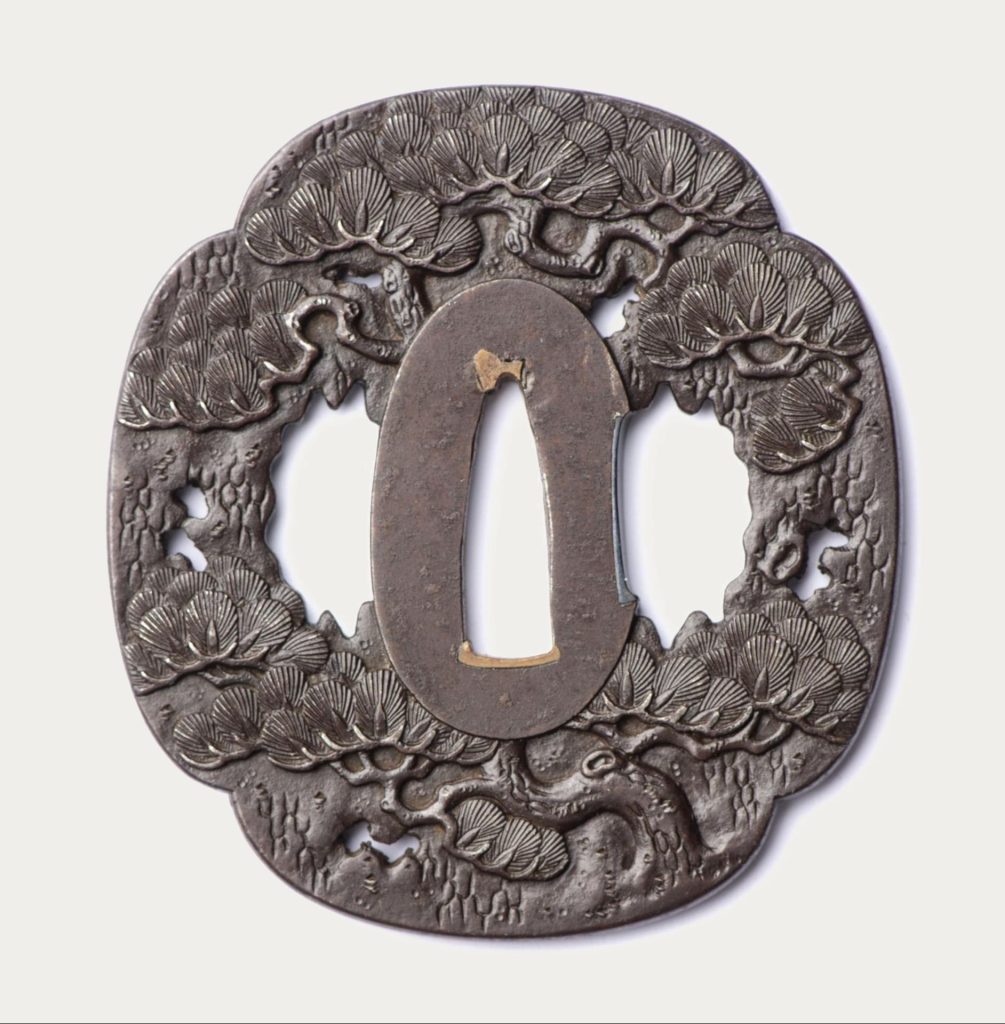
Masachika Tsuba
Tsuba. Bushu-ju Masachika. Tetsu, nikubori, sukidashi-bori, mokko-gata. Spaete Edo-Zeit, um 1774. Signiert. Privatsammlung, erworben in Europa. Auktionhaus in der Schweiz. Derzeit zur NBTHK Tokubetsu-Hozon-Shinsa