Der Gesang des Herbstes
A Cricket in Autumn Grass, Hamano Noriyuki
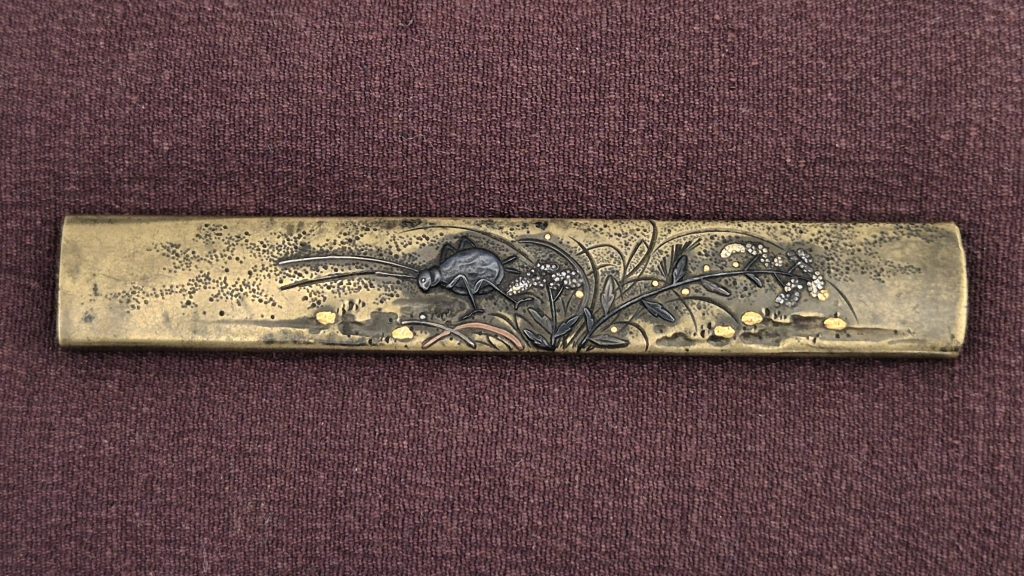
A kozuka by Hamano Noriyuki, sentoku, warm yellow and pitted with small punch marks that thicken towards the left. A cricket stands in the left half, dark and rounded, its long silver antennae drawn back over the field. To the right the grasses rise, some engraved into the ground, some inlaid in shakudo and copper. Small silver blossoms hang in clusters among them, and gold pebbles lie along the lower edge.
Das Objekt
The cricket is shakudo, raised in relief, so that its body throws a small shadow on the ground. The blossoms are silver, the pebbles gold, a few stems copper. Everything else is engraved, in fine lines that curve with the leaves. The back is plain sentoku. It is signed 濱野矩随, Hamano Noriyuki, and closed with a square seal.
Die Szene
The insect does not sing. It stands among the stems with its antennae laid back, and the grasses bend around it. In Japan the voices of insects belong to autumn, and the kozuka gives the season through the creature that makes its sound.
Hamano Noriyuki
The Walters Art Museum records two makers of this name: Hamano Noriyuki, 1736 to 1787, and Hamano Noriyuki II, 1771 to 1852. Both worked in the Hamano line that Shozui founded, and both signed with the same characters. The signature on this kozuka does not say which of the two is meant. Whether it is genuine, and which generation it names, the collection leaves open.
Eine Korrektur
An earlier version of this page ranked both generations in the Kinko Meikan and gave Noriyuki I a personal name. Those details had no source on the page and are left out here.
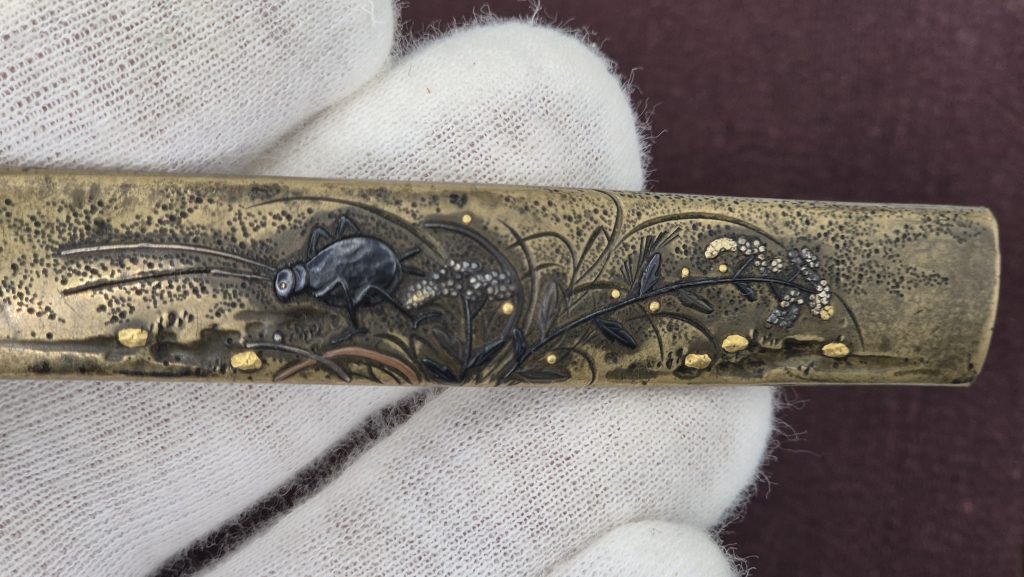
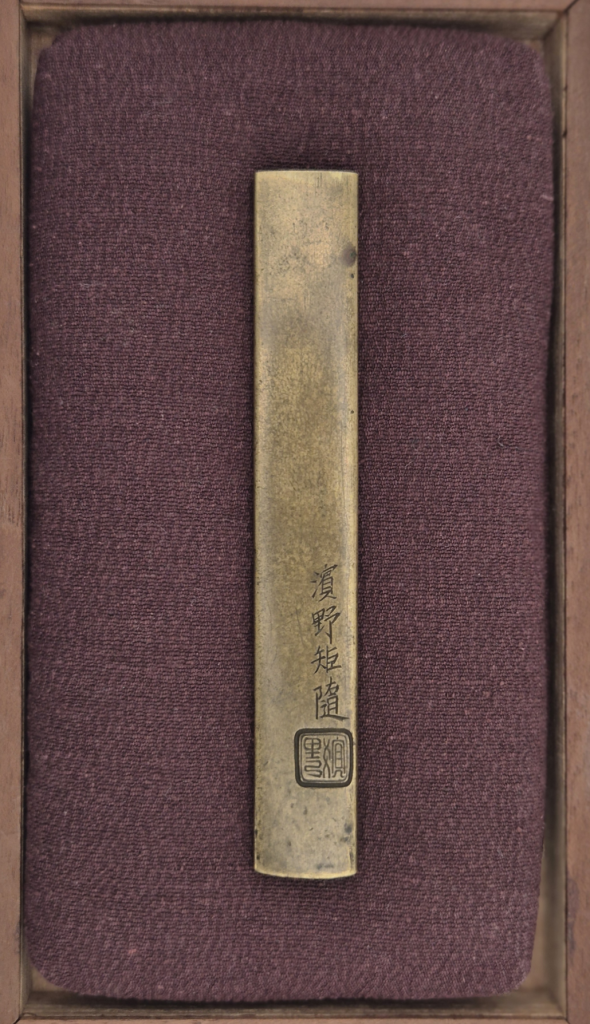
Kozuka by Hamano Noriyuki
Kozuka. Signiert Hamano Noriyuki (濱野矩随) mit Siegel. Sentoku, ishime-ji, takabori mit iroe in shakudo, gin, kin und akagane, kebori. Grille im Herbstgras. Späte Edo-Zeit. Privatsammlung, erworben in Europa.
In the collection
- Type
- Tosogu › Kozuka
- School
- Hamano
- Period
- Edo-Zeit › Späte Edo-Zeit
- Material
- Sentoku
- Motif
- InsektenPflanzen und Jahreszeiten