Zwei Drachen im selben Sturm
Mumei · Shibuichi · Iroe takazogan · Fruehe Edo-Zeit
Dragon Tsuba
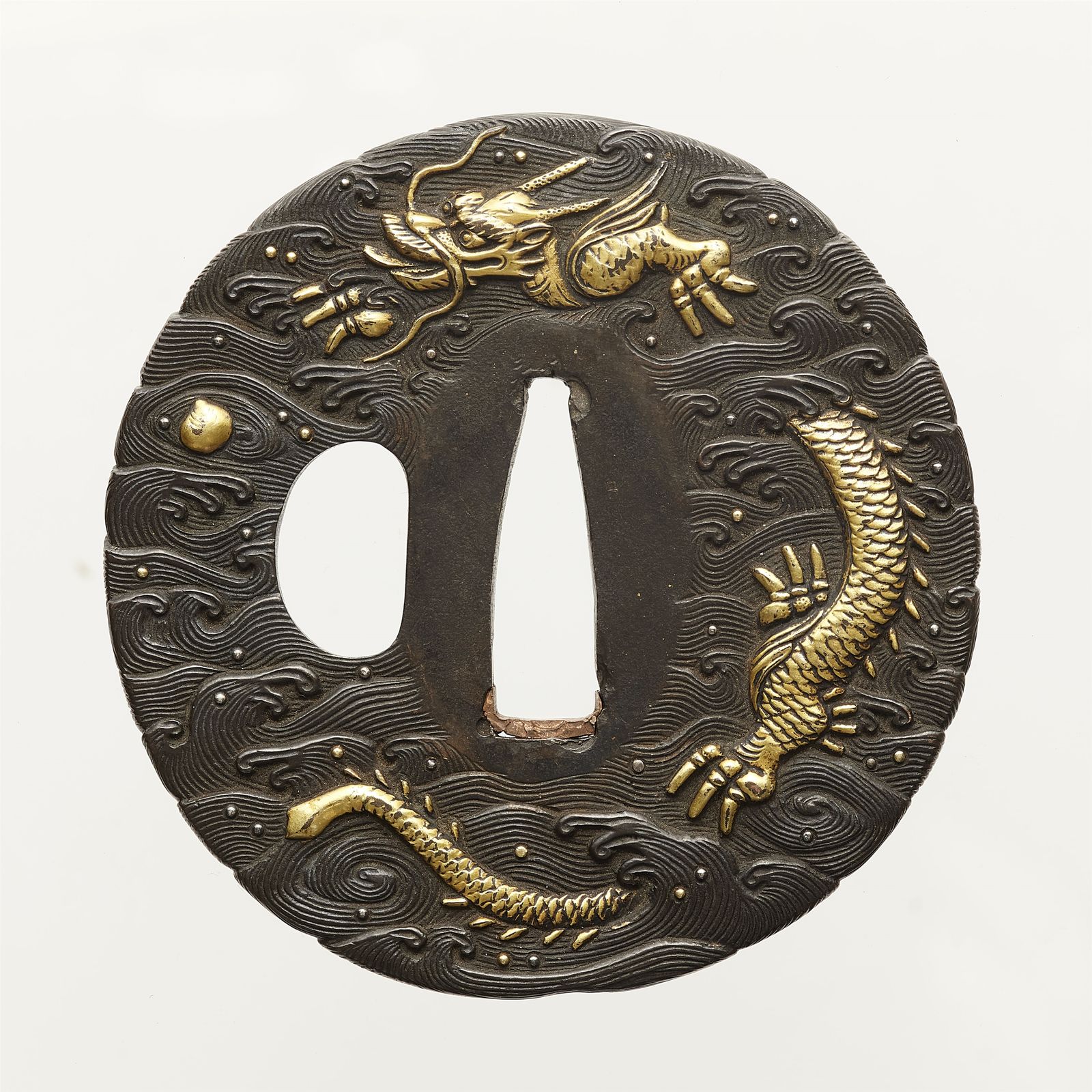
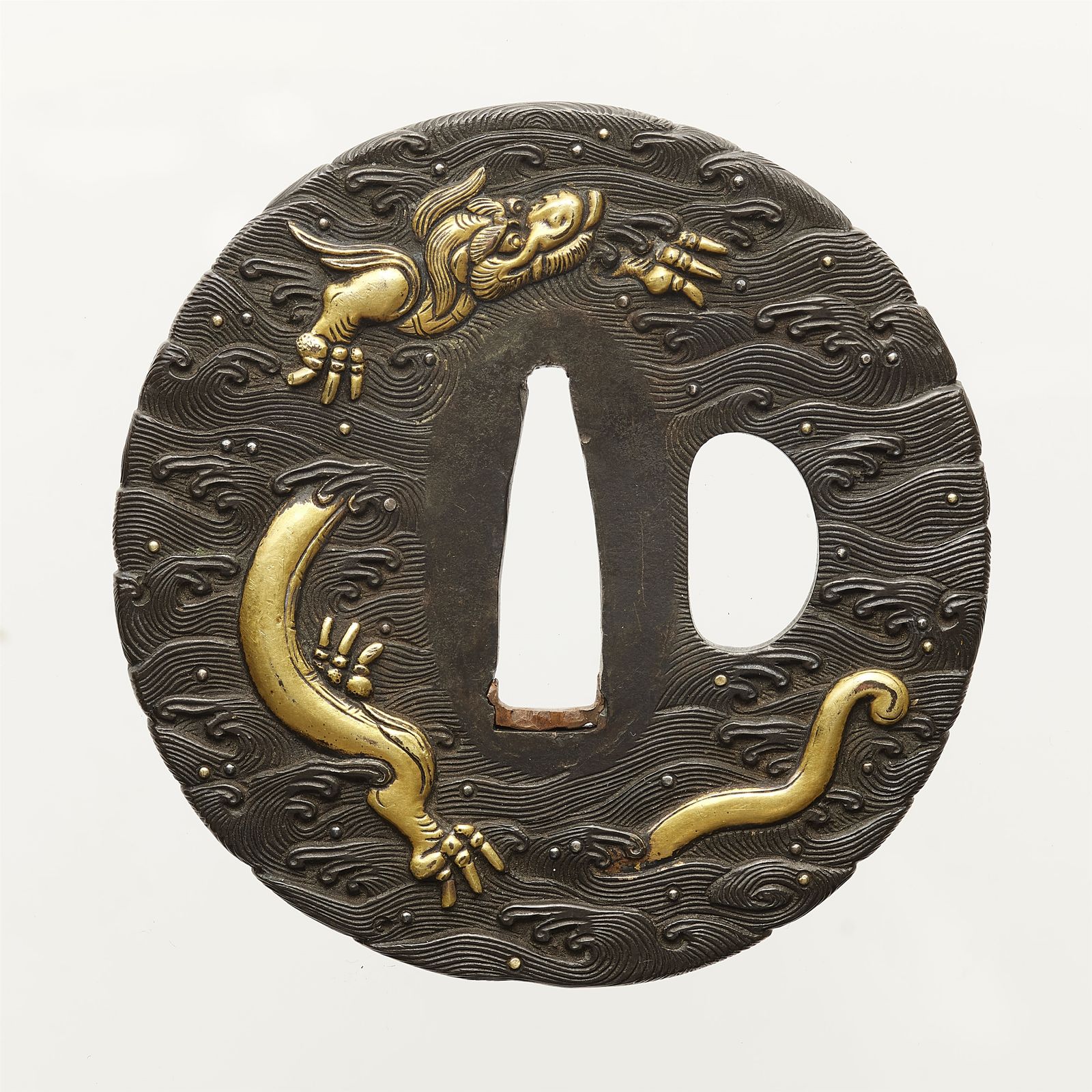
Turn it over. The dragon changes. Not the subject, not the material, not the wave-covered world they both inhabit. But the dragon itself is different: different posture, different scale, different relationship to the plate. On the omote a compact, coiling form, head facing left, a gold tama floating in the waves to its left as though dropped mid-flight. On the ura a larger, more serpentine body curving dramatically from upper left to lower center, the head turned right, the tail completing a full arc across the plate. The same storm, two creatures, one continuous sea. This is a compositional decision of real ambition.
Das Material & die Oberflaeche
The ground is shibuichi. The wave engraving is dense, fine, covering the entire plate on both faces, each wave individually worked. This is not a background. It is a landscape, and the dragons move through it rather than sitting on top of it. Against this ground the gold iroe takazogan, the high-relief inlay forming the dragons, reads with exceptional clarity. The gold is not surface gilding. It is substantial, with the sculptural presence of separately formed and applied elements. The tama on the omote, that single gold sphere drifting in the waves, turns the composition into something closer to a narrative: two creatures, one prize, one storm.
Zur Datierung und Attribution
Several features point toward an early date within the Edo period, the Kanbun to Genroku era roughly from the 1660s to 1700s. The wave engraving technique, fine and disciplined, covering the entire ground without any ishime texture, is characteristic of the earlier kinko tradition. The gold inlay has a quality of sculptural volume that becomes rarer as later schools moved toward flatter, more painterly inlay approaches. The piece is currently before the NBTHK in Tokyo. The wave ground alone represents a significant investment of skill and time. The dual-dragon composition with its narrative tama element is not a standard arrangement. Whatever the papers confirm, the ambition of the piece is already readable.
The two Dragon Tsuba
Tsuba. Mumei. Shibuichi migakiji, iroe takazogan in kin. Maru-gata. Fruehe bis mittlere Edo-Zeit. Derzeit zur NBTHK-Shinsa in Tokyo. Privatsammlung, erworben in Europa. Auktionhaus Lempertz, Cologne. Derzeit zur NBTHK Tokubetsu-Hozon-Shinsa