
Die Koto-Spielerin
Goto Injo · Kozuka · Shakudo · Fruehe Edo-Zeit · NTHK Hozon shoshin · NTHK Hozon · Veroeffentlicht
Kozuka Goto Injo 後藤殷乗
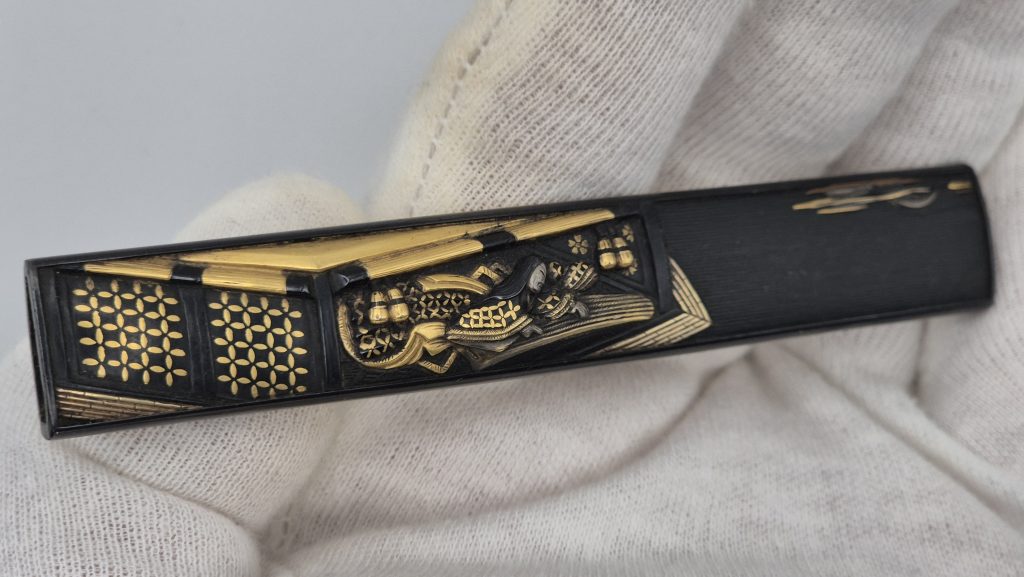
A woman alone in an inner room. No audience, no occasion. She sits before a koto and plays for no one — or perhaps for herself, which is a different thing entirely. Outside, nothing is visible. The scene gives you only this: a figure, an instrument, and the silence that music fills.
Die Geschichte hinter der Geschichte
Goto Injo (後藤殷乗) was born in 1621, the third son of Kenjo, the seventh generation head of the Goto main family. He grew up within one of the most prestigious artistic lineages in Edo-period Japan, and eventually founded its Shichirōemon branch, the lateral line that would, through his student Yokoya Soyo, become the origin point of the entire machibori tradition.
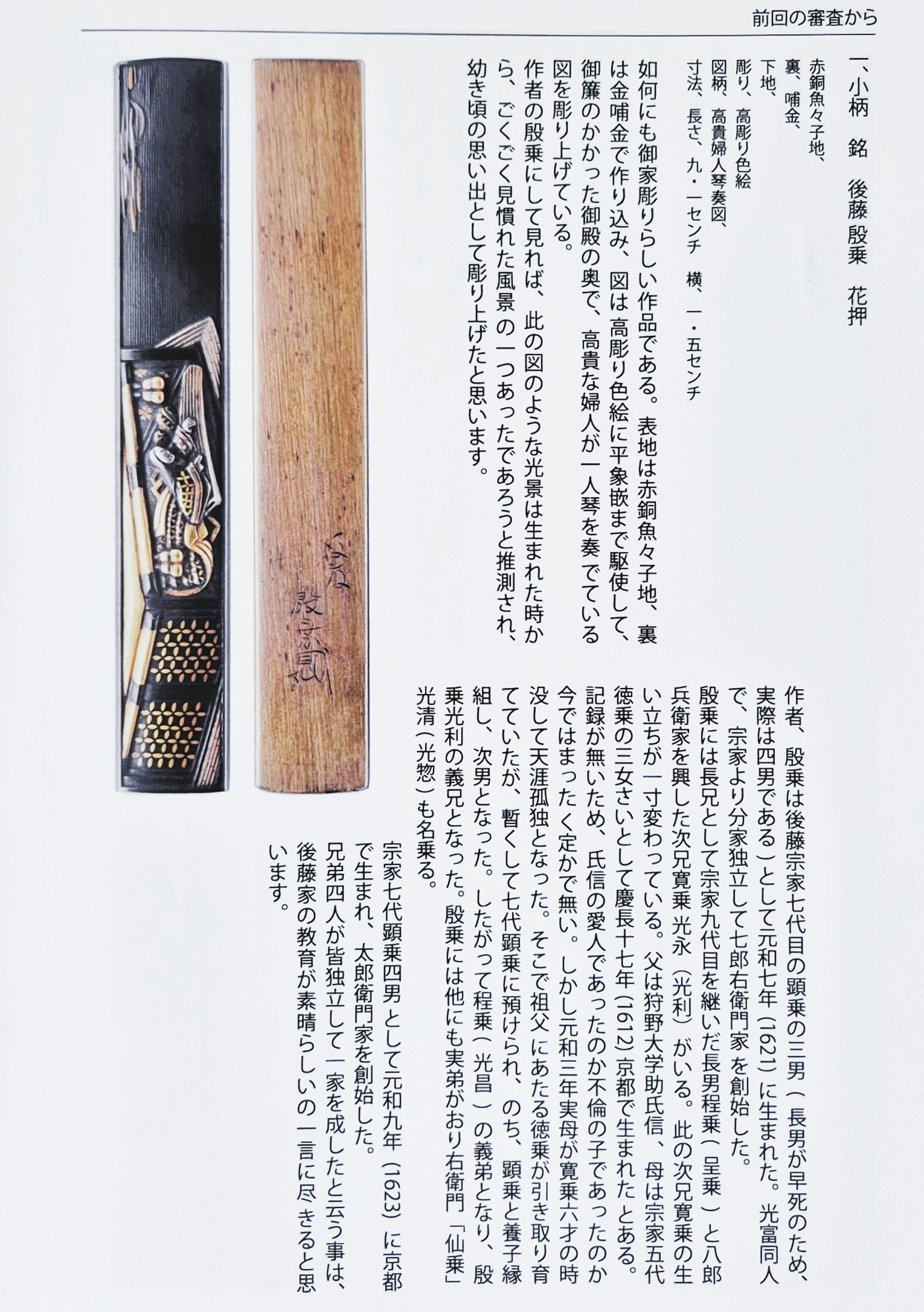
The note preserved with this piece offers something unusual: the speculation that the scene Injo carved here was drawn from personal experience. That the palace interiors, the quiet rooms, the sound of the koto were things he had known as a child — that what appears to be a genre subject is, in fact, a memory. Memory as subject matter is already intimate. Memory worked into metal, where it cannot change, is something else.

Das Objekt
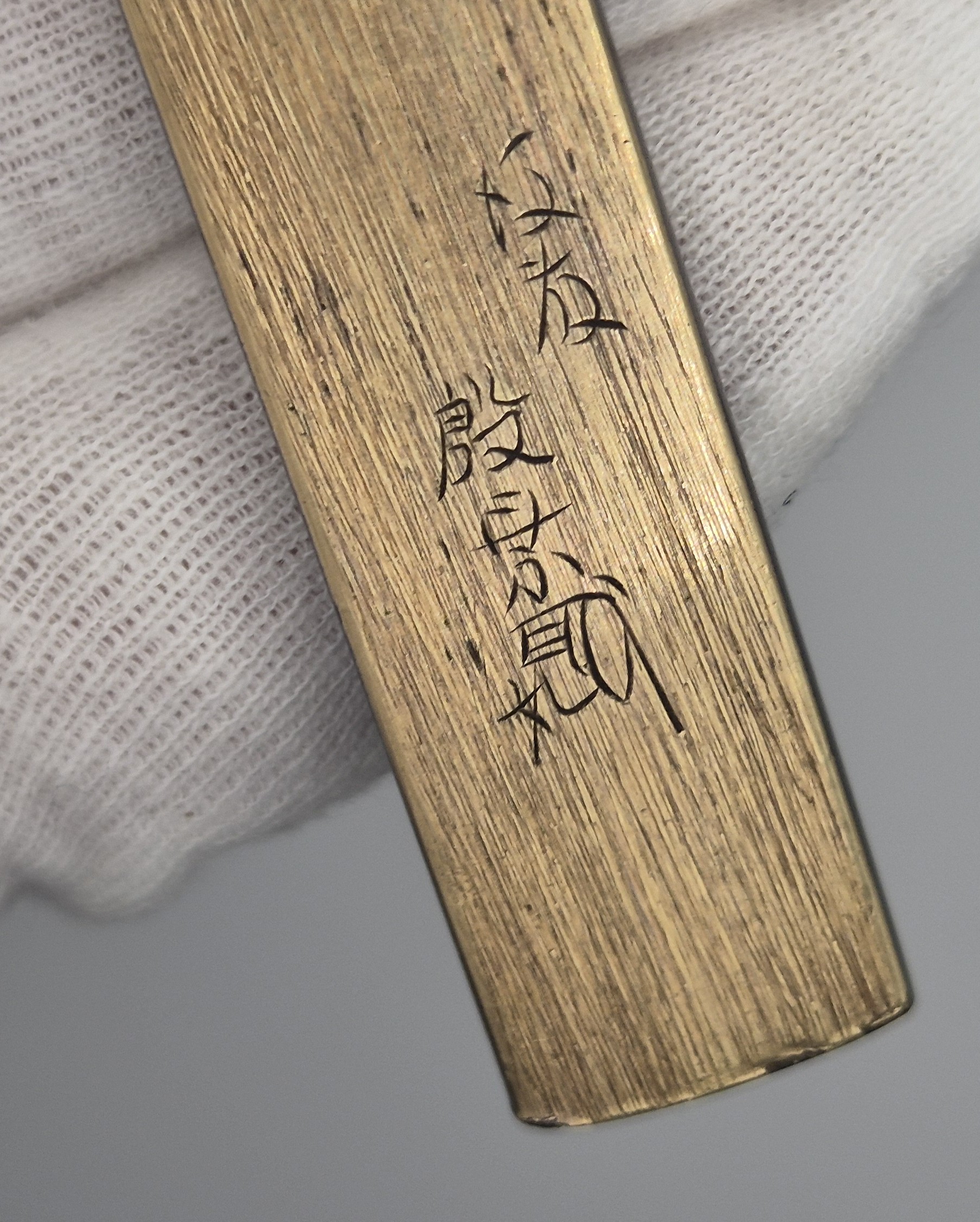
The ground is shakudō nanako-ji, the fine fish-roe surface that is the Goto family’s characteristic base. The figure of the noble lady rises from it in takabori irogane — high-relief polychrome metalwork, layers of alloyed metal building depth and colour simultaneously. The reverse carries nunome-zōgan inlay. The kozuka measures 9.1 × 1.5 cm. Signed Goto Injo (後藤殷乗) with kaō.
The object was assessed under the NBTHK shinsa process and is catalogued under 前回の審査から, “From the Previous Examination.”
Das Koto
The koto was one of the four noble accomplishments. To play it well was to demonstrate a particular quality of attention: the ability to remain present with something slow, something that rewards patience over performance. For a craftsman whose medium was the sword fitting — objects made for men whose lives were defined by readiness — there were reasons to keep other things close. Reminders that readiness was not the whole of existence. That somewhere a woman played alone in a quiet room, and that this too was worth preserving in metal, where it would last.
Die Veroeffentlichung
The object was assessed under the NTHK shinsa process and the entry appears in Tōken Kansō (刀剣観想), No. 776, March 2024, published by the NPO NTHK — Nihon Tōken Hozonkai (日本刀剣保存会, Society for the Preservation of the Japanese Sword). The society was founded in the Meiji period (Meiji 43) and its journal, Tōken Kansō, is one of the longest-running specialist publications in the field of Japanese swords and fittings. The entry appears under the standing rubric 前回の審査から — “From the Previous Examination” — in which the society documents objects assessed at its preceding shinsa session. Publication in this context is not a certificate; it is something closer to a record of scholarly attention. The object was judged worthy of documentation by the examining body, and the catalogue entry, with its unusually detailed biographical commentary on Injo’s family circumstances and the speculation about personal memory as pictorial source, reflects the level of engagement that serious shinsa assessment brings to a piece. For a European collector, the appearance of a work in Tōken Kansō carries weight precisely because it represents the judgment of practitioners within the tradition itself, not observers of it from outside.
Kozuka Noble Lady & Koto
Kozuka. Goto Injo. Shakudo, nanako Grund, takabori, urafukumi-kin. Fruehe Edo-Zeit. 9.2 x 1.5 cm. Signiert mit kao. NTHK Hozon. Privatsammlung, erworben in Japan. Veröffentlich in Tōken Kansō No. 776 (2024).