
Der Gesang des Herbstes
Hamano Noriyuki (浜野矩随) · Kozuka · Sentoku ishime-ji · Spaete Edo-Zeit
Hamano Noriyuki Kozuka
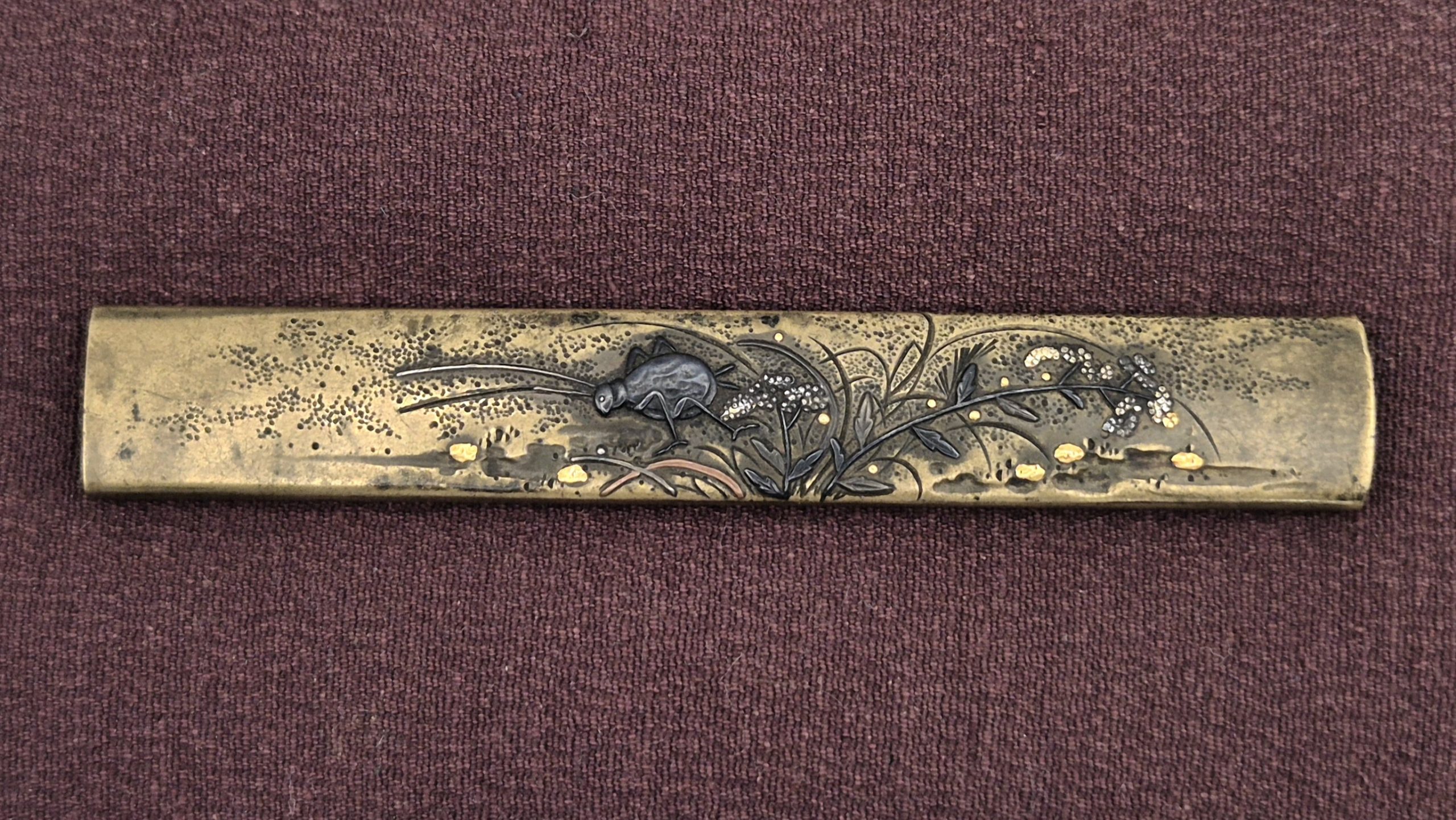
It is small enough to miss at first. A cricket, rendered in shakudo, stands among the water grasses of the left field — six legs, segmented body, antennae extending forward into the vegetation. It has found its position in the stems and settled there, entirely absorbed in whatever a cricket is absorbed in when it is not singing.
Around it, a world built from autumn’s vocabulary: wild flower clusters in silver, their white heads catching light differently from the warm sentoku ground. Gold pebbles at the waterline. Grasses and stems engraved into the metal itself, their lines thin and precise, curving right across the face to a second flowering head. The ground is ishime, stone-textured, giving the surface the quality of earth or bark rather than polished metal. Everything here is specific. Nothing is generic.
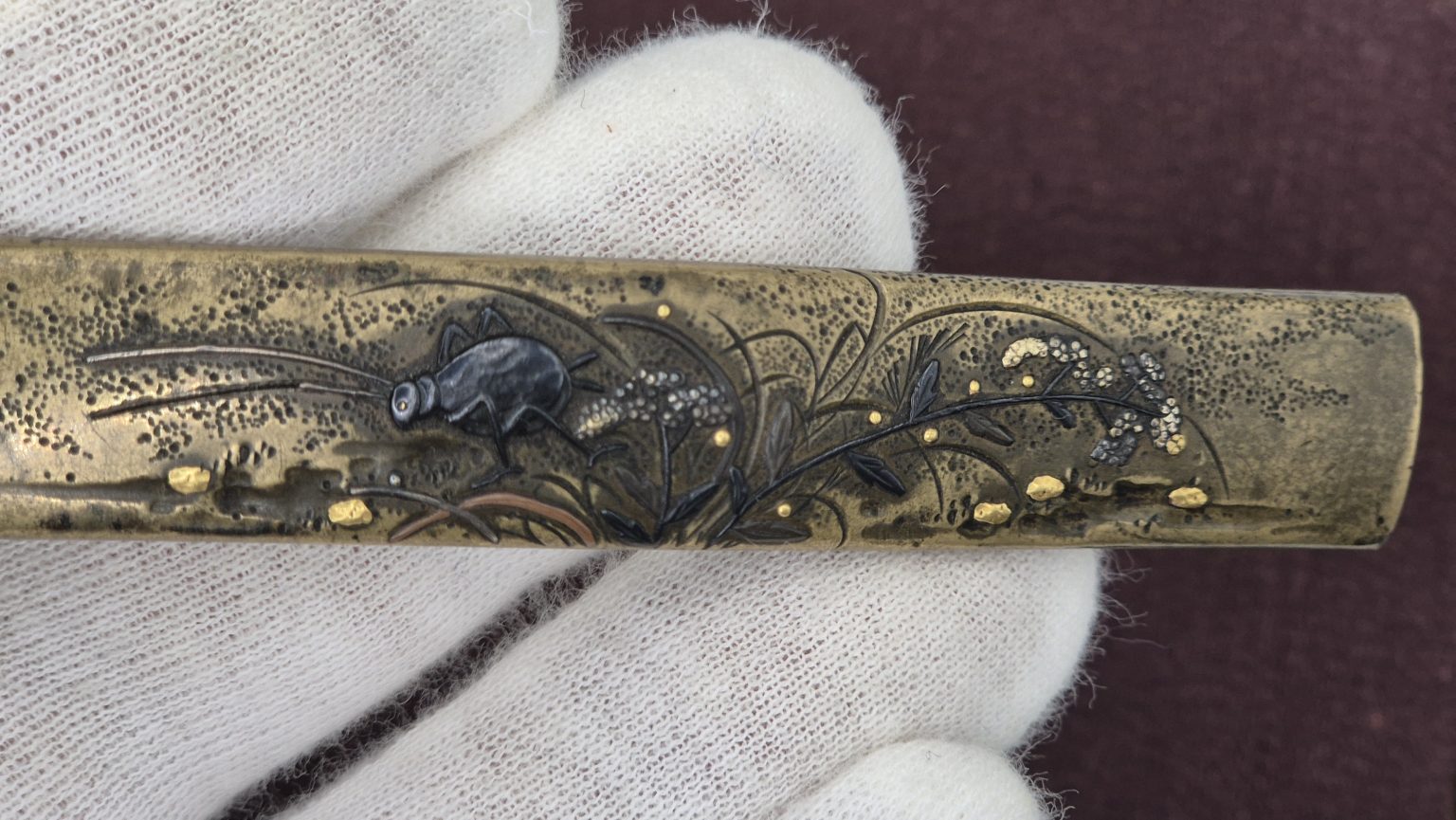
Korogi
The cricket is the sound of autumn in Japanese culture. Its call appears throughout the classical poetry tradition — from the Man’yoshu onward — as the defining voice of the season, heard at night, from the grass, at the precise moment when summer has become something past. To render one in shakudo, standing still among seri and gold pebbles, on an object carried inside a sword’s scabbard — this is to preserve the moment before the sound, the creature in its silence, which is somehow more present than the song itself.
Das Objekt
The material is sentoku, a brass alloy with a warm golden tone. The ishime ground is worked across the entire face: Fine, granular, consistent. Giving the scene a surface quality that absorbs rather than reflects. Against this, the inlay elements are placed with great precision: the cricket in high-relief shakudo, its body three-dimensional enough to cast a slight shadow; the flower clusters in silver; the gold pebbles at the lower margin; the stems and leaves in fine kebori worked into the sentoku itself.
The reverse is plain sentoku, the warm surface undecorated. The signature, 浜野矩随, is engraved in clear cursive script, followed by a rectangular inkan seal.

Hamano Noriyuki
Hamano Noriyuki represents two generations with very similar work styles. The first generation was a student of Hamano Shozui, his personal name was Someno Chugoro, born in 1736 and died in 1787 at 52 years old. The second generation is his son, known as Matsujiro, born in 1771, who died at 82 years old in 1852. The style of the two Noriyuki shows much influence from Nara Toshinaga and Sugiura Joi. Both generations of Noriyuki have been targeted by forgers — in the Kinko Meikan the first generation is ranked Meiko (second to highest possible) and the second generation Ryoko (third to highest). In spite of their fame and high level of skill, work of either smith is rather difficult to find today.
Eine letzte Bemerkung
There is a particular kind of ambition that does not announce itself: the ambition to make something small seem sufficient. A kozuka depicting a cricket in autumn grass is not competing with a tsuba depicting a battle scene or a god. It is making a completely different argument — that the cricket, standing still in the stem, in the moment before it sings, is as worthy of serious attention as anything the tradition has produced. Noriyuki understood this. The cricket stands in its grass. The gold pebbles sit at the water’s edge. The season is ending. It is enough.
Kozuka by Hamano Norijuki
Kozuka. Hamano Noriyuki (浜野矩随). Sentoku ishime-ji, iroe zogan in shakudo, gin und kin. Korogi to seri no zu. Spaete Edo-Zeit. Signiert mit inkan. Privatsammlung, erworben in Europa