Der Reiher & das Schilf
Mumei · Kozuka · Tetsu · Iroe zogan · Edo-Zeit
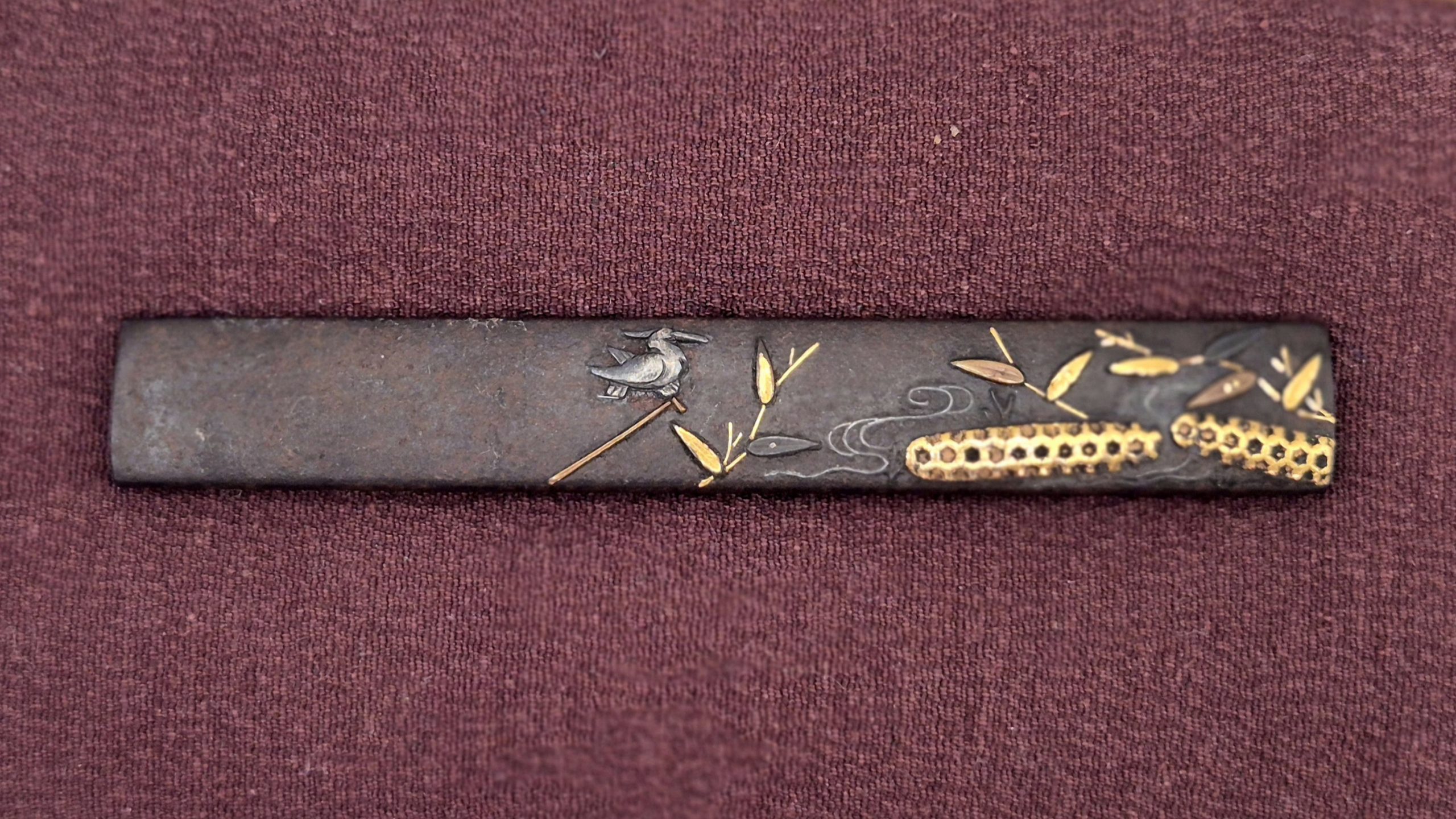
Kozuka with Heron
Everything here belongs to the water’s edge. The bird perches on a thin gold stem to the left — silver, compact, its body turned right — a heron or egret caught in that particular posture of absolute stillness that these birds adopt when they are waiting, which is most of the time. Around it and past it, across the full length of the kozuka, gold leaves of bamboo or water grass scatter at different angles, moving the way vegetation moves when a slight current stirs it. And to the right, dominating the final third of the composition, a tall reed: its long cylindrical seed head in gold, its surface worked with a fine texture that gives it warmth and botanical specificity, its stem reaching toward the right edge of the face. The iron ground holds all of this in its dark field: Rough, deep, the surface of a riverbank at dusk.
Sagi ni Ashi
The heron among reeds is one of the oldest and most quietly persistent subjects in Japanese art. Its persistence is not accidental. The subject contains an entire quality of attention: the bird at the water’s edge, completely still, waiting with a patience that looks effortless and is not. Common reeds, ashi or yoshi, grow wherever water meets land. The seed head of the mature reed, cylindrical and dense, was a recognizable form in Japanese landscape art and poetry — associated with autumn, with the harvest season, with the particular melancholy beauty of places where land is not quite land and water is not quite water.
Das Objekt
The ground is tetsu, iron, rough-surfaced and genuinely dark. Against this ground the composition is built in hira-zogan and takazogan: the bird in silver with real three-dimensional presence; the scattered leaves in gold, individually placed at different angles; the reed seed head in gold, its cylindrical form worked with a fine surface texture. The iron was chosen because it is itself the color of the riverbank at the end of day — dark earth and dark water — and because the gold and silver inlay reads with maximum luminosity against it.
Kozuka with Heron
Kozuka. Mumei. Tetsu, iroe zogan in kin und gin. Sagi ni ashi, kusa no zu. Edo-Zeit. Privatsammlung, erworben in Europa.