Die Weisheit der Verrueckten
Mumei · Kozuka · Suaka (Kupfer) · Katakiribori · Edo-Zeit
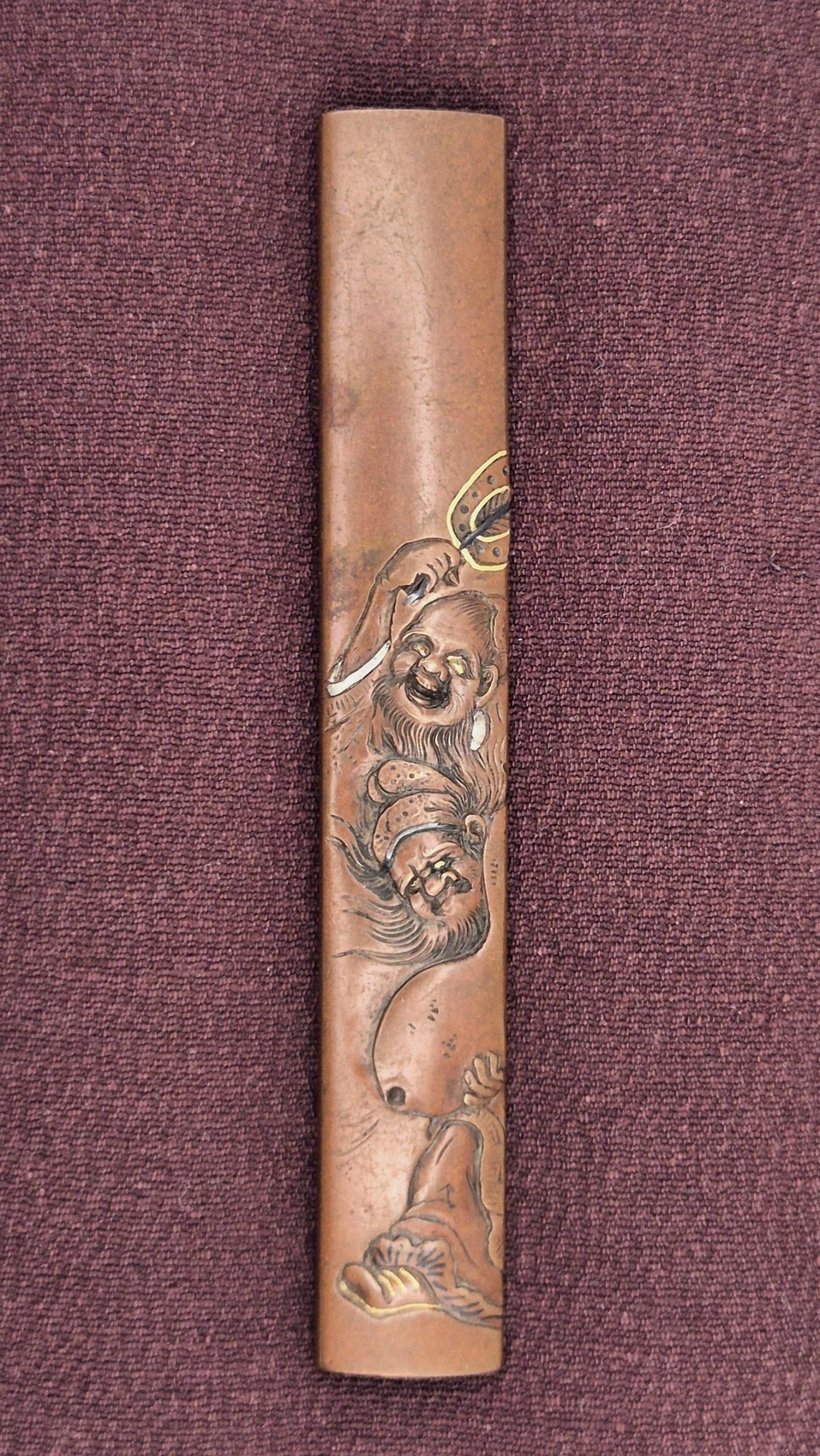
Kozuka with Kanzan & Jittoku
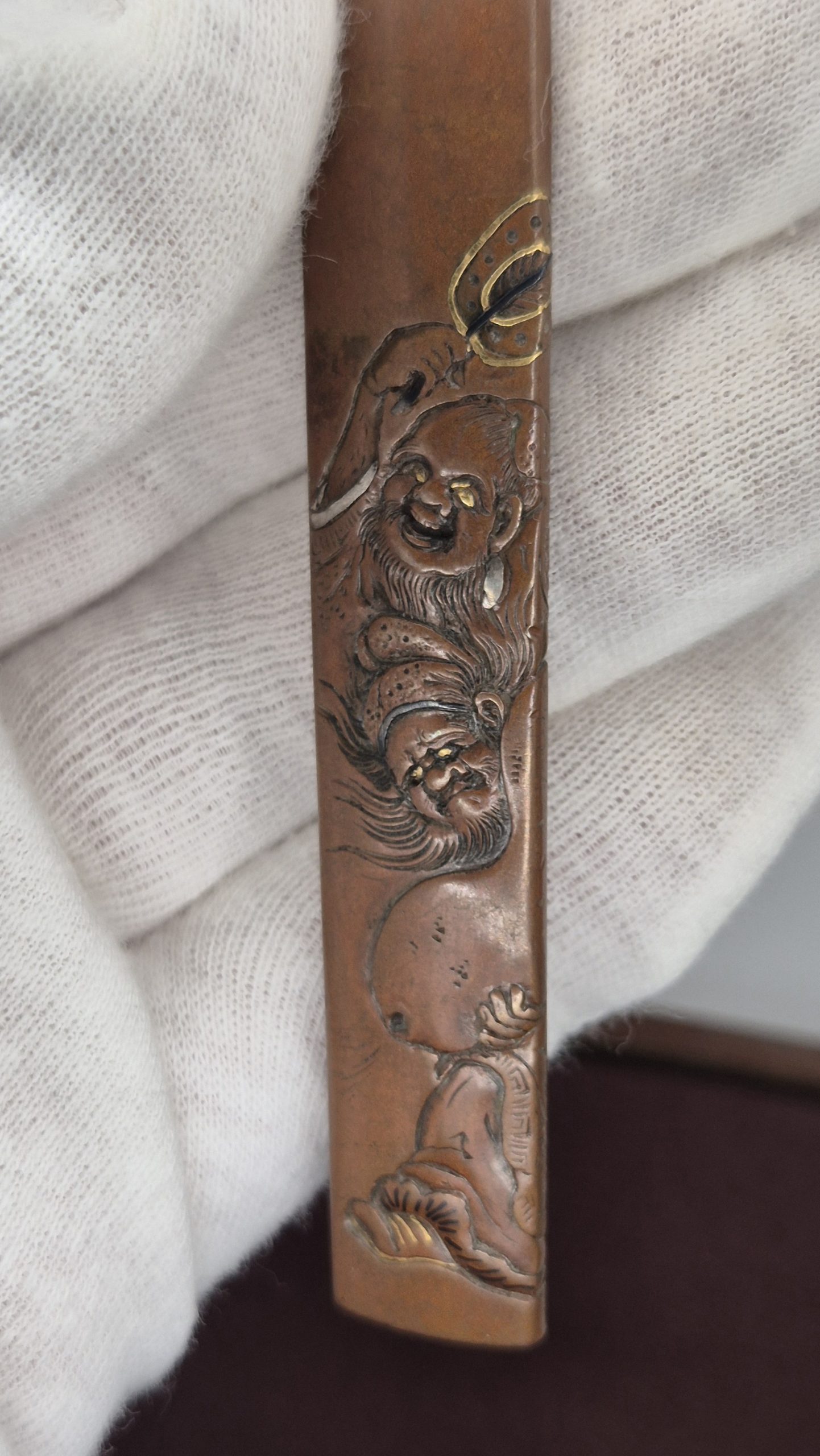
The material is copper — suaka, pure copper — and its warmth is the first thing the eye registers before any subject becomes clear. Not the yellow of sentoku, not the cool grey of shibuichi, but a reddish-brown that in natural light has a quality closer to terracotta than to metal. Against this ground, two figures are carved directly into the surface in katakiribori, their forms emerging from the copper itself rather than being applied to it. They are laughing. They are always laughing.
Kanzan & Jittoku
Kanzan and Jittoku are a pair of Zen eccentrics who lived at a monastery on Mount Tendai in China during the Tang period. They spoke to each other in a nonsense language that no one else understood. According to legend, Kanzan was a recluse and poet who lived on a sacred Buddhist mountain. Jittoku was an orphan who grew up in a monastery kitchen and frequently supplied Kanzan with leftovers. This inseparable pair of eccentrics became a favorite subject in Zen paintings. What made them extraordinary was not wisdom in any conventional sense but their complete indifference to the forms that wisdom was supposed to take. Their depictions summarize the nonconformist Daoist ideals of the kijin lifestyle. Hanshan and Shide worked in the kitchen of a Zen monastery but were actually reincarnations of the bodhisattvas Manjushri and Samantabhadra.
Die zwei Figuren
The upper figure is Kanzan. He holds a fan — raised, open, its ribs caught in gold and silver inlay above his bearded, laughing face. His hair and beard are wild, worked in flowing katakiribori lines. His eyes are gold-inlaid. Below him, Jittoku empties a large jug. His arms are around it or raised toward it, his body given over to the act completely. The jug is the right attribute: Jittoku fed Kanzan from the monastery kitchen, and his face looks upward toward his companion. The two figures occupy the full length of the kozuka face, stacked vertically, their forms carved in katakiribori directly into the warm copper. These are not generic sage figures. These are two specific people in a specific moment of their specific relationship
Das Kupfer und die Technik
Suaka (pure copper) responds differently to the katakiribori chisel than brass or shibuichi. It is softer, and the angled cut moves through it with greater fluency. The warm reddish-brown of the ground gives the cut edges a particular readability: not the high contrast of a dark ground but something more intimate, the figures emerging from their material rather than standing against it. The gold and silver inlay — on the fan ribs, in the eyes of both figures — is restrained. Punctuation rather than decoration.
Die Rueckseite
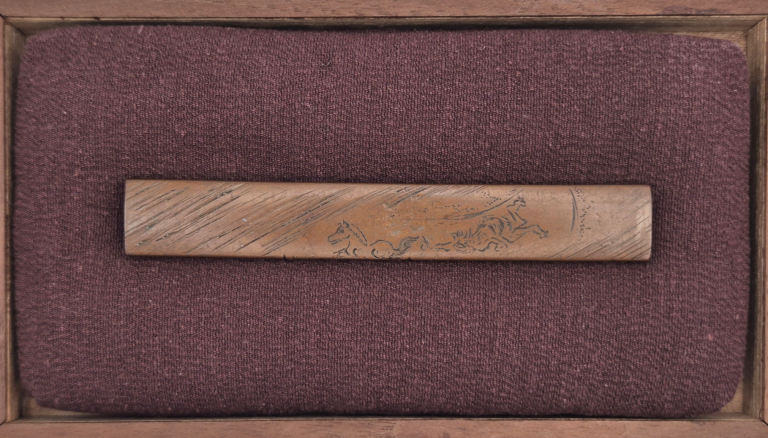
The ura carries two horses in katakiribori, running through diagonal lines that fill the surface — rain, or wind, or simply the striated yasuri ground that becomes indistinguishable from depicted weather. The horses are small and confident, their movement captured in the economy of minimal strokes. They do not explain Kanzan and Jittoku. They exist on the other side of the same object without commentary, which is perhaps the most Kanzan-and-Jittoku response possible.
Kanzan & Jittoku Kozuka
Kozuka. Mumei. Suaka (Kupfer), katakiribori, iroe zogan in kin und gin. Kanzan Jittoku zu / Uma ni ame no zu. Edo-Zeit. Privatsammlung, erworben in Europa. Auktionshaus in Düsseldorf.