Die Grille & der Tau
Mumei · Kozuka · Tetsu · Iroe zogan · Edo-Zeit
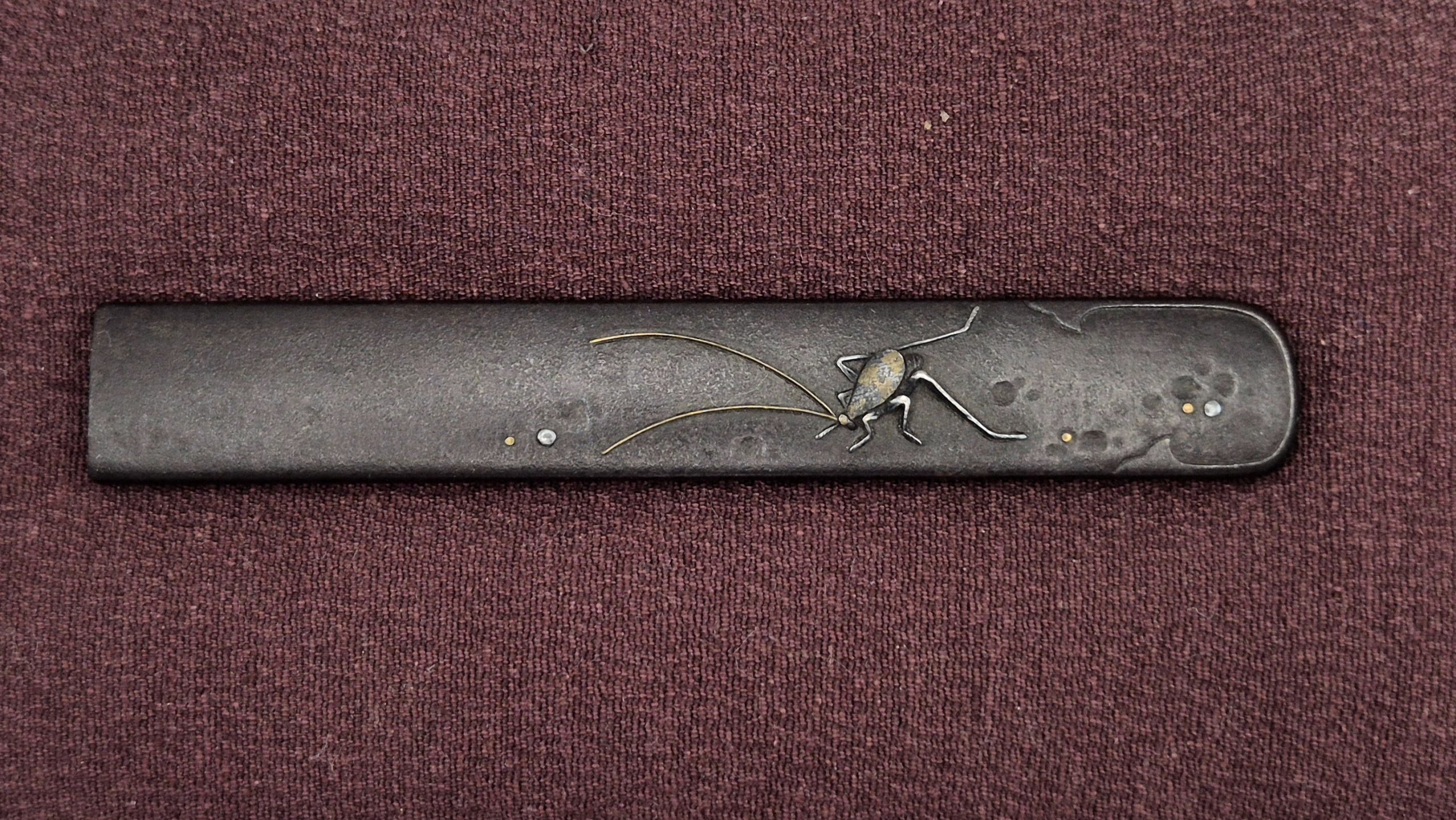
Kozuka with Kirigirisu
Almost nothing. That is the first and most important thing about this kozuka. The iron field is nearly empty — rough, dark, scattered with small circular depressions that suggest dewdrops resting on a cold surface. To the right of center, an insect stands on this field: compact body in mixed metals, six angular legs in silver, and then the antennae — two long gold lines sweeping left across most of the face, curving slightly, extending far beyond the creature that produces them. The antennae are the composition. Everything else is in service of those two lines.
Das Insekt
The long-horned grasshopper or katydid — kirigirisu — is the autumn insect par excellence. Its antennae, which can be twice the length of its body, are the feature that distinguishes it from the cricket in Japanese visual culture, and it is those antennae that a maker working in gold wire on an iron ground would seize upon. They give the composition its horizontal momentum. They reach across the dark field the way the insect’s song reaches across a dark autumn garden: further than seems possible, into silence.
Das Eisen & die Stille
The iron ground here is doing more work than the inlay. The small circular depressions scattered across the surface — deliberate, evenly sized — read as dewdrops, as the moisture that settles on iron surfaces in the cold of an autumn night. They give the dark field a quality of outdoor presence. Against this field, the gold antennae lines and the silver legs of the insect are placed with absolute economy. No vegetation, no second element, no flower or grass. The insect exists alone on the dark field with its dewdrops, its antennae extending into space that the maker chose not to fill.
This is the most minimal composition in the collection. A single insect. Two gold lines. An iron surface alive with implied moisture. The autumn night that surrounds all of this exists only in the viewer’s imagination, which is where the maker intended it to exist.
Tetsu Kozuka with Kirigirisu
Kozuka. Mumei. Tetsu, iroe zogan in kin und gin. Kirigirisu ni tsuyu no zu. Edo-Zeit. Privatsammlung, erworben in Europa.