
Die Wachtel hoert den Herbst
Mumei · Kozuka · Sentoku · Iroe takazogan · Edo-Zeit
Kozuka with Quail and Autumn Flowers
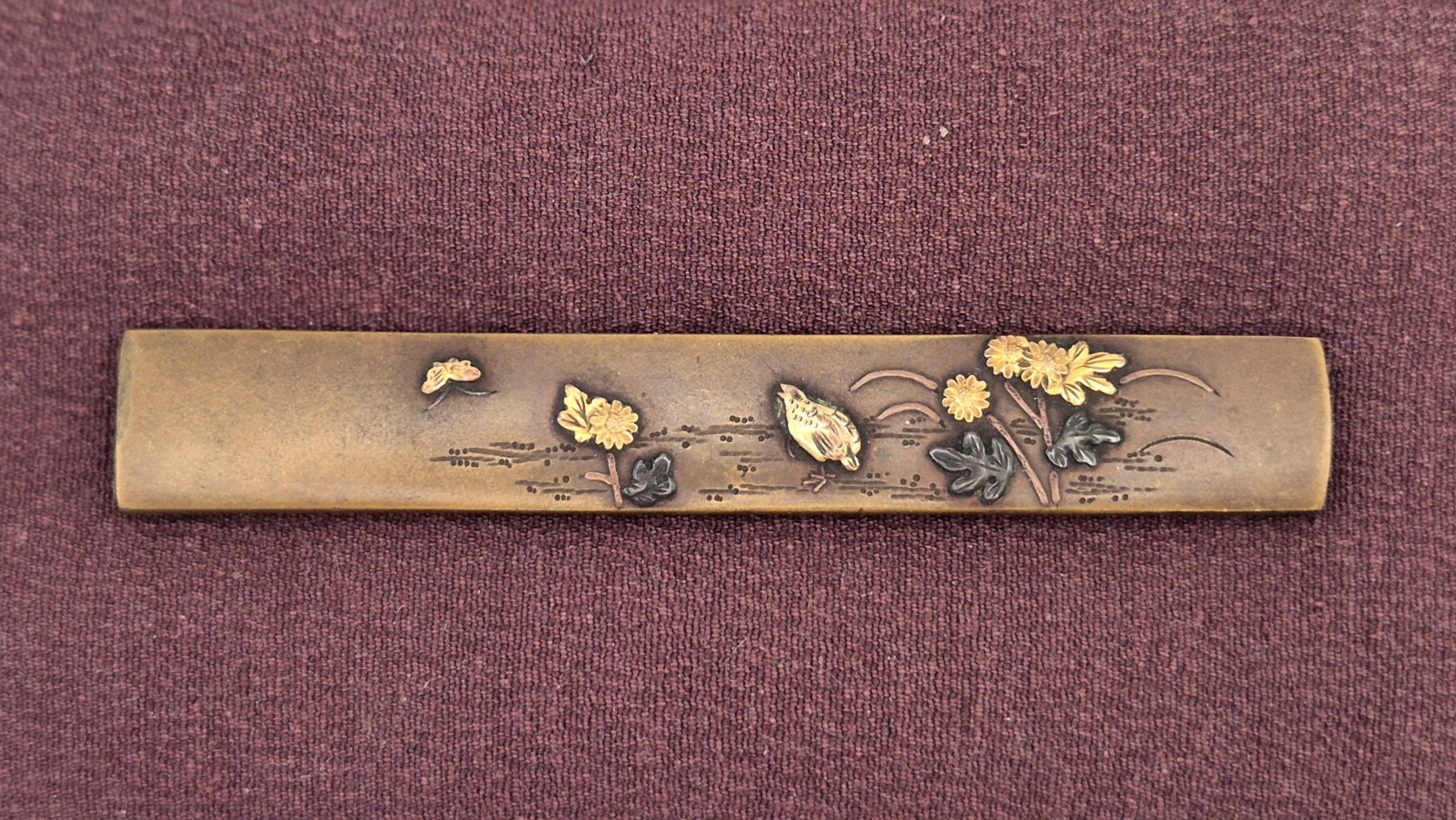
The quail does not look up. It stands among the chrysanthemums with the particular concentration of a ground bird that has found what it was looking for, its compact body low, its feet planted, its attention directed at something the viewer cannot see. Above and around it, chrysanthemum flowers in gold rise on their stems, their petals worked with individual care. A butterfly drifts in from the left. The scene is complete and entirely unhurried.
Uzura ni Kiku
The quail and the chrysanthemum appear together in Japanese art from the Heian period onward. The pairing is seasonal: both belong to autumn. In the Man’yoshu, the quail appears as a creature of the autumn fields, its call associated with loneliness, with the shortening days. The chrysanthemum was the flower of the ninth month, associated with longevity and the imperial household. A quail among chrysanthemums is a composition of extraordinary semantic density: the transient and the enduring, the small and vulnerable creature beside the flower that stands for ten thousand years. The butterfly adds a third element: transformation, the brief and weightless presence that crosses the scene without touching it.
Das Objekt
The ground is sentoku, its warm golden-brown tone working as the ambient light of an autumn afternoon. Against this ground the composition is built in iroe takazogan of real quality: the quail in mixed metals, copper-red and shakudo giving its mottled feathers a specific warmth that plain gold or silver could not achieve; the chrysanthemum flowers in gold, their petals individually curled; the leaves in dark shakudo with a naturalistic bend; the butterfly small and precise at the far left. The arc lines in the lower register — wave-like, curved — suggest either autumn grasses bending in wind or abbreviated landscape strokes.
Die Wachtel in der japanischen Kunst
The quail occupies an unusual position: it is humble, small, and entirely without symbolic grandeur, and yet it appears in some of the most celebrated paintings and sword fittings of the Edo period. The reason is precisely its humility. A quail among chrysanthemums does not assert anything. It simply inhabits its season with complete attention, and that quality of attention was exactly what the Japanese aesthetic tradition most valued.
Kozuka with Autumn Theme
Kozuka. Mumei. Sentoku, iroe takazogan in kin, shakudo und do. Uzura ni kiku, cho no zu. Edo-Zeit. Privatsammlung, erworben in Europa.