
Zwei Hasen im Mondlicht
Mumei · Kozuka · Shakudo nanako-ji · Iroe takazogan · Urafukumi-kin · Kin-mimi · Edo-Zeit
Kozuka with Rabbits under the Moon
The nanako covers everything. Thousands of tiny raised dots, each one pressed with a spherical punch, consistent in size and spacing across the entire face of the kozuka without interruption. This is the ground the Goto school made canonical — the surface that more than any other single technique defines the highest register of Japanese soft-metal work. Against it, two hares.
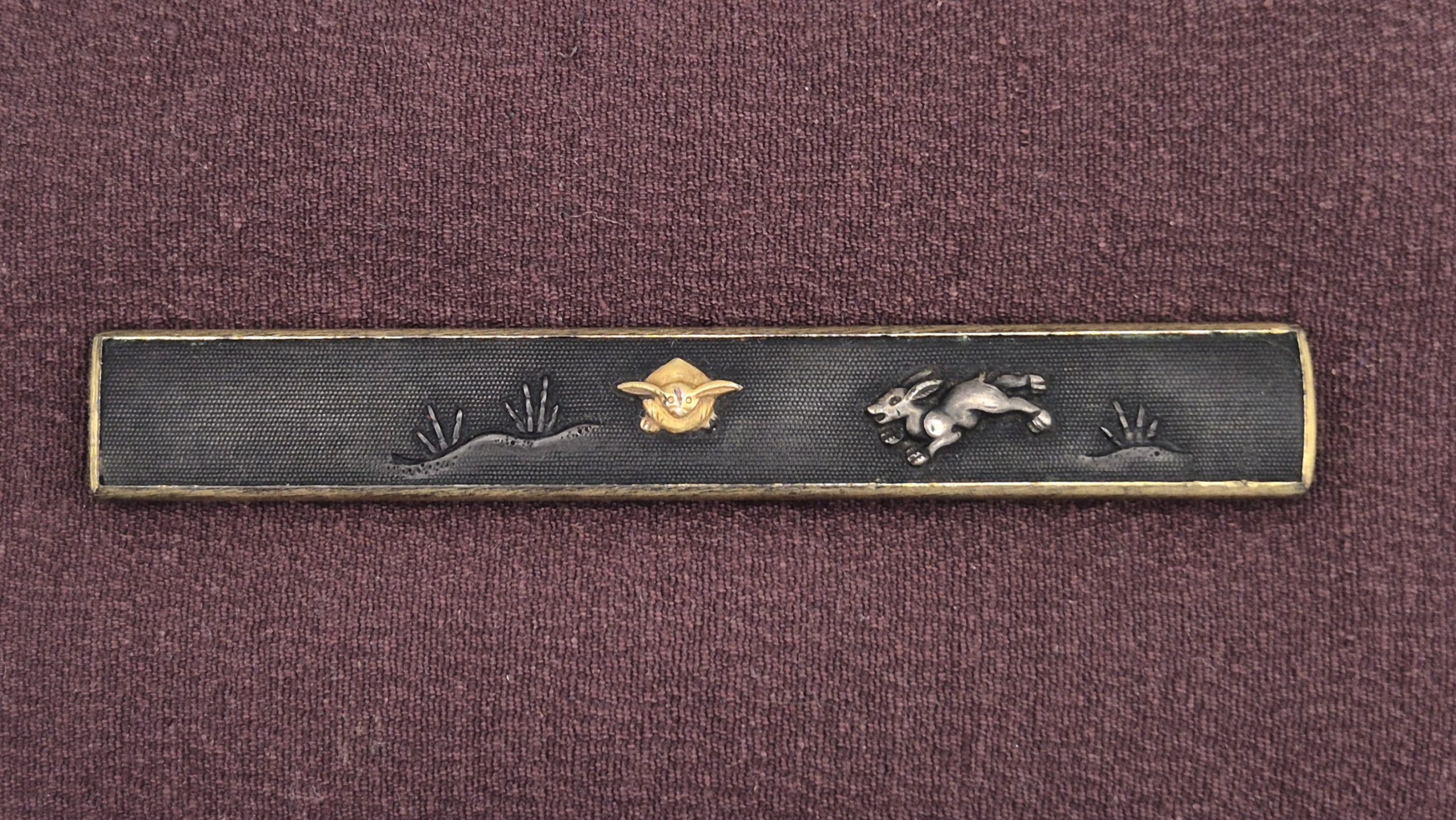
One sits. One runs.
The sitting hare is gold, center-left, its body compact and low, ears up, facing right toward its companion. The running hare is silver, to the right, fully airborne — all four legs extended, body horizontal, ears flat — moving at the speed that hares move when they have decided to move. Between them, low grass in dark shakudo. At either margin, more grass, suggesting the ground of a meadow or a hillside at night.
Der Hase & der Mond
The hare is the moon’s animal in Japanese culture. The dark markings of the moon, seen clearly on a full autumn night, resolve into the shape of a rabbit pounding mochi rice cakes with a pestle. To depict two hares on a deep shakudo ground — the darkest of metals, the color of a moonless sky — is a composition in which the moon is everywhere and nowhere: present in the animals, absent from the field, implied by everything the eye sees.
Two hares rather than one doubles the resonance without explaining it. The gold hare and the silver hare are the same creature in two different states: stillness and motion, contemplation and flight, the moon’s reflection sitting on water and the moon’s light moving across the ground. Neither cancels the other.
Das Objekt
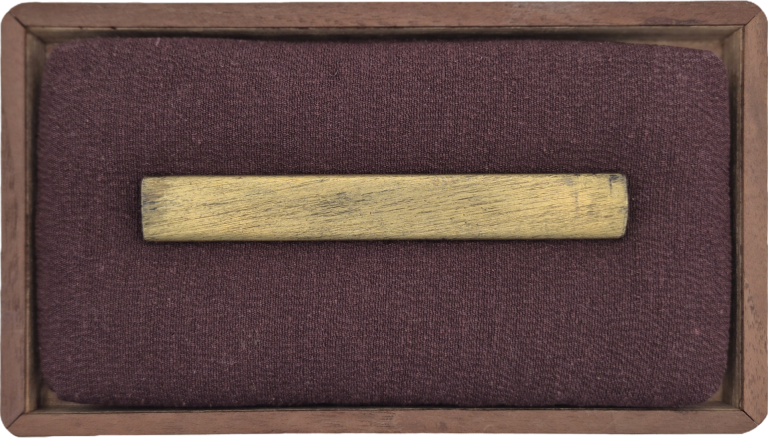
The shakudo is deep, warm-dark, the patina of real age. The nanako is of exceptional quality — even spacing, consistent dot size, no visible variation across the face. The mimi is finished in gold foil, giving the kozuka its frame in the warmest possible register. The ura carries the same gold foil treatment across the entire reverse face — urafukumi-kin, the hidden gold, a luxury applied to the side no viewer sees when the piece is mounted. This is the Goto tradition’s most distinctive declaration of intent: that the invisible surface deserves the same quality as the visible one, because the object’s worth is not contingent on being observed. The piece is mumei, unsigned. The urafukumi-kin and the gold-foil mimi, combined with the regularity of the nanako ground, place this piece within the tradition’s upper registers without requiring a signature to make the argument.
Kozuka Hares & Moon
Kozuka. Mumei. Shakudo nanako-ji, iroe takazogan in kin und gin, urafukumi-kin, kin-mimi. Usagi ni tsuki no zu. Edo-Zeit. Privatsammlung, erworben in Europa.