Die Spinne verlaesst ihr Netz
Mumei · Kozuka · Tetsu · Mokume-ji · Iroe takazogan · Edo-Zeit
Kozuka with Spider
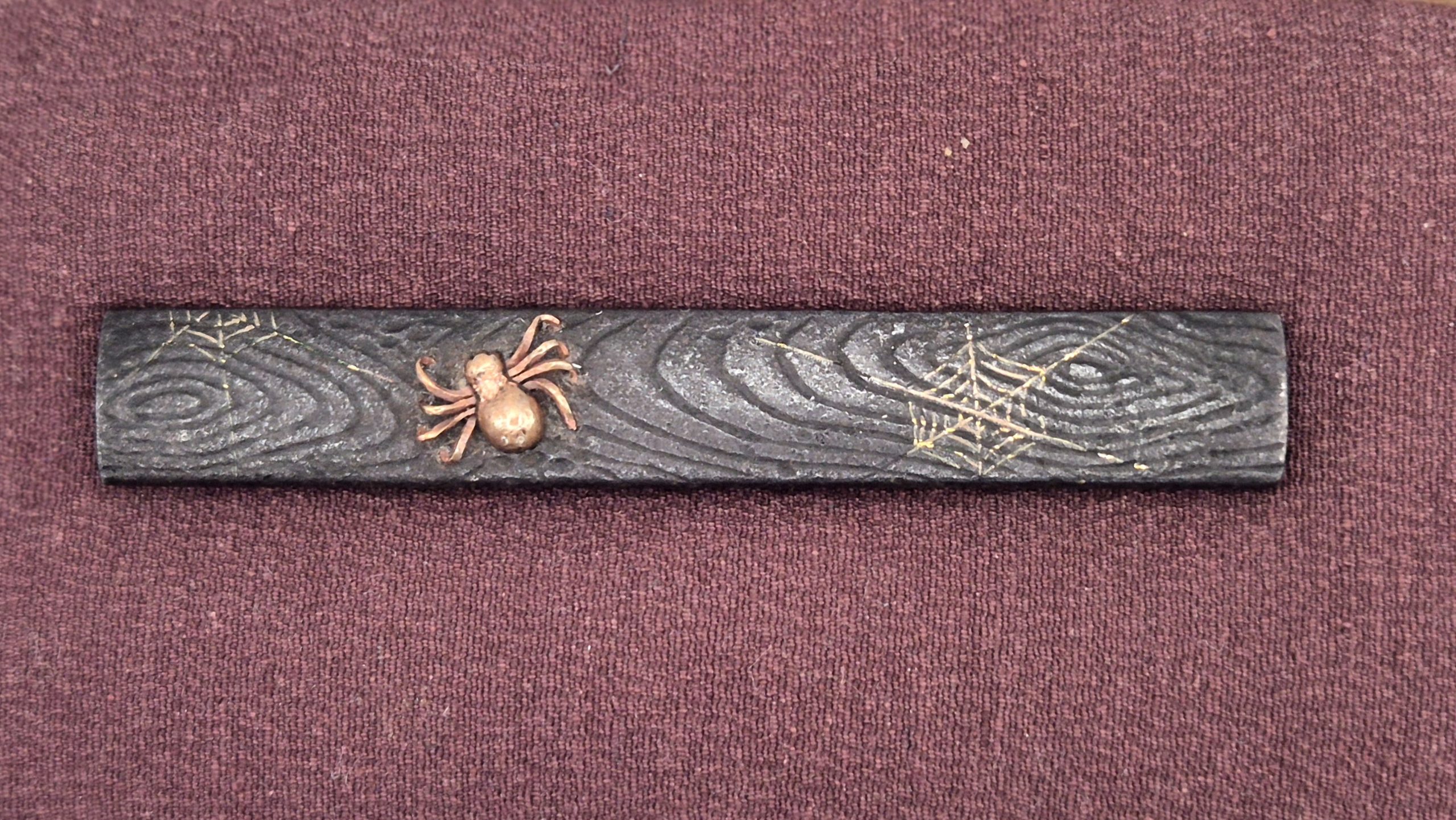
The webs are empty. Two of them, engraved in fine gold lines on the iron ground — one at the left end of the kozuka, one at the right — their radial threads and spiral catches rendered with the precision of someone who had studied how webs are actually built. The spider is not in either of them. It stands at center-left, its copper body raised high above the surface, eight legs spread and curved, occupying the space between its two abandoned constructions with the complete self-possession of a creature that needs no fixed address.
The ground beneath all of this moves. Concentric rings spiral across the entire iron face — three distinct centers, their rings expanding and overlapping — giving the surface the quality of water disturbed in three places simultaneously, or wood grain in old timber, or the kind of pattern that appears behind closed eyes.
Die Spinne
In Japanese culture the spider can represent both good fortune and malevolent transformation. It is also one of the most structurally fascinating creatures in the natural world: an animal whose primary activity is the construction of an elaborate trap. The spider on this kozuka has left its webs. Two gold webs exist as evidence of work completed, structures built and maintained, patient constructions that the spider has chosen not to occupy at this moment. The empty web is a demonstration of skill without the craftsman — the work persisting after its maker has moved on.
Das Mokume-Eisen
The ground texture — the concentric ring pattern read as mokume (wood grain), as disturbed water, or as abstract movement — is worked across the entire face with a consistency that required sustained effort. Three spiral centers, their expanding rings intersecting without collision, covering the iron field completely. Against this moving ground, the flat gold webs and the three-dimensional copper spider exist in productive tension: the webs drawn into the iron’s motion, the spider rising above the motion entirely. The copper catches light differently from both the iron ground and the gold webs — the only warm element in a composition of cold iron and cold gold. It is, in that sense, the living thing among the structures.
Tetsu Kozuka with Spider
Kozuka. Mumei. Tetsu, mokume-ji, iroe takazogan in suaka, kin kebori. Kumo ni kumo no su no zu. Edo-Zeit. Privatsammlung, erworben in Europa.