
Zwei Kraniche unter der Kiefer
Aizu Shoami-Schule · Tsuba · Tetsu · Iroe takazogan · Edo-Zeit · NBTHK Hozon
Aizu Shoami Tsuru Tsuba
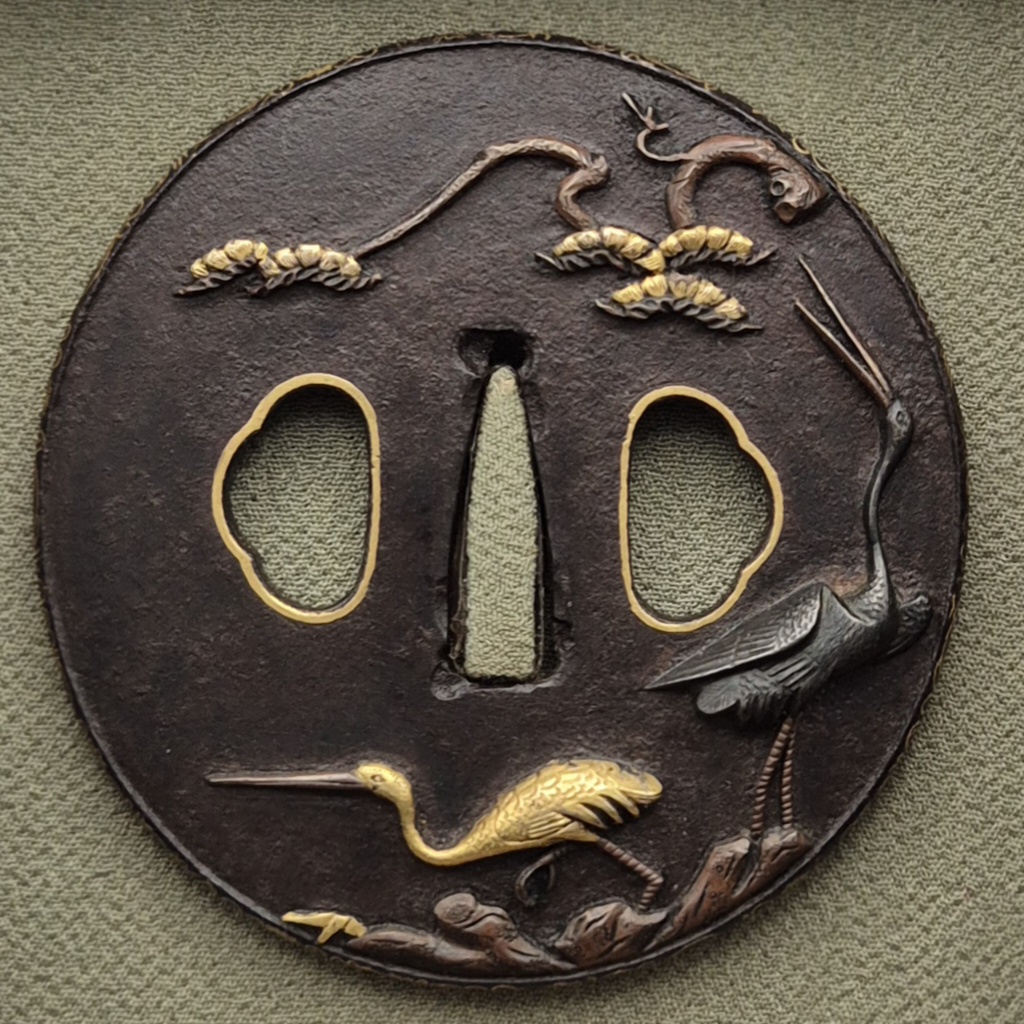
The iron plate is nearly empty. That is the first thing. In a tradition where makers frequently covered every available surface with engraving or texture, this tsuba leaves the ground largely open — a dark, fine field of worked iron from which three or four carefully placed elements emerge with the force that only generous spacing can give them. The cranes do not crowd each other. The pine does not overwhelm. Everything breathes. And then, at the rim, the gold begins.
Das Eisen und der Mimi
The ground is tetsu of real quality — dark, warm, worked to a surface that has developed across the Edo period into the kind of patina that resists easy description. Not simply black, not uniformly textured, but alive in the way that good iron becomes alive when it has been handled by people who understood it. The hitsu-ana on both sides are lined with gold, a refinement that announces the maker’s intentions before the eye reaches the composition: nothing here is incidental.
The mimi runs around the entire circumference of the plate decorated with fine gold inlay — continuous, disciplined, a band of worked precious metal that frames the composition and closes the world of the tsuba against the world outside it. Aizu Shoami works were made from iron and decorated with gold inlaying, and this piece demonstrates what that tradition could achieve at its most refined: the gold is not applied as ornament but as structural framing, giving the plate a boundary as deliberate as the composition it contains.
Die Kraniche
On the omote, two cranes. They are entirely different in character and in material. The larger bird stands on the right, rendered in deep shakudo with precise feather detail — dark, composed, its head raised. It occupies the lower right of the plate with the stillness of a creature that has decided where it is and has no intention of moving. The smaller crane, lower center-left, is gold, its body lower to the ground, its posture suggesting motion, either arriving or feeding. Between them, above, two pine branches extend in copper-brown with gold needle clusters, their gnarled forms sweeping across the upper field. A vine reaches further right toward the plate’s edge.
The crane, tsuru, is among the most auspicious animals in Japanese culture. The combination of crane and pine is a classic pairing in Japanese art, representing longevity and the endurance of refined life across time. The pine lives for centuries. The crane, in tradition, for a thousand years. To place them together on the instrument of a warrior’s daily life was to invoke a form of protection that had nothing to do with the sword’s edge: the protection of time itself, of endurance, of the long life that martial excellence was supposed to serve rather than shorten.
Two cranes, not one, introduces a further dimension: companionship, fidelity, the paired existence that the crane also symbolizes in Japanese culture. The gold crane and the dark crane on the same ground, different materials, different postures, one composition.
Die Rueckseite
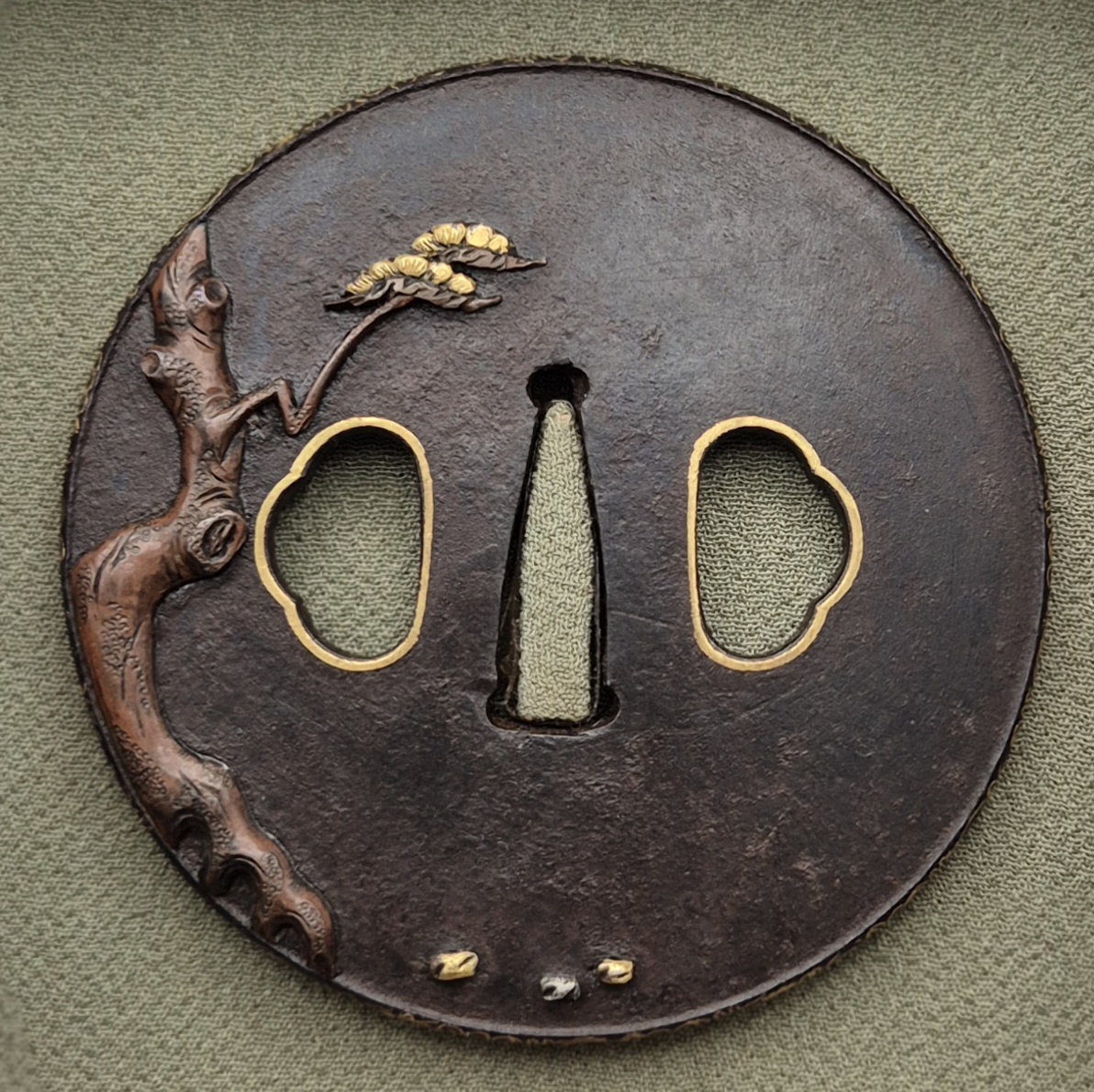
The ura reduces the composition to its essential element. A single pine tree, its trunk in copper-brown sweeping from lower left in a long arc upward, its bark textured with the deep, rough carving that this school brought to three-dimensional applied work. At the upper left, a small cluster of gold pine needles. At the lower center of the seppa-dai, three small gold elements. The ura does not explain the omote. It continues it, quieter, the pine alone now, the cranes gone, the world reduced to one long arc of endurance.
Die Aizu Shoami-Schule
The Shoami school is said to have prospered for about 500 years as one of the three major schools in the metalwork world, alongside the Goto and Umetada families, serving the Ashikaga shogunate. The Shoami school originated in Kyoto, and in various places and each era, there were many craftsmen who called themselves the Shoami school. The Akita Shoami, the Aizu Shoami, and the Iyo Shoami exceedingly prospered among this school.
Aizu Shoami was a group of people who were members of the Shoami school and did well in the Aizu area, Mutsu no Kuni, part of today’s Fukushima, Niigata and Tochigi prefectures. This area was famous for tsuba production, especially by Shoami school’s makers. Aizu itself was a significant domain — politically important through much of the Edo period, geographically positioned in the interior of Honshu, removed from both Edo and Kyoto and therefore developing its own regional character.
What distinguishes the better Aizu Shoami work is exactly what this tsuba demonstrates: the quality of the iron ground, the three-dimensionality of the applied inlay elements, and the compositional intelligence that knows when to leave space empty. The gold-lined hitsu-ana and the decorated mimi are signatures of the school’s approach to the whole object, not just its central image.
Tsuba with two Cranes
Tsuba. Aizu Shoami-Schule. Tetsu, iroe takazogan in kin, gin und do. Maru-gata, kin-zogan mimi. Tsuru ni matsu no zu. Edo-Zeit. NBTHK Hozon. Privatsammlung, erworben in Europa.