
Das Meer, das nie aufhört
Mumei (atomei, Goto) · Shibuichi · Ko-Kinko
Momoyama Periode
Ko-Kinko Tsuba with Waves
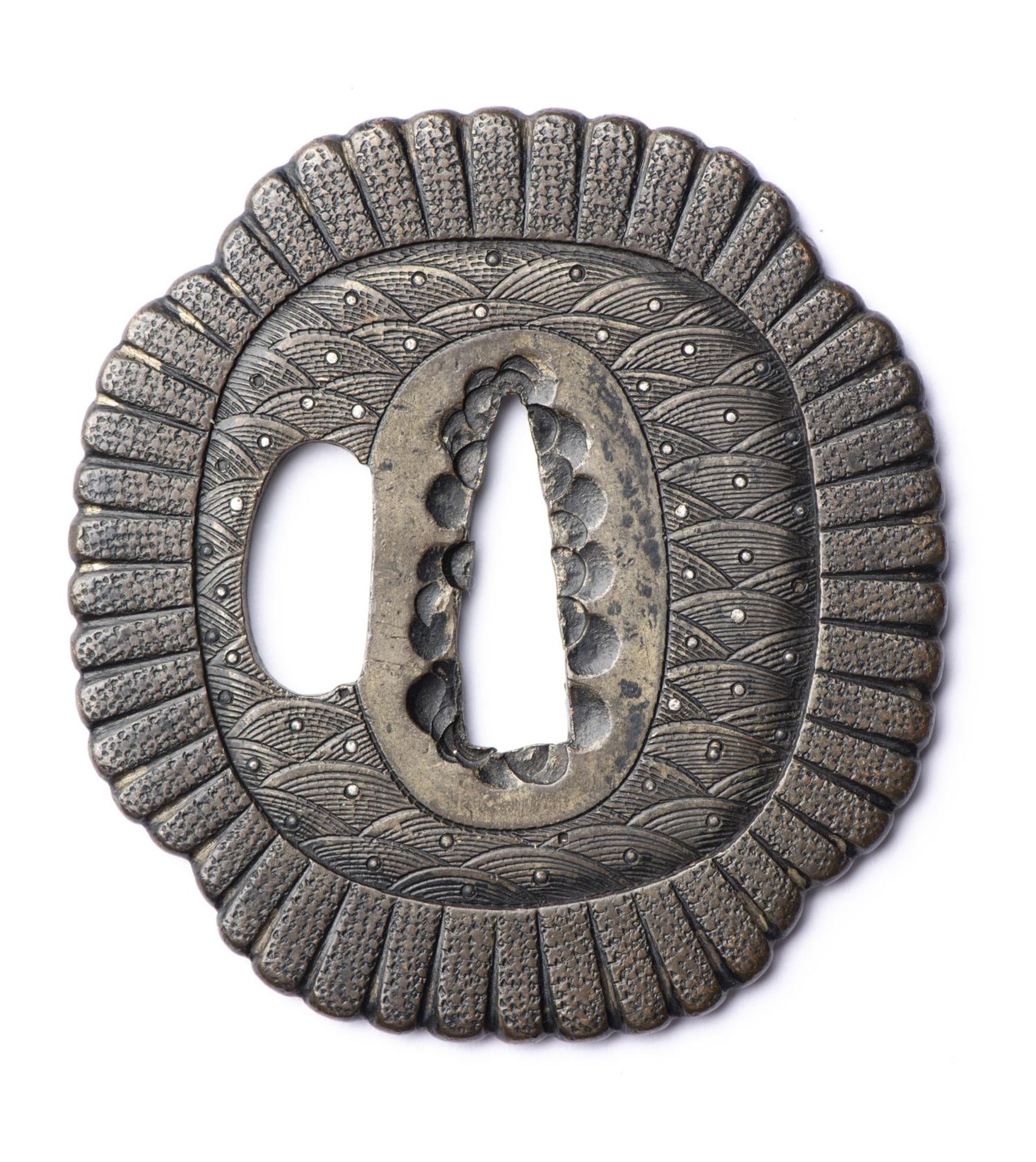
Before the subject, the rim. It stops you first. Each lobe of the chrysanthemum-petal mimi is individually worked — not cast and finished but formed with the kind of attention that makes each segment slightly distinct from its neighbor while the overall rhythm remains disciplined. There are perhaps thirty petals encircling the plate, each one textured with fine punch marks across its surface. In the hand it would feel like holding something that knows it has weight.
Inside this rim, the ground: seigaiha, the blue sea wave pattern, worked across the entire inner field of both faces. Each scale individually engraved with fine kebori lines defining the concentric arc, and at each crest a tiny inlaid dot — almost certainly silver — catching whatever light the room provides. Thousands of individual marks.
Das Seigaiha
The seigaiha pattern symbolizes a peaceful sea, quiet strength, and good fortune. The name is written 青海波: blue, ocean, wave. Its geometric regularity makes it calm, repeating, and endlessly expansive. Unlike the dramatic naturalistic waves of later schools, the seigaiha does not depict any particular moment in the sea’s behavior. It depicts the sea as a condition: permanent, rhythmic, beyond any single event that occurs on its surface. To cover an entire tsuba plate with this pattern, on both faces, leaving no ground unworked, was a statement about totality.
Das Objekt
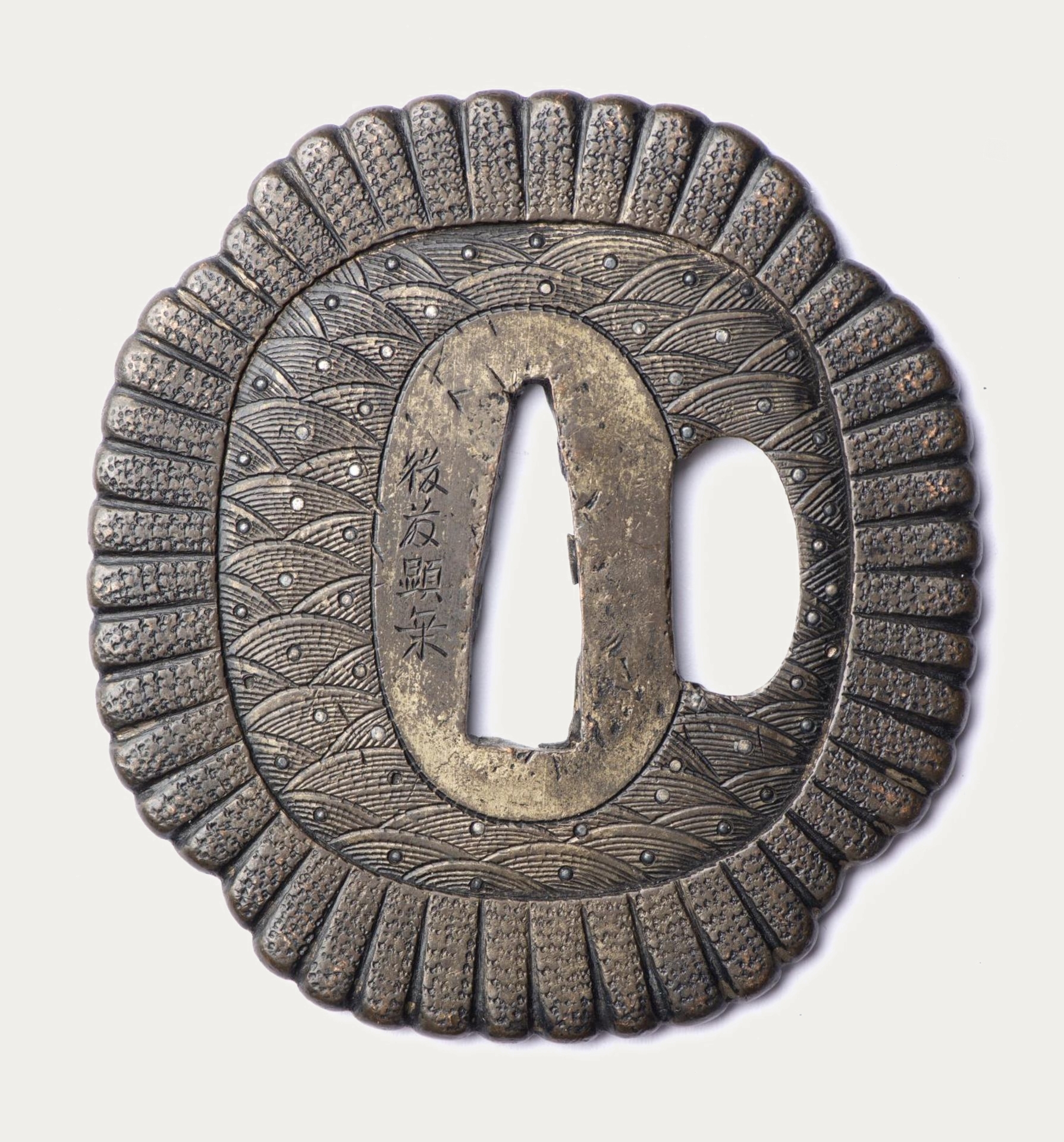
The material is shibuichi, worked to a surface that has deepened across centuries into the quiet grey that this alloy achieves at its best. The seppa-dai on the omote carries an engraved signature — the name of a Goto master. It is not authentic. The signature is a atomei, added at some point after the piece was made, almost certainly to elevate a perceived commercial or reputational value. This was not uncommon in the tosogu market, and it changes nothing about the quality of the object itself. The work on this tsuba does not require a Goto name to justify its existence. The ura presents something unusual at the nakago-ana: around the blade opening, what appears to be a low-relief carved cloud form frames the passage. The kikka-mimi required the maker to form each lobe separately and integrate them into a coherent outer edge that reinforces the plate structurally while functioning as a second layer of visual composition.
Eine Anmerkung zur Atomei
A false signature on an old piece tells two stories simultaneously: the story of the object itself, and the story of someone who, at some later point, decided the object needed more authority than it had. The irony is that the decision to add a prestigious name was usually made because the piece was already considered good enough to warrant it. No one adds a Goto signature to a mediocre tsuba. The seigaiha ground is executed with a precision that represents a serious investment of time and skill. The kikka-mimi is a structural and aesthetic achievement that most makers did not attempt. The silver dot inlays at the wave crests are still present after centuries of handling. The atomei can be noted, set aside, and the object can be met for what it is.
Ko-Kinko Tsuba
Tsuba. Mumei (Signatur atomei, Goto-Meister). Shibuichi, seigaiha kebori mit gin ten-zogan, kikka-mimi. Ko-Kinko. Momoyama Zeit. Privatsammlung, erworben in Europa.