
Die Blume und ihre Besucherin
Mumei · Tetsu · Amida-Yasuri · Edo-Zeit
Tiger Lily Tsuba with Wasp
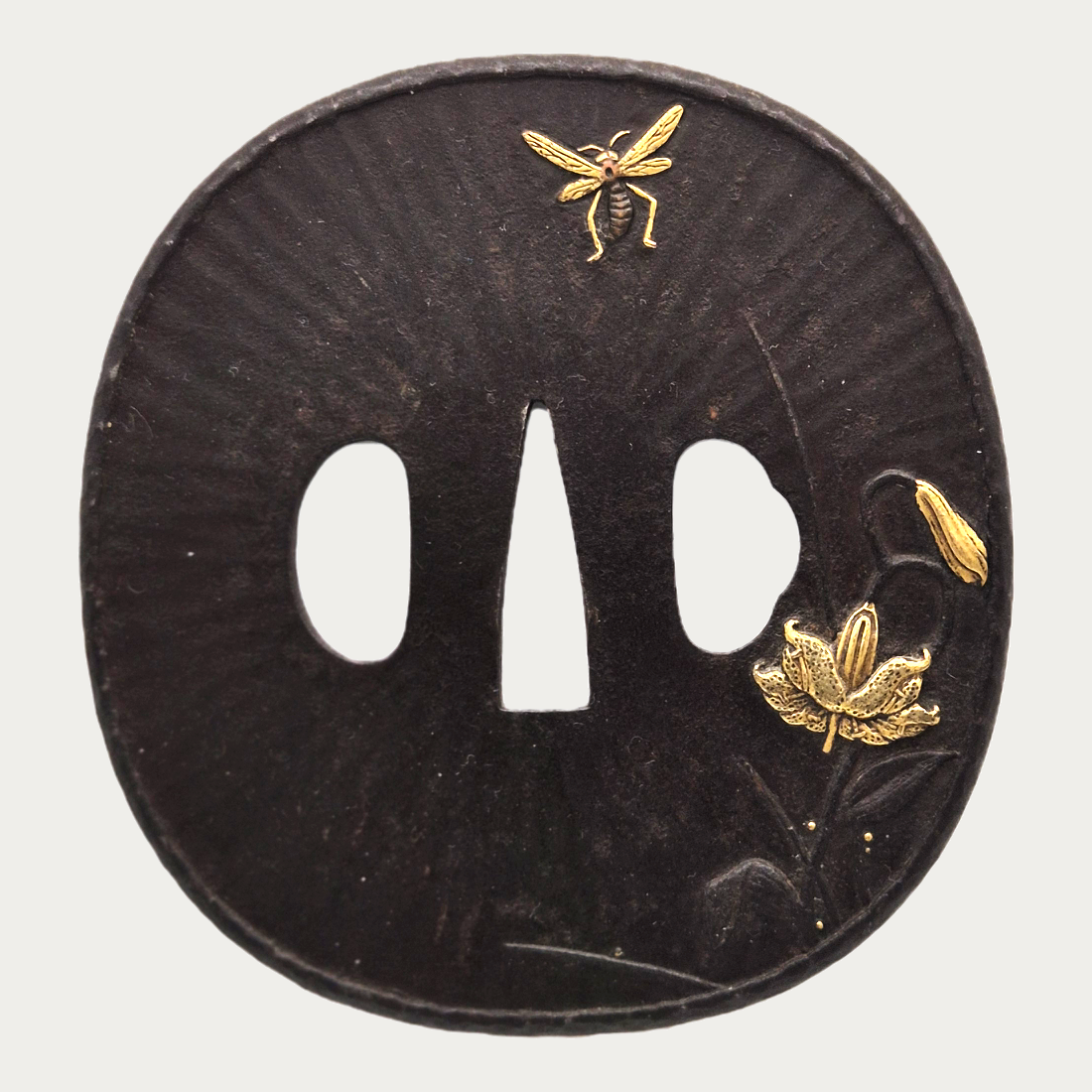
Thin lines are engraved with a file, radiating from the center of the tsuba. This design looks similar to the halo of Amida Nyorai, Amitabha Tathagata — it is the origin of this technique’s name: amida-yasuri. The halo of a Buddhist deity as the ground for a flower and a wasp. The contrast is so quiet it almost passes unnoticed: a surface invoking the infinite light of compassion, and on it, the most ordinary things in the natural world.
Das Material
The plate has a color that photographs struggle with: not the dark iron-black of tetsu at its densest, nor the yellow of sentoku, but a warm brownish-grey that suggests either yamagane — the natural copper-iron alloy — or an iron with specific surface treatment. Whatever the precise alloy, the color was chosen deliberately: the amida-yasuri lines catch light across this warm surface in a way that darker iron would not permit. The rim is uchikaeshi-mimi — the edge rolled and hammered, giving the plate a slight raised border.
Die Blumen und die Wespe
On the omote, a single flower occupies the lower left. A bell-shaped pendant bloom in gold — the individual petals rendered with precision suggesting a lily, possibly tiger lily or hototogisu — on a tall, slightly curved stem. The composition gives this single flower the entire plate as breathing room. On the ura, the scene gains a second element. A wasp — rendered in gold with copper-red accents on the body, its wings precise and individual — hovers in the upper center. Below and right, a second flower, more open, its petals fuller, its center more complex. A closed bud above on a trailing stem.

Sparsamkeit als Entscheidung
Both faces of this tsuba make the same choice: maximum restraint. One flower on the omote. One flower and one insect on the ura. The amida-yasuri ground covers everything else. This is not a tsuba that fills its space with incident. It trusts the ground itself to carry most of the weight, and places its three elements — lily, lily, wasp — with the precision of someone who knows that placement is a form of meaning. A wasp on the other side. The argument continues.

Wasp & Lily Tsuba
Tsuba. Mumei. Yamagane oder Tetsu, amida-yasuri, iroe zogan in kin. Maru-gata, uchikaeshi-mimi. Yuri to hachi no zu. Edo-Zeit. Privatsammlung, erworben in Europa.