On an electrical engineer from France, the collections he documented, and what happens when one person holds a field together.
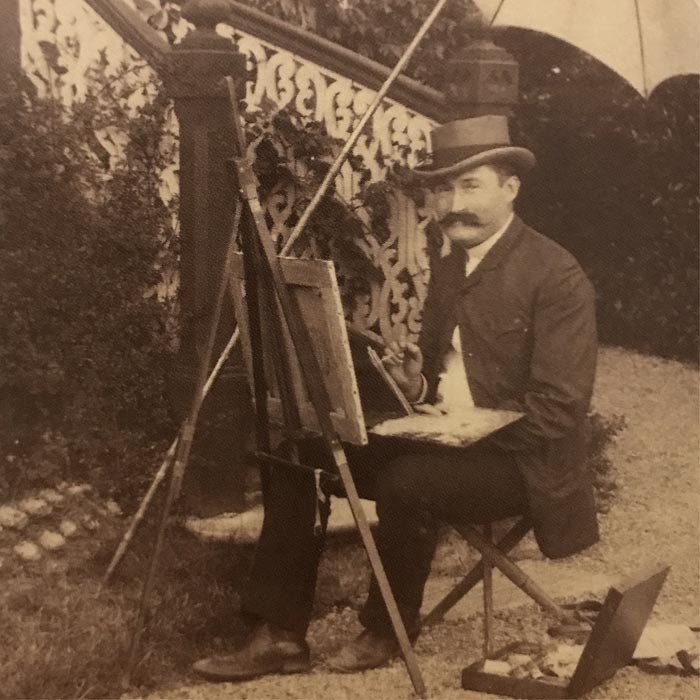
Henri Louis Joly was born in 1876 and died in 1920. He was an electrical engineer, with particular expertise in the development of batteries for electric vehicles. He lived in France in the first half of his life and in London in the latter half. He was a member of the Japan Society in London and the Société Franco-Japonaise in Paris. He photographed sword guards with his own camera and printed the plates himself using the collotype process. He translated classical Japanese texts into English. He compiled, between roughly 1908 and his death at 44, an output that no single scholar of Tosogu in any language had matched before him — and that most who came after him have not matched since.
Great Britain & Ireland
The biographical facts accumulate oddly. An electrical engineer who became the foremost European authority on Japanese sword fittings. A Frenchman who worked in London. A man without formal training in art history who produced what remain, a century later, indispensable reference works. His enthusiasm for the art of Japan was rooted in the metallurgy of the components of Japanese swords — which is to say, he came to the objects the same way Church did, through material rather than aesthetic interest. What the iron was, how it was worked, what the alloys revealed about period and school. This was an engineer’s entry point, and it gave him a precision that more conventionally trained art historians of his era rarely achieved.
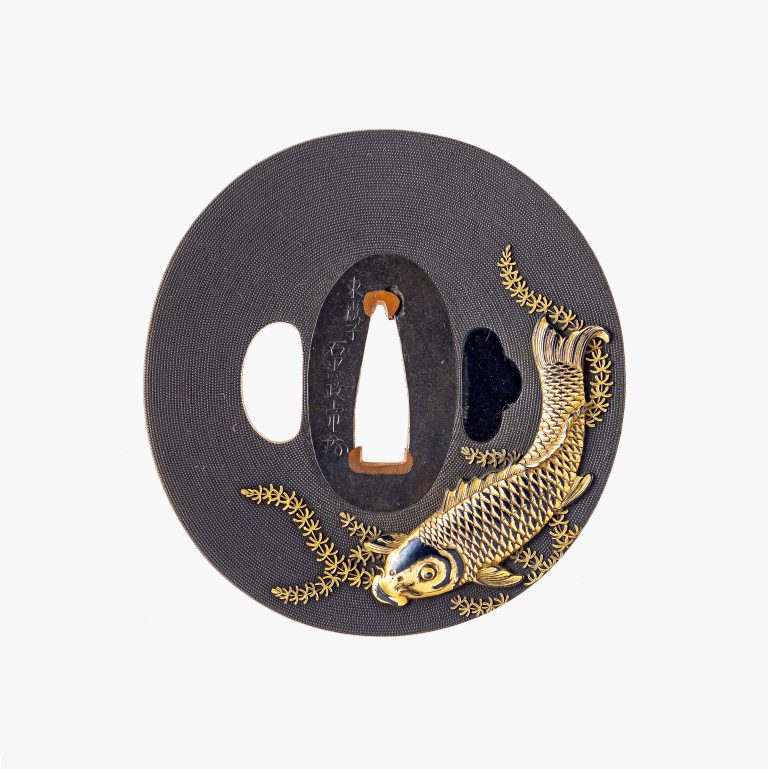
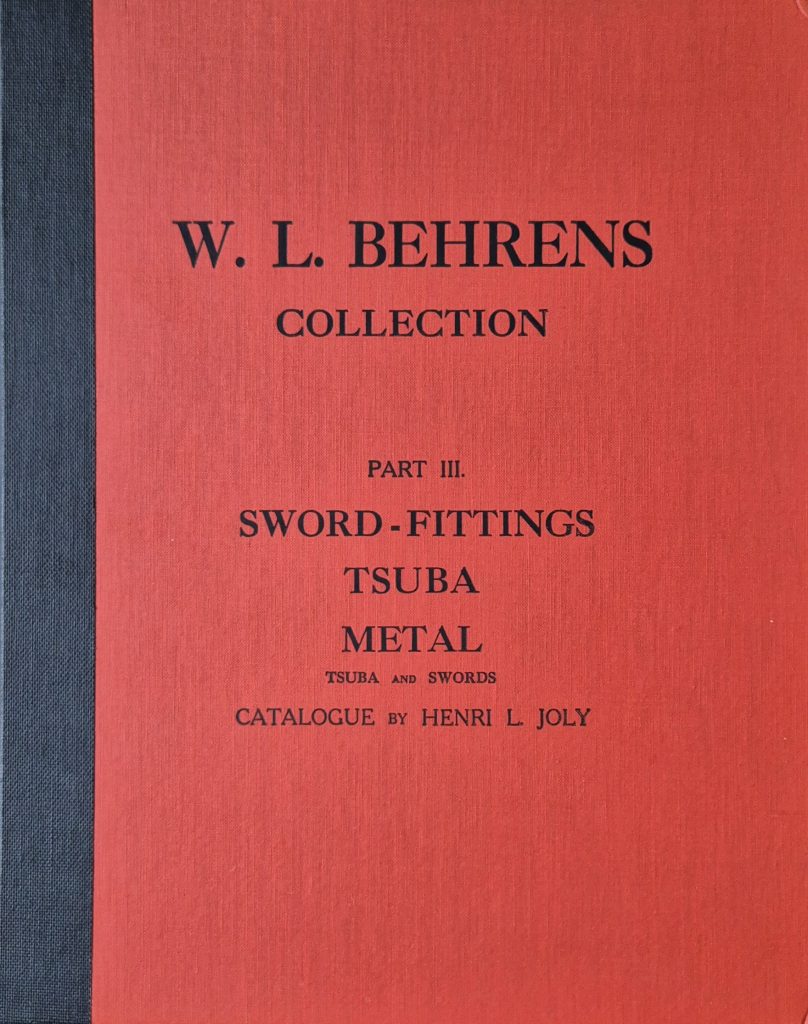
The catalogues came in quick succession in the decade before his death. Hawkshaw in 1910 — privately printed, limited to 300 numbered copies, illustrated with 50 collotype plates from Joly’s own photographs. Naunton in 1912 — 88 full-page collotype plates with descriptive tissue guards, depicting over 4,000 items including tsuba, kozuka, fuchi-kashira, and menuki. The Behrens collection in multiple parts from 1912 to 1914. Church’s collection catalogued in typescript, the published version appearing posthumously. A separate catalogue of a fine collection of tsuba in 1921, issued after his death.
Each catalogue was physically made as well as intellectually assembled: Joly photographed the objects, processed the plates, wrote the descriptions, compiled the indices of signatures in Japanese characters. The copyright on the Hawkshaw catalogue was held not by Hawkshaw but by Joly himself — Member of the Japan Society, London; Membre de la Société Franco-Japonaise, Paris. This is an unusual arrangement, and a telling one. The collections belonged to their owners; the knowledge embedded in the catalogues belonged to Joly.
Between the private catalogues, he produced the work for which he is most broadly known: Legend in Japanese Art, published in 1908. A detailed iconography — one of the first ever compiled on Japan, and still considered the best reference work — devoted to explanations of decorations on netsuke, inro, tsuba, and other sword furniture, sculpture, prints, illustrated books, and paintings. Illustrating pieces from the Behrens, Gilbertson, Hawkshaw, Naunton, and Victoria & Albert collections, among others. 700 illustrations. Sixteen colour plates. A Japanese character index. The book that made the iconographic vocabulary of Japanese decorative art legible to European collectors who could not read the primary sources.
Joly researched and wrote Legend in Japanese Art just a few decades after Japan had been opened to the Western world and collectors had begun to assemble sizable collections. Even so, the detail and care that he brought to cataloguing persons and creatures that appear in Japanese art remain unmatched by any subsequent scholar. This is a remarkable judgment to make of any work over a century old — and it reflects something real about what Joly accomplished. He did not simply translate or summarise Japanese sources. He synthesised them, cross-referenced them, tested them against the objects he had spent years examining, and produced a tool that collectors could actually use while looking at a tsuba in their hands.
What is striking, in retrospect, is how much depended on a single person. The British collectors of the Edwardian period — Gilbertson, Hawkshaw, Behrens, Naunton, Church — were significant figures individually. But the network they formed, the documentation that preserved their collections for subsequent scholarship, the English-language literature that made their holdings accessible beyond their own circles: almost all of it passed through Joly. He was the node through which the information flowed. He photographed the objects, wrote the descriptions, compiled the indices, published the catalogues, presented papers to the Japan Society, and produced the iconographic reference that tied it all together.
He died in 1920, at 44. Its mentioned in the Journal of the Royal Asiatic Society of Great Britain and Ireland that it was due “to long and painfull illness, bravely suffered”. What is recorded is the volume of work he left behind, and the gap his death created. No comparable figure emerged to replace him in the British field. The private catalogue tradition he had sustained — small editions, collotype plates, careful attributions, signature indices in Japanese characters — largely ended with him. The collections he had documented were gradually dispersed through the auction rooms. The knowledge he had accumulated in a decade of intense work remained, encoded in books that most collectors had never held, in editions of 100 or 300 copies.His real legacy is the enormous and still fundamentally useful Legend in Japanese Art — and his obituary is a compendium of those activities that typify Edwardian London’s scholarly world: the Japan Society Transactions, the Bulletin de la Société Franco-Japonaise de Paris. A world of learned amateurs, meeting in rented rooms, presenting papers to small audiences, corresponding across Europe about objects that most of their contemporaries considered curiosities. Joly was the most productive member of that world. He was also, in a sense, its instrument: the person through whom the objects became legible, the collections became records, and the field — briefly, in one city, in one decade — became something approaching a discipline.
Sources
- Joly, Henri L. Legend in Japanese Art. London: John Lane, 1908. — The primary work on which Joly’s reputation rests; widely available via reprint and online.
- Joly, Henri L., and J. C. Hawkshaw. Japanese Sword-Mounts: a Descriptive Catalogue of the Collection of J.C. Hawkshaw. London, 1910. — The primary example of Joly’s catalogue method; cited in the Metropolitan Museum bibliography.
- Toshidama Japanese Prints Gallery. “Japanese Prints, Henri Joly and the Amateur Scholars.” Blog post, 21 October 2016. (toshidama.wordpress.com) — The most accessible secondary source on Joly’s biography and significance.
- W. P. Y. “Henri Louis Joly.” Journal of the Royal Asiatic Society of Great Britain and Ireland, no. 4, 1920, pp. 669–71. JSTOR, http://www.jstor.org/stable/25209685. Accessed 18 Apr. 2026.