On a scientist who collected tsuba, and what his training taught him to see.
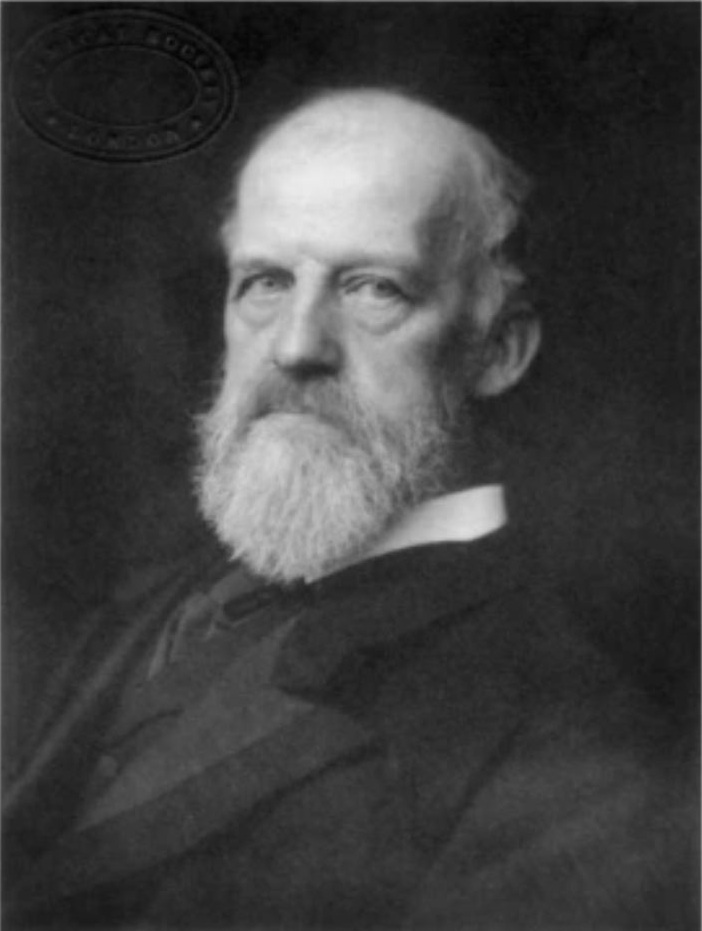
Sir Arthur Herbert Church Knight Commander of the Royal Victorian Order & Fellow of the Royal Society was born in 1834 and died in 1915: A British chemist, expert on pottery, stones, and the chemistry of paintings, who discovered the pigment turacin in 1869 and identified several minerals, including the only British cerium mineral. He was Professor of Chemistry at the Royal Academy of Arts for over thirty years. He wrote on food adulteration, on precious stones, on the chemistry of pigments used by the Old Masters. He was, in the most precise sense of the term, a man who understood what things were made of.
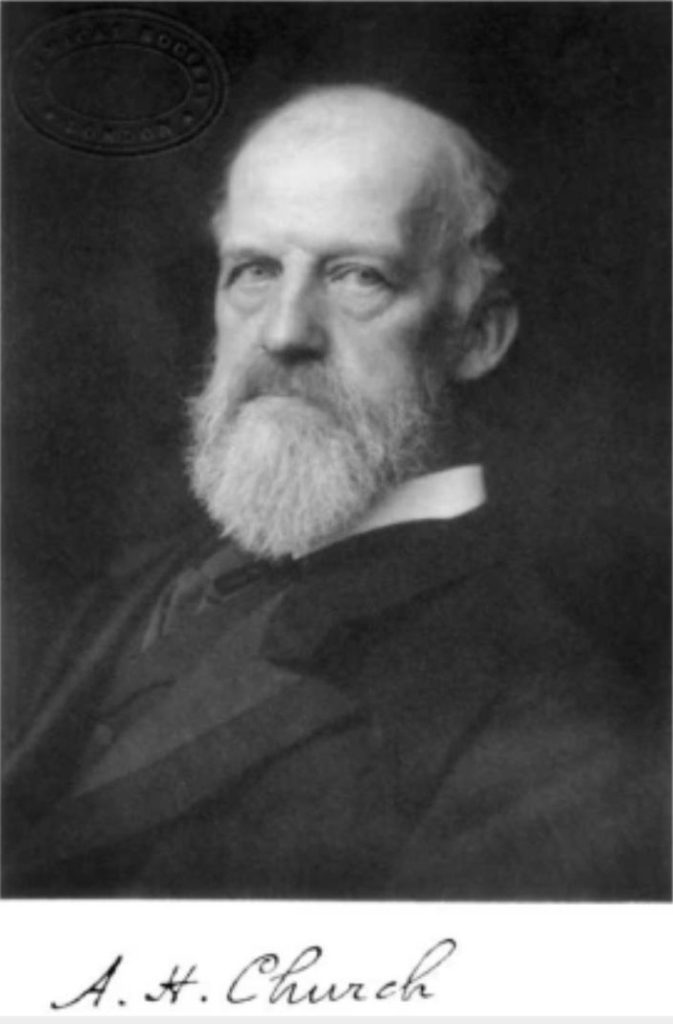
He was also an enthusiastic collector of objects of art of various kinds. His collection of faceted gemstones was presented to the trustees of the British Museum, his chemical apparatus and mineral specimens went to Oxford, and his private chemistry laboratory in the grounds of his house at Kew was where he pursued research that would shape the understanding of natural pigments for decades after his death.
And then there were the Tsuba
The pride of the Ashmolean’s early Japanese collection was the collection of sword-guards formed by the eminent scientist Sir Arthur Church, transferred from the Bodleian Library. It was, the museum’s own account notes, the finest British holding of its kind — and it had been built not by a connoisseur in the traditional sense, not by a Japanophile or a dealer’s client, but by a chemist who looked at iron and shakudō the way he looked at everything else: with the trained attention of someone who wanted to understand the material before he assessed the form.
The Ashmolean’s catalogue of the collection, produced in three volumes by Albert James Koop, records what Church’s predilections actually were — and they are revealing. In the matter of subjects depicted, his predilection was for the botanical or the purely conventional and geometric, as against the animal or human figure. Hence what the catalogue calls a “superfluity of material” in groups such as the Chōshū, Kinai, Akasaka, and Itō schools, and a corresponding shortage in others.
Botanical and geometric — the preference of a man who looked at structure, at pattern, at the underlying logic of a design rather than its narrative or pictorial content. A chemist who spent years studying the molecular composition of plant pigments, who catalogued the optical properties of precious stones, who examined the physical chemistry of fresco surfaces — such a man would naturally be drawn to tsuba that rewarded sustained formal attention. A flying crane is beautiful; a tsuba whose entire surface is organised around a geometric principle that reveals itself slowly, through close looking, is interesting in a different and perhaps deeper way.
The Cataloge & they way to Oxford
The catalogue of his collection was privately printed in 1914, limited to only 100 copies. Church was 80 years old. He had been collecting for decades, and he understood that what he had assembled was too important to leave undocumented. He gave a copy to Charles Francis Bell, first Keeper of the Fine Art Department at the Ashmolean — the institution to which he bequeathed the entire collection the following year, when he died at 81.
The collections that British collectors of this period formed were of variable quality. The best, including that of Sir Arthur Church, were catalogued by Henri Joly — though in Church’s case, Joly’s complete typescript catalogue of the collection remained unpublished, held by the museum’s own department. The published version was Church’s own, more selective — a final act of editorial judgement by a man who had spent his life making precisely that kind of distinction.
What Church represents in the British history of Tosogu collecting is a particular model: the scientist as collector. Not the wealthy amateur who accumulates because he can, not the aesthete who buys on feeling, not the scholar who builds a reference collection — but the trained observer for whom looking and thinking are the same activity. His chemistry gave him two things that most collectors lacked: a deep understanding of materials, and a habit of patient, systematic attention to the thing itself rather than its reputation.
He understood, as a chemist, that iron is not simply iron. That the quality of the metal, its treatment, its patina, the way it responds to light, are all data that bear on attribution and period. He understood that shakudō’s characteristic blue-black surface is the result of a specific chemical process, not an accident of time. He understood that what looked like a superficial difference in texture could be evidence of entirely different working methods.
He formed a comprehensive collection. He gave it to Oxford. It remains there; one of the finest holdings of Tosogu outside Japan, built by a man who spent his life understanding what things are made of, and who applied that understanding, at the end of a long career, to some of the most sophisticated metalwork the Edo period produced.
Sources
- Koop, Albert James. Unpublished catalogue of the A. H. Church collection of Japanese sword-guards. Ashmolean Museum, Oxford.
- Church, Arthur H. Japanese Sword Guards (Tsuba). Reading: Privately Printed, 1914. Limited to 100 copies. — The primary published catalogue of the collection; described in bookseller records.
- Ashmolean Museum / Jameel Centre. Collection entry for A. H. Church Collection. (jameelcentre.ashmolean.org) — The institution’s own description of the collection and Church’s predilections. https://jameelcentre.ashmolean.org/collection/7/10237