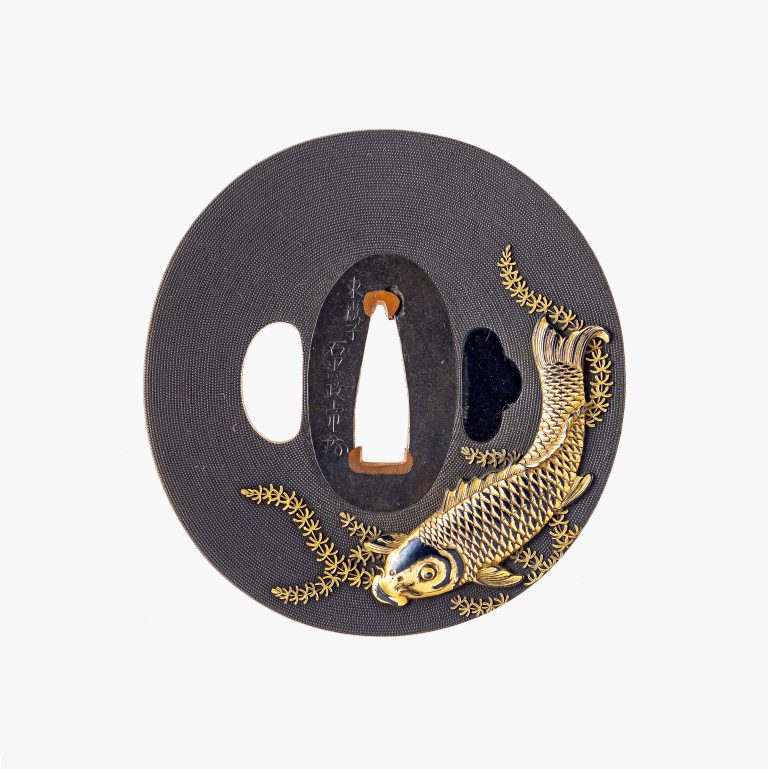
On a Parisian jeweler, a table full of connoisseurs, the Art of Seeing Twice, and the collection that went around the world.
“Henri Vever was, by all accounts, the most passionate of them all.”
The phrase comes from Edmond de Goncourt, who wrote it in his diary in 1893, describing Vever at a dinner of the Amis de l’Art Japonais — the monthly gatherings organised by Siegfried Bing at which the core of Parisian Japonisme met to eat, argue, and pass objects around a table. Among the fervent collectors of Japanese art in fin-de-siècle France, active from approximately 1880 to 1900, Vever figures as one of the most prominent members of a second wave of Parisian enthusiasts — well-connected to networks of dealers, museum officials, publications, and sites of sociability such as the dîners japonais. Goncourt noted him purchasing his ticket for the steamer to Chicago, intending to surprise Hayashi Tadamasa at the World’s Columbian Exposition and secure the finest Japanese prints before anyone else could get to them. The image is precise: a man leaving his jewellery shop on the Rue de la Paix, boarding a transatlantic steamer, arriving in Chicago specifically to be first at the crates.
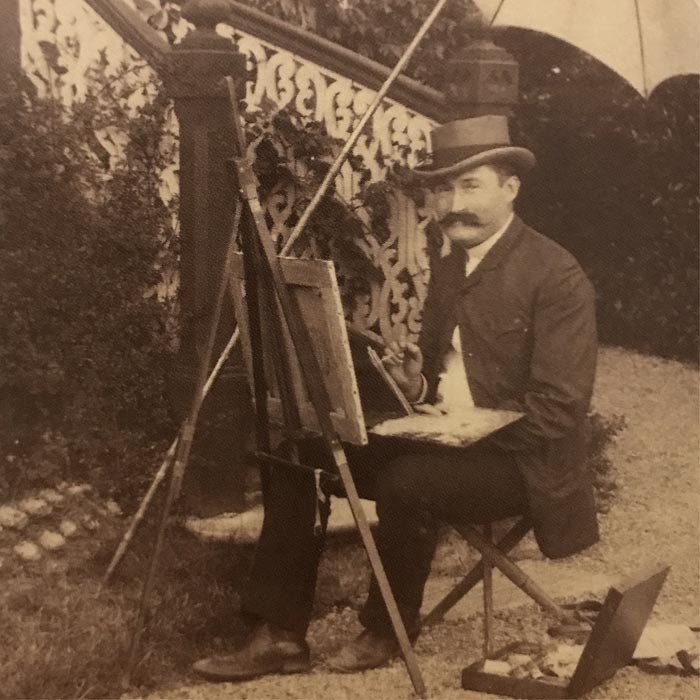
Henri Vever was born in 1854 in Metz and died in 1942. He was one of the most preeminent European jewelers of the early twentieth century, operating the family business Maison Vever, whose designs were renowned for their innovative use of enamel and gemstones drawing significant influence from Japanese art. The connection between the two sides of his life — jeweler & collector — was not coincidental. It was structural. A man who spent his days designing objects in which enamel, metal, and precious stones were combined with absolute precision was constitutionally equipped to understand what made a Goto kozuka exceptional, or why the surface treatment of a particular iron tsuba revealed the hand of a master rather than a workshop.
It was through the art printer Charles Gillot that Vever was probably introduced to other objects of interest beyond prints: sabre guards (tsuba), vases, bronzes, lacquered objects, fans, and textiles. In the workshop on the Rue La Boétie and later in the Chaussée d’Antin, the décor was conceived as a showcase for the Japanese and Islamic collections — a veritable place of sociability, where Vever entertained friends surrounded by netsuke, pottery, bronzes, screens, and Japanese prints. His workshops were not simply places of production. They were rooms arranged for looking, designed to show what he understood about the objects he had accumulated.
Amis de l’Art Japonais
The network he moved through was the most concentrated group of Japanese art knowledge in Europe at the time. At the monthly dinners of the Amis de l’Art Japonais, Vever met fervent Japanese collectors — Charles Gillot, Hayashi Tadamasa, Michel Manzi, Gaston Migeon, Raymond Koechlin, Raphaël Collin, and Camille Groult — who gathered at the Café Riche, the Café Cardinal, or at Véfour’s. These were not casual social occasions. They were the primary mechanism through which expertise was transmitted, objects were evaluated, and the standards of the field were established in France. To be invited was to be admitted into a circle where the difference between a fine Hamano kozuka and a competent imitation was a matter of common discussion.
Forty-nine letters from Vever to Hayashi Tadamasa and his brother Hagiwara, written between 1893 and 1906, reveal the special relations between the two men. Vever, who held an account with Hayashi, asked to be the first to see his discoveries. This was not merely a commercial arrangement. It was an epistemic one: Vever understood that access to the best objects, before the market had seen them, was what separated the serious collection from the merely good one.
L’ Exposition Universelle, Paris
The Exposition Universelle of 1900 was the summit of this world. With Hayashi Tadamasa as commissaire général, the Japanese pavilion presented an unprecedented retrospective — 800 ancient artworks; Offering the Western public a more authentic vision of Japanese artistic production than the decorative exports that had previously dominated European collections. Vever was there, of course — as a jeweler exhibiting under his own name and winning the Grand Prix, and as a collector watching the moment when the field he had helped build was confirmed by the most public possible occasion.
Then came the war. And one of the strangest transactions in the history of collecting. Around 1916, Matsukata Kojirō acquired from Vever some 8,000 Japanese woodblock prints, which he purchased sight-unseen based entirely on the collection’s reputation. These prints would eventually find their way to the Tokyo National Museum, forming a significant part of that institution’s ukiyo-e holdings. The scale of the transaction is almost impossible to absorb: a collection assembled over thirty years of intense personal engagement, sold to a man who had not seen a single piece, repatriated to the country of origin, and installed in a national museum. The objects went home. The collector remained in Paris.
He kept the best for himself. Although many of the masterpieces made their way back to Japan via Matsukata, Vever had kept some of his finest prints and continued to collect after the First World War, acquiring pieces from former rivals Gonse, Haviland, Manzi, and Javal as their collections went to the auction houses of Paris. He stopped collecting in the 1930s, and his legendary collection disappeared during World War II and the German occupation of France, not to reappear until 1974 when Sotheby’s announced it would be auctioned.
Sotheby & Co., New York City
The dispersal took four parts, each in London. The final portion, around 200 of the finest pieces he had kept back even from the 1974 sale, did not appear until 1997. Between those two dates, scholars had continued to study pieces whose location was essentially unknown. The Vever collection had become a ghost that was both everywhere in the literature and nowhere physically accessible.
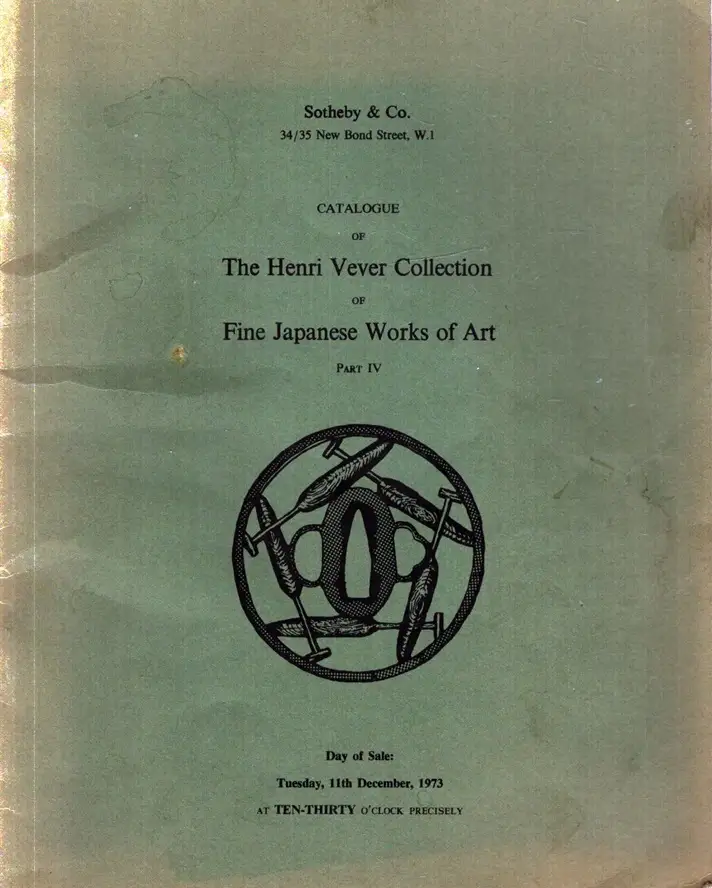
The tsuba and kodogu in his holdings followed a different trajectory. A portion of his Japanese sword fittings — including tsuba, kozuka, fuchi-kashira, and kojiri from most of the major schools — appeared at Sotheby Parke Bernet in New York as Part IV of the Henri Vever collection sale in 1973. These were the objects that had lived in his workshops alongside the prints, the bronzes, the lacquer. Part of the same sustained act of looking that defined his engagement with Japanese art. A tsuba from the Vever collection carries, in its provenance, not just the record of one man’s taste but the accumulated intelligence of the most serious Japonisme network in Europe.
What Vever offers the contemporary collector, and what makes him different from the German and British figures in this series, is the dimension of professional expertise applied to collecting. Oeder was a painter who learned to see differently. Church was a scientist who read materials. Joly was an engineer who built documentation systems. Vever was a craftsman at the highest level. A man who understood, from daily practice, what it meant to work precious materials with precision, to subordinate technique to vision, to make objects that would be looked at long after the maker was gone.
That understanding shaped what he bought and how he looked at it. That the objects he collected were genuine there was no doubt, as they bore the seal of Henri Vever: A small red mark that became, in the field, a reliable indicator of quality and authenticity. It is one of the few cases in the history of European collecting where a provenance mark functions as something close to a certificate: not merely a record of ownership, but a judgment.
He died in 1942, in occupied Paris, at 88. The collection he had spent sixty years assembling disappeared into the war and did not emerge for another thirty years. When it did, the field recognised it immediately. Not because it had been catalogued or announced, but because the objects themselves, with their red seals and their exceptional quality, were unmistakable. A collection that had gone around the world, in fragments and in whole, and survived.
Sources
- Wikipedia contributors. “Henri Vever.” Wikipedia, the Free Encyclopedia. (en.wikipedia.org/wiki/Henri_Vever)
- Sotheby’s dates, and collection history. Sotheby & Co. Catalogue of Highly Important Japanese Prints, Illustrated Books and Drawings from the Henri Vever Collection. Parts I–IV. London: Sotheby’s, 1974–1997. — The primary auction documentation of the collection’s dispersal.
- National Museum of Western Art, Tokyo. “Matsukata Collection.” (nmwa.go.jp/en/about/matsukata.html)