On a German Cavalry Officer, a Midnight Party in Berlin and the most resilient collection of them all.
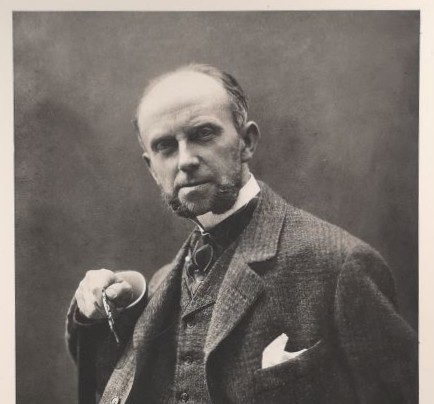
There is something almost implausible about Felix Tikotin’s story. Not because it is exceptional, but because it is too complete. A life that begins with a few Japanese woodblock prints purchased for ten Pfennig apiece at a Dresden exhibition, and ends, ninety-two years later, with a museum bearing his name on a mountainside in Israel: this is not the trajectory of a collector so much as a vocation followed to its furthest conclusion.
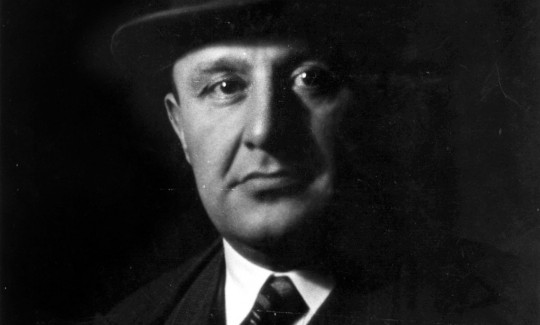
He was born in 1893 in Glogau, Silesia, and grew up in Dresden, where he came into contact with the artists of Die Brücke and developed an early instinct for what others had not yet learned to see. His parents steered him toward architecture: a respectable compromise between art and profession. But the collecting impulse was never really suppressed. At the International Hygiene Exhibition of 1911, he encountered Japanese woodcuts for the first time. When the exhibition closed, he purchased as many as he could afford, at ten Pfennigs each. The price is worth noting. What he recognized in those prints, others had not yet thought to want.
After the First World War — in which he served as a cavalry officer of the Kaiser — he abandoned architecture and committed himself entirely to Japanese art. This was not a casual decision. The Weimar years were a moment of genuine openness to Asian culture in Germany, and Tikotin moved at the center of it. In Berlin, he rented a large gallery space on the Kurfürstendamm. In April 1927, at midnight, he opened with an exhibition of Japanese ghost prints — a deliberately theatrical gesture entirely in keeping with the spirit of that city at that moment.The choice of subject was characteristic: not the obvious and decorative face of Japanese art, but something stranger, more psychologically demanding.
What distinguished Tikotin from many of his contemporaries was the seriousness of his engagement. He did not collect from a distance. He traveled to Japan on the Trans-Siberian Railway with the Japanologist Fritz Rumpf, and returned with a deepened understanding that transformed him from an enthusiastic amateur into a professional of genuine standing. He made the journey repeatedly. He built relationships in Japan that lasted decades. His collection, over time, came to reflect not a tourist’s eye but an informed one — attentive to quality, resistant to fashion.
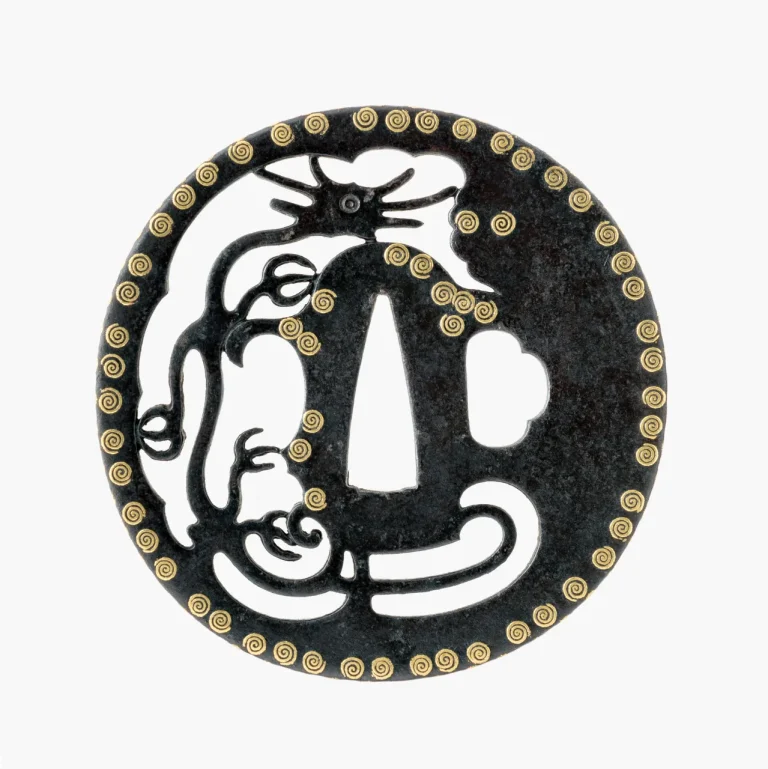
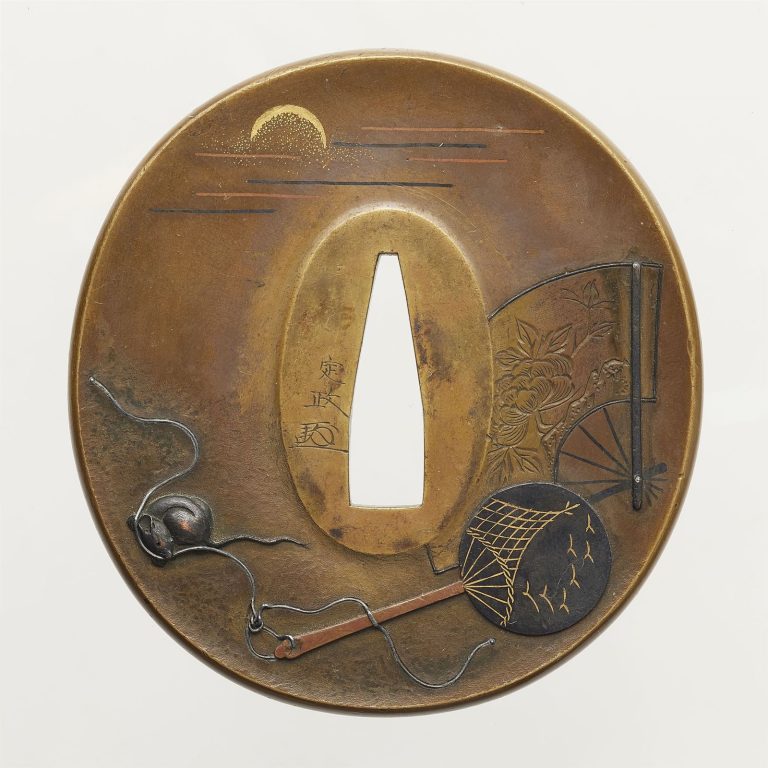
The collection he built was broad. It included paintings, prints, lacquerwork, netsuke, ceramics, textiles — and metalwork. Among the more than four thousand pieces Tikotin personally acquired, the holdings included antique swords and functional art works, primarily from the seventeenth through nineteenth centuries. Tosogu would have been part of this world — not as isolated curiosities, but as elements of a coherent material culture that he had come to understand through sustained, direct study. For a collector of his formation, the sword fittings of the Edo period were inseparable from the broader artistic conversation he was following: the same schools, the same patrons, the same aesthetics of restraint and allusion that shaped the prints and the lacquer and the painted screens.
Then the world he had built was taken apart
In 1933, sensing what was coming, Tikotin arranged for his collection to travel to an exhibition in Copenhagen. On the night he crossed into Denmark, the Reichstag burned. A Danish friend intervened, rerouting the collection to Holland rather than back to Germany. The few remaining pieces in Berlin were smuggled out afterward, declared as samples of no commercial value. It is difficult to fully register what this moment meant — a life’s work preserved by the speed of a decision made in someone else’s name, on a night when everything was changing.
In Holland, the collection survived the occupation hidden by neighbors. Then it was stolen. Five years after the war, Dutch police pursuing art smugglers called Tikotin in as an expert. To his amazement, he recognized the pieces as his own. The collection had been recovered twice — once by a friend’s presence of mind in Copenhagen, once by a fortunate coincidence on the Dutch border. Tikotin himself drew a kind of meaning from this. A collection that had survived so much, he concluded, deserved to survive further — and to be seen.
In 1956, on his first visit to Israel, he decided the collection belonged there. He engaged museum directors, academics, and cultural figures across Europe and Japan to build the institution he had in mind. In 1959, together with Haifa’s mayor Abba Hushi, he established what would become the only Japanese art museum in the Middle East. The building was designed in a Japanese spirit, with shōji screens and a garden. A Japanese professor was brought in as first director. Nobody in Israel knew anything about Japanese art.That was, in a sense, precisely the point.
What Tikotin represents in the lineage of European collectors is something specific and worth attending to: the possibility that deep engagement with Japanese art could survive displacement, loss, persecution — that it was not contingent on a stable bourgeois life in a particular city, but was something more durable and portable than that. He collected through two world wars, through exile, through theft, through the long uncertainty of postwar Europe. And at the end of it, he did not sell the collection or disperse it. He gave it an address.
The Tikotin Museum still stands on Mount Carmel. In 2000, it received the Japan Foundation Special Award, recognizing its contribution to cultural exchange between the two nations.The collection numbers some eight thousand pieces today. Among them, in the quiet of the metalwork cases, the sword fittings that Tikotin once handled — small objects, carefully chosen — continue their patient existence, indifferent to the improbability of how they came to be there.
Felix Tikotin is one of a handful of European collectors whose engagement with Japanese art extended across a full biographical arc — from early enthusiasm to institutional legacy. His collection, now housed at the Tikotin Museum of Japanese Art in Haifa, remains among the most significant outside Japan.
Sources
- Tikotin Museum of Japanese Art. Official History. (tmja.org.il/eng/The_Museum) — The museum’s own account of its founding.
- Borensztajn, Jaron (dir.). Tikotin — A Life Devoted to Japanese Art. Documentary, screened at Haifa International Film Festival, 2014. — Grandson’s documentary, reviewed in the Times of Israel
- American Friends of Museums in Israel. “Tikotin Museum of Japanese Art.” (museumsinisrael.org)
- lana Drukker-Tikotin – History of the Tikotin Museum of Japanese Art and the Tikotin Collection, first published in full in 2018
- Haifa Museums