On a German painter, a seven-year stay in Tokyo, and what remains when objects disappear,
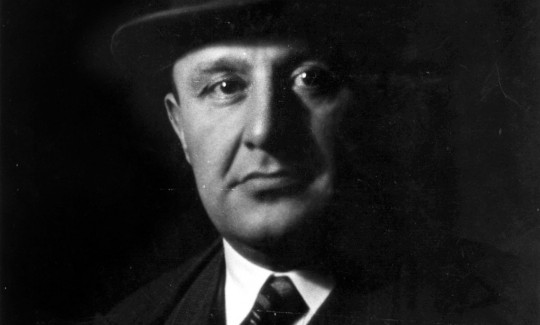
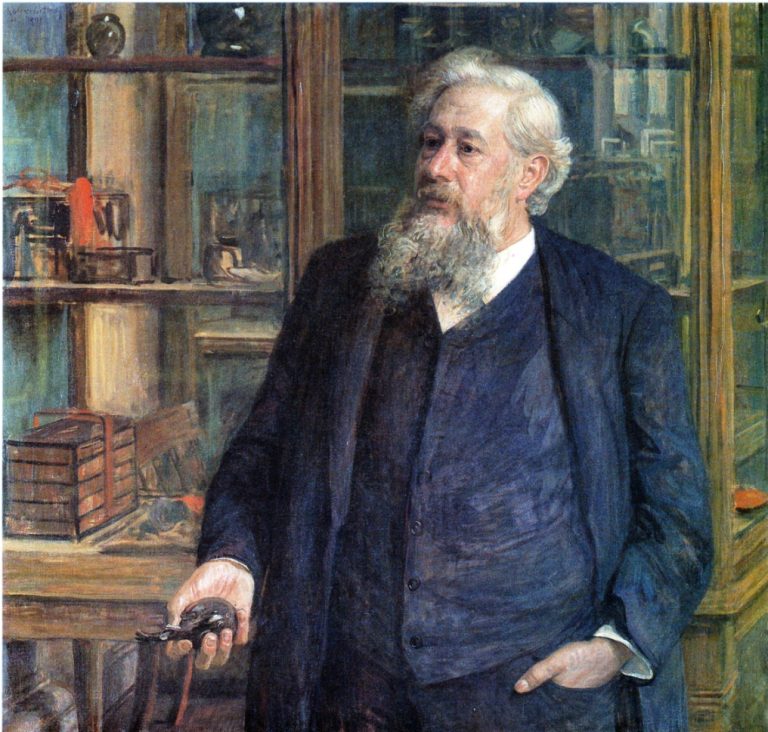
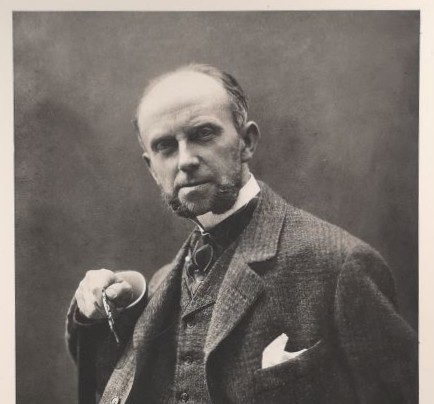
In the mid-1890s, a head condition forced Georg Oeder to give up landscape painting. He was 47 years old. Shortly before, he had been awarded the title of professor. A career built over decades — plein air studies in the Westphalian countryside, a studio in Düsseldorf, recognition from the Kunstakademie — came to an abrupt end not through failure, but through the body’s refusal to cooperate.
What followed was a second life, conducted largely in Japan
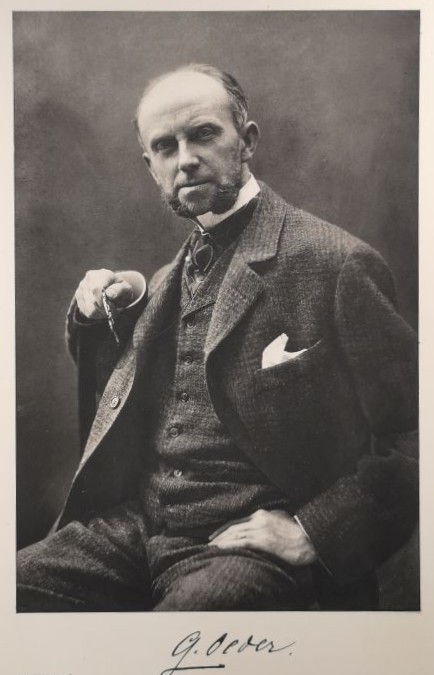
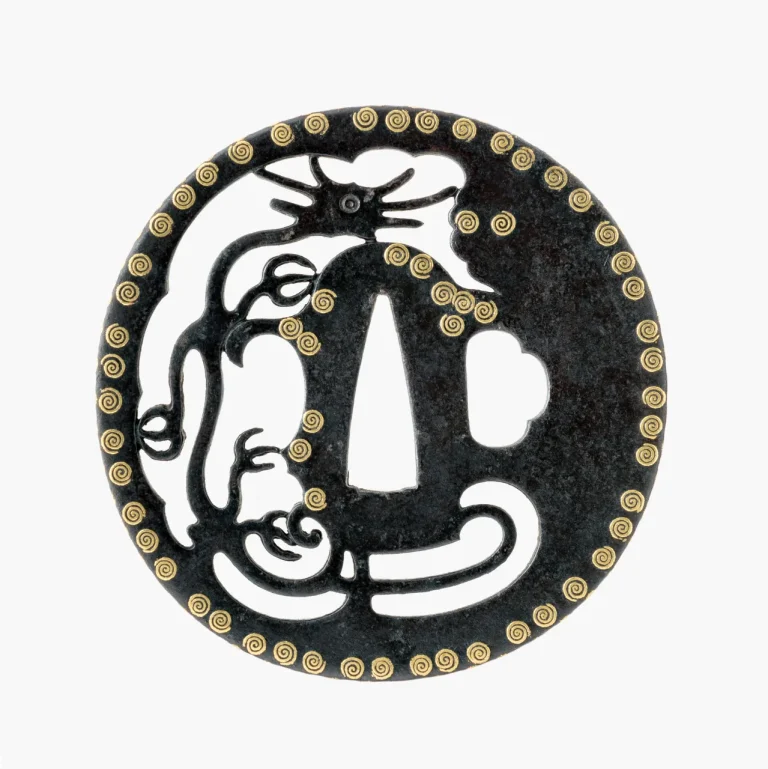
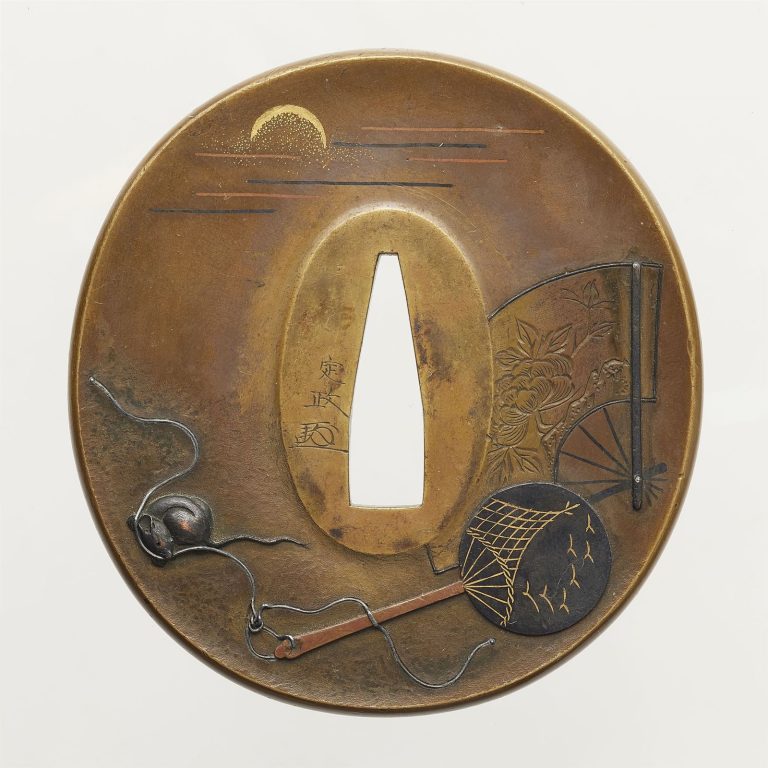
Oeder amassed his tsuba, as well as other examples of Japanese sword mountings, during a seven-year stay in Tokyo. He had come not as a diplomat or a merchant, but as something harder to categorise: a trained observer, accustomed to looking with precision, suddenly freed from the object of that precision. The eye that had spent thirty years reading light on Westphalian meadows now turned to iron, shakudō, and the compressed world of the sword guard.
He was not alone in this turn. The 1890s were a moment of intense European fascination with Japanese craft objects. After the Meiji-era banning of wearing swords in public, artisans had found a new market among newly arriving Western traders and travellers, fascinated by the legend of the samurai. But Oeder was doing something different from the tourist who buys a lacquered souvenir. He was building a scholarly collection, deliberately and with critical rigour.
There, with the help of Wada Tunashiro and Akiyama Kysaka, he — in his own words — “purged the collection of counterfeits, eliminated excesses, and not infrequently obtained missing items.” The phrasing is telling. This is not the language of accumulation, but of curation. Of someone who understood that the value of a collection lies not in its size but in its coherence. Oeder was one of the first European collectors to approach Tosogu with the methodology of a connoisseur rather than the appetite of an enthusiast.
The Oeder Collection
He returned to Düsseldorf with what had become, by any measure, an extraordinary holding. His collection was not kept private: his Palais on the Jacobistraße, built in the early 1870s next to the artists’ club Malkasten, functioned as a semi-public gallery. Rainer Maria Rilke visited in 1904 and described a day spent immersed in prints by Utamaro, Kiyonaga, and Hokusai. Oeder exhibited his Japanese collection at the Museum of Applied Arts in Cologne and the Kunstgewerbemuseum in Dresden. In 1902, it was shown at the Deutsch-Nationale Kunstausstellung in Düsseldorf, where it occupied a small cabinet — dense with prints and masks, an island of intimacy amid the pompous official rooms of German painting.
His influence extended into applied art. For his collection of tsuba and ceramics, Oeder designed his own display cabinets — using Xylektypon wood with floral relief decoration in the form of dandelions, a Rhineland motif drawn from the same unspectacular meadows he had once painted. Justus Brinckmann adopted these cabinets for the Museum für Kunst und Gewerbe Hamburg, noting in the 1909 annual report that they “offered a welcome model.” The collection shaped not just taste but form.
The catalogue came in 1916. Edited by Paul Vautier and prefaced by Otto Kümmel, Japanische Stichblätter und Schwertzieraten documented nearly 1,798 Japanese sword ornaments, with information on material, period, motif, region of origin, and maker. The original catalogue is now one of the hardest to find in the field: a rarity that reflects not only its age, but the catastrophe that followed.
What remains & where
The story of what happened next has long been treated as a mystery. It is not. It is something considerably more unsettling than a mystery: it is a documented fact with no resolution in sight.
After Oeder’s death in 1931, the collection passed in part to his son Hans-Georg, who donated the tsuba (around 2,000 objects) to the Museum für Ostasiatische Kunst in Berlin, out of friendship with its director Otto Kümmel. When war came, the museum moved to secure its holdings. Around 90% of the collection was stored in the Flakturm at the Berlin Zoo, and survived the bombing undamaged. But in the final days before the Western Allies arrived, Soviet forces removed everything from the tower. The convoy moved east, first to Karlshorst in the Soviet sector, then further. Among the objects taken: 216 Nō masks, all the large paintings and folding screens, the entire sculptural collection. And over 3,000 sword fittings from the Jacoby and Oeder collections combined.
The tsuba are not lost. They are in St. Petersburg, in the treasury storerooms of the Hermitage. All 1,798 of them, still in the cabinets that Oeder himself designed, the same dandelion-carved cases that Brinckmann had once admired in Düsseldorf. A researcher who visited the depot was shown the collection but forbidden to photograph it. The unique Chinese bronze ritual vessel from the Oeder collection (a zun in the form of a tapir, donated separately in 1943) was present but could not be examined.
In 1990, a German-Soviet treaty established the first framework for the restitution of cultural property. In early 1993, negotiations began in Dresden. They led nowhere. Today, all talks are frozen. A presentation by Anna Pushakova of the State Museum for Oriental Art at a Berlin provenance workshop in 2018 made the position clear: the objects from the Museum für Ostasiatische Kunst and from the Oeder collection may not be exhibited in Germany. A return to Germany is, in the assessment of those who know the situation, virtually excluded.
This is, in a way, the most precisely European of fates for a collection of Japanese objects. The tsuba themselves were made to endure: Iron and shakudō, alloys designed for centuries of use. They have endured. It is not the objects that are fragile but the political and institutional framework around them: a framework that has now been frozen for more than three decades, while the cabinets sit in a depot that no camera may enter.
The catalogue and the question it leaves
What Oeder’s story offers the contemporary European collector is not just historical interest, but a mirror. The questions he faced: How to read objects outside their original context, how to verify authenticity without proximity to Japanese expertise, how to build coherence from accumulation. These are the same questions the field still asks. His answers, preserved in a catalogue that most people in the field have never held, remain among the most serious European attempts to address them.
There is a 2011 facsimile edition, and a 2017 partial reprint and translation that focuses only on the illustrated tsuba. These are the versions most readers will encounter today. They are useful, but something is lost in the reproduction, as it always is. The original catalogue, with its particular weight and its period typography, was itself an object made with care. Reading it, one is close not just to the collection, but to the mind that assembled it: a painter who could no longer paint, looking very carefully at things made by hands as precise as his own had once been.
The objects he looked at most carefully are now in a locked room in St. Petersburg, in cabinets he designed himself, in a collection that cannot be photographed, cannot be shown, and cannot be returned. The catalogue remains the most accessible form of the collection. It was always meant as documentation. It has become, through no intention of its own, the only available version of something that still exists — somewhere, intact, just beyond reach.
Sources
- Vautier, Paul (authored); Kümmel, Otto (ed.). Japanische Stichblätter und Schwertzieraten. Sammlung Georg Oeder, Düsseldorf. Berlin: Oesterheld & Co., 1916. — The primary source; digitised by the Boston Public Library and available via Internet Archive.
- Delank, Claudia. “Georg Oeder (1846–1931), einer der ersten Sammler japanischer Kunst in Deutschland. Einfluss und Schicksal seiner Sammlung und das Junge Rheinland.” In: Das Junge Rheinland. De Gruyter/Gerda Henkel Stiftung, 2021, pp. 148–165. — The most substantial recent scholarly treatment of Oeder’s collecting history.
- Public Domain Review. “Photographs of Japanese Sword Guards (1916).” — Accessible contextual overview drawing directly on the 1916 catalogue.