Acht Ansichten; ein See, zwei Gesichte
The Eight Views of Omi, Hizen
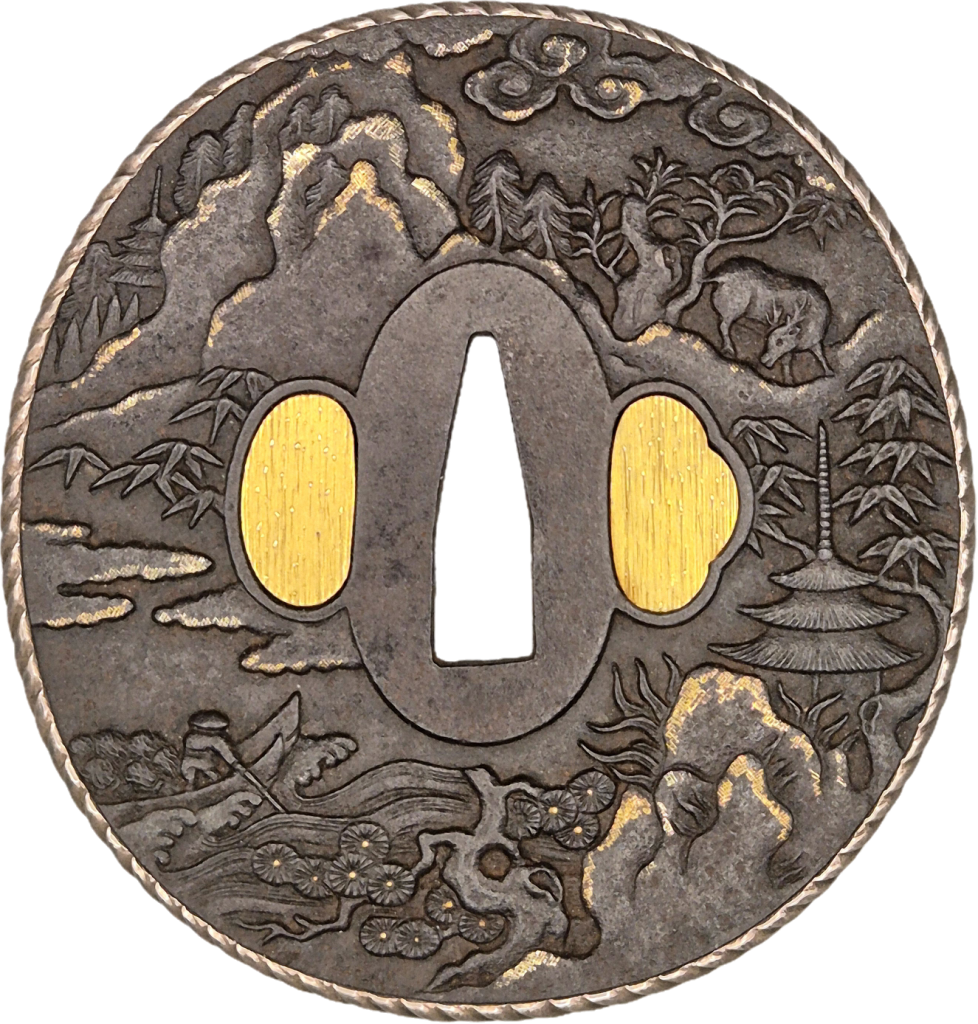
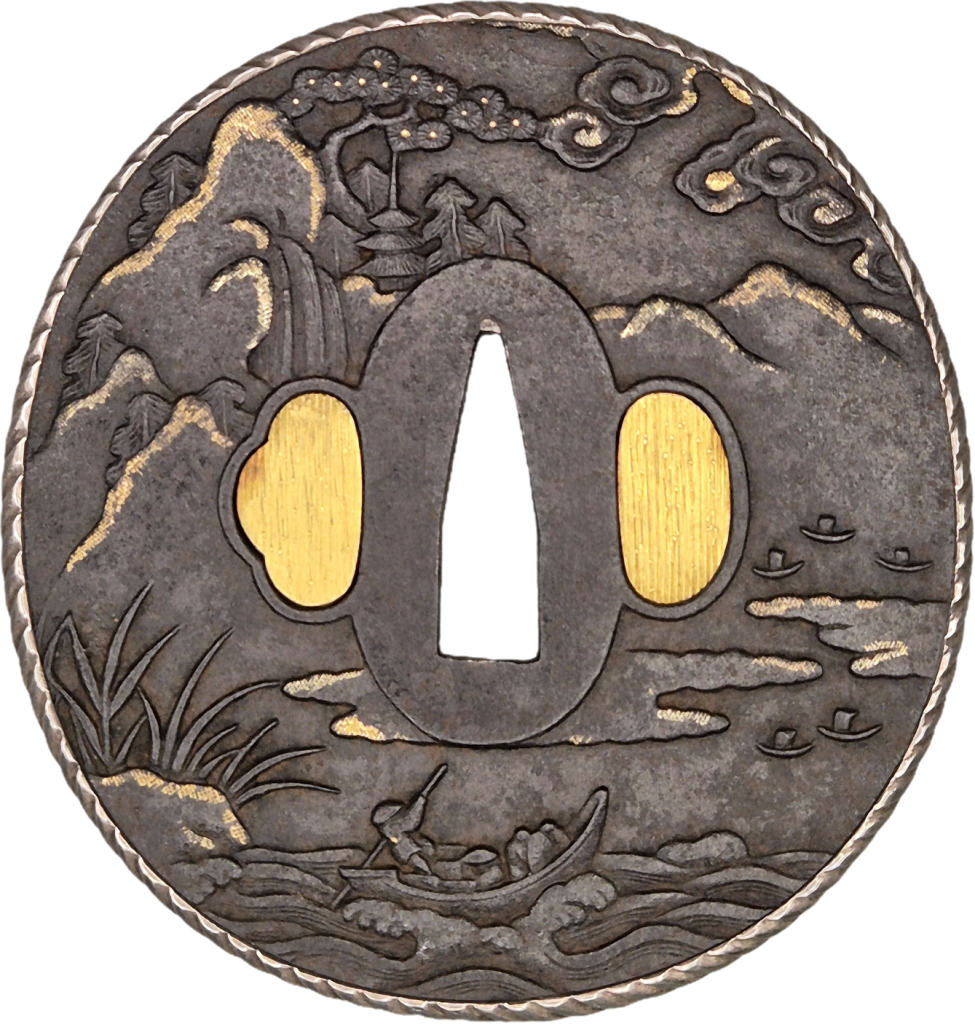
A round iron tsuba inside a twisted rope of silver, showing the Omi Hakkei, the Eight Views of Omi. Within the rim lies a lake country. Mountains, pines and temple roofs fill one face, open water and small boats the other. Both hitsu-ana are closed with gold, each plug cut with fine parallel lines. Gold lies along the ridges of the hills, laid in as nunome-zogan.
Die Landschaft lesen
On the first face a small pagoda stands on a mountain at the upper left. To the right a deer grazes beneath a gnarled tree. Lower right, a tall pagoda rises among bamboo. Lower left, a boatman works through the waves, and chrysanthemums grow from the rocks below.
On the other face a waterfall drops from the mountain at the left. A pavilion stands under a pine at the top, and cloud scrolls drift in from the upper right. The water opens to the right, with small boats scattered across it. Reeds grow at the lower left, and a boatman poles through the waves.
The maker does not label the views or set them in order. Read with the series in mind, the temple on the hill may stand for Ishiyama and the boats for the returning sails of Yabase. That is a reading, not an inscription. The guard works as one lake, seen from two shores.
Omi Hakkei
The Eight Views of Omi set a Chinese model on the shores of Lake Biwa. JAANUS, the dictionary of Japanese art terms, traces the selection to the Eight Views of the Xiao and Xiang rivers. It lists the Japanese eight: evening snow on Mount Hira, geese descending at Katata, night rain at Karasaki and the evening bell of Mii-dera. Then sunset at Seta, clearing mist at Awazu, returning sails at Yabase and the autumn moon at Ishiyama-dera.
Tradition has the courtier Konoe Masaie writing eight poems on the views in 1500. JAANUS notes that his surviving diary mentions neither the visit nor the poems. Most scholars, it says, take a calligraphy by Konoe Nobutada in the Enman’in collection as the earliest record of the standard eight.
Hizen
The NBTHK attributes the guard to Hizen, the province in the far west of Kyushu that held the port of Nagasaki. In the Edo period Chinese ships still put in there, and Chinese painting arrived with them.
The Ashmolean Museum in Oxford describes the best-known line of Hizen landscape guards, the Jakushi of Nagasaki. Their first master was a painter before he turned to metal, and he favored Chinese scenery. The museum notes that such landscapes were first etched and then chiseled, with gold nunome graduated like the washes of a painting.
The paper names the province, not the Jakushi, and this page does not go further. Yet the gold on the hills here is nunome-zogan as well, laid thin and pale, closer to a wash than to an inlay. And the subject is a Chinese form, carried to a Japanese lake, and worked in the one Japanese port where its Chinese ancestor still arrived by ship.
Eine Korrektur
Before the paper came back, this page placed the guard in the east of Japan, with the Mito school or a related kinko workshop. The shinsa placed it in Hizen. The earlier guess is noted here rather than quietly removed.
The Omi Hakkei Tsuba
Tsuba. Mumei, Hizen. Tetsu, kebori und kin-nunome-zogan, gin yori-mimi, Hitsu-ana mit Gold verschlossen. Maru-gata. Omi Hakkei-zu. Edo-Zeit. NBTHK Tokubetsu Hozon. Privatsammlung, erworben in Japan.
In the collection
- Type
- Tosogu › Tsuba
- School
- Hizen
- Period
- Edo-Zeit
- Material
- Tetsu
- Motif
- Landschaft