Der ewige Baum
Pines in Iron, Bushu-ju Masachika
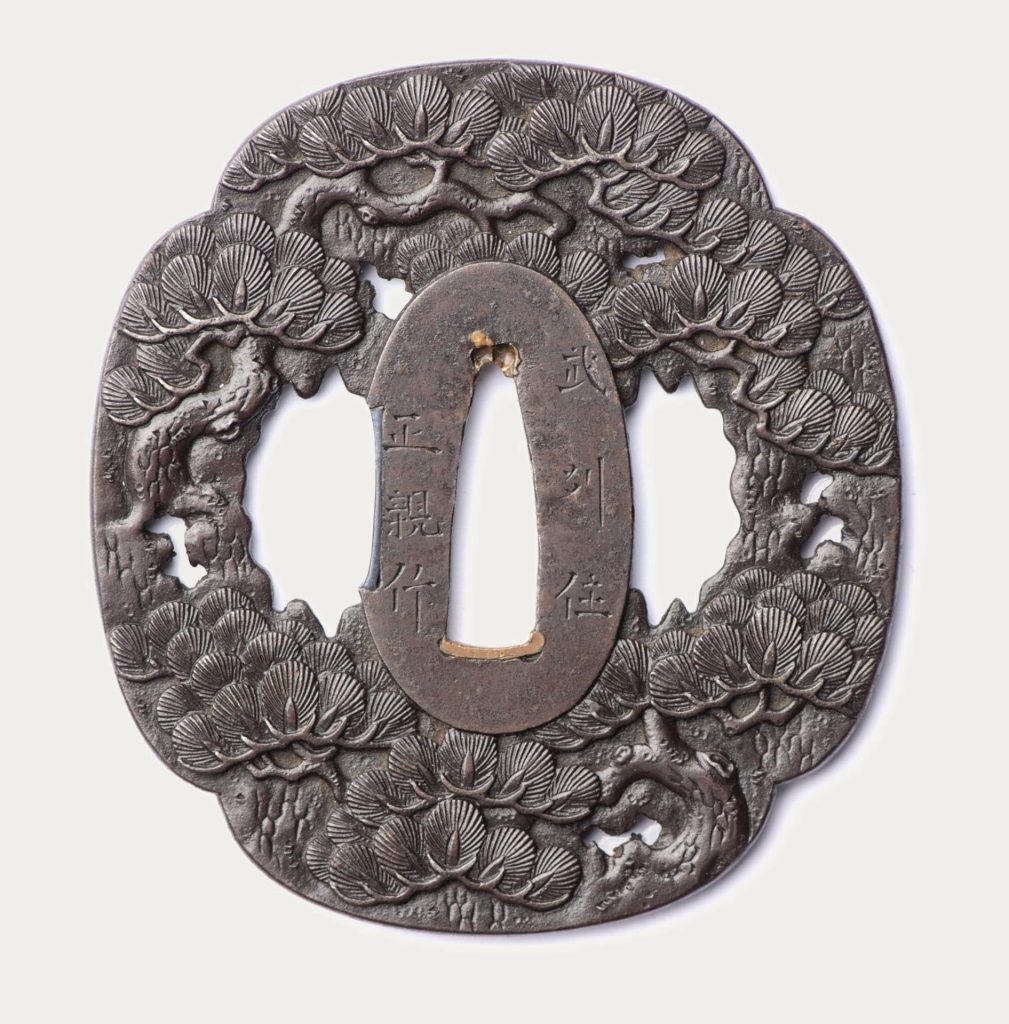
A Masachika tsuba of iron in mokko-gata, four lobes around an oval centre. The whole plate is pine. Trunks twist up from the rocks at the bottom, branches spread to the rim, and the needles open in fan-shaped clusters, each needle cut as its own line. Where the branches part, the iron is pierced through, so that light passes between them. On the back the trees go on.
Das Objekt
The pines are carved in relief out of the plate and pierced where the design leaves room. Nothing is inlaid. The iron has a dark, even surface, and the carving is left to carry the guard alone. The seppa-dai stays smooth. On it the signature runs down both sides of the tang opening: Bushu ju, living in Musashi province, on the right, and Masachika saku, made by Masachika, on the left.
Masachika und die Bushu-Schule
The Museum of Fine Arts, Boston, lists several iron guards by Ito Masachika of the Bushu school, dated from the late eighteenth to the early nineteenth century, worked in fine openwork, engraving and inlay. The reference literature records a guard by him dated to the twelfth month of An’ei 3, 1774, and gives his address as Asakusa Hottahara in Edo. The NBTHK has papered this guard Tokubetsu Hozon under his name.
Die Kiefer
The pine keeps its needles through the winter. The Metropolitan Museum of Art, describing a kimono with pine, bamboo and plum, names the three the Three Friends of Winter, shochikubai, and reads the pine as longevity and renewal. Here it fills both faces, without a figure and without a season, as if the guard were a small grove.
Eine Korrektur
An earlier version of this page reported the guard as submitted to the NBTHK. It has since been papered Tokubetsu Hozon.
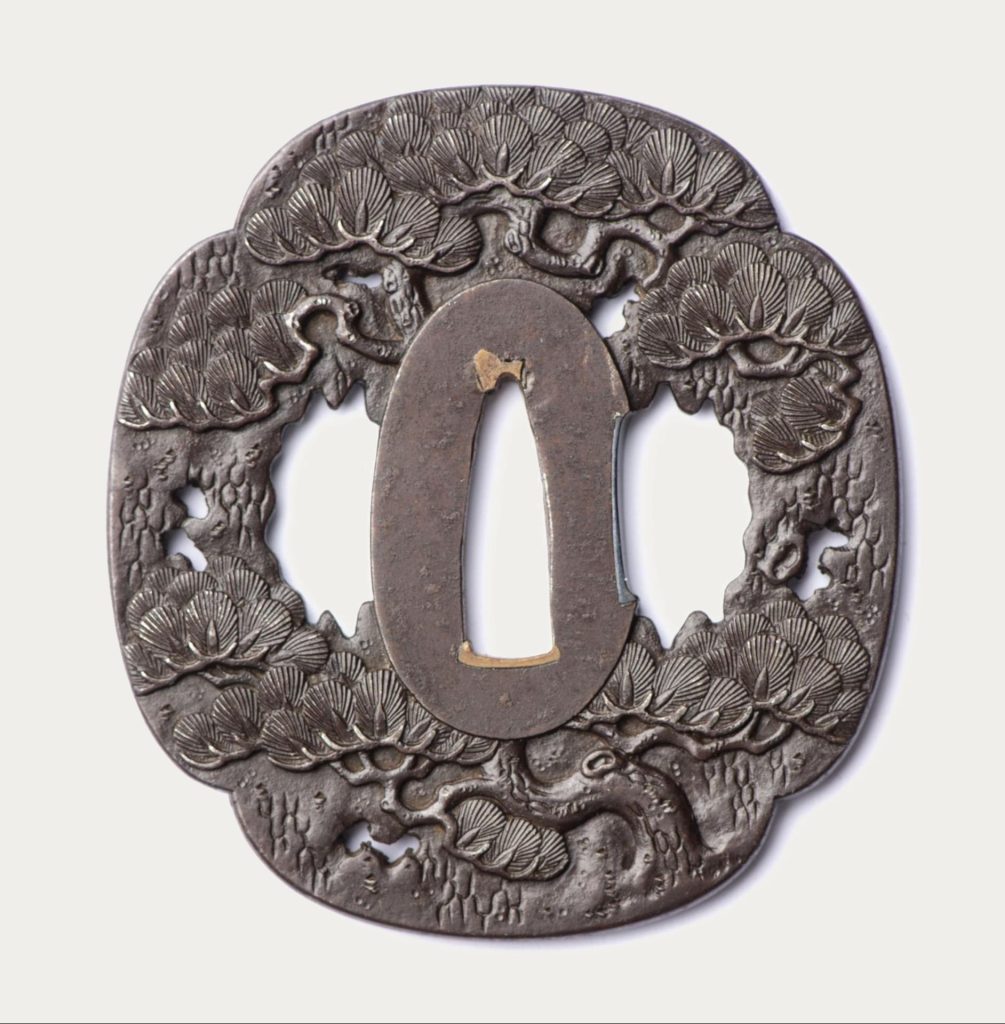
Masachika’s Pine Tsuba
Tsuba. Signiert Bushu ju Masachika saku. Tetsu, nikubori ji-sukashi. Mokko-gata. Matsu-zu. Mittlere Edo-Zeit. NBTHK Tokubetsu Hozon. Privatsammlung, erworben in Europa.
In the collection
- Type
- Tosogu › Tsuba
- School
- Bushu
- Period
- Edo-Zeit › Mittlere Edo-Zeit
- Material
- Tetsu
- Motif
- Pflanzen und Jahreszeiten