Der erste Mann über dem Fluss
The Race at the Uji River, Hamano Naoyuki
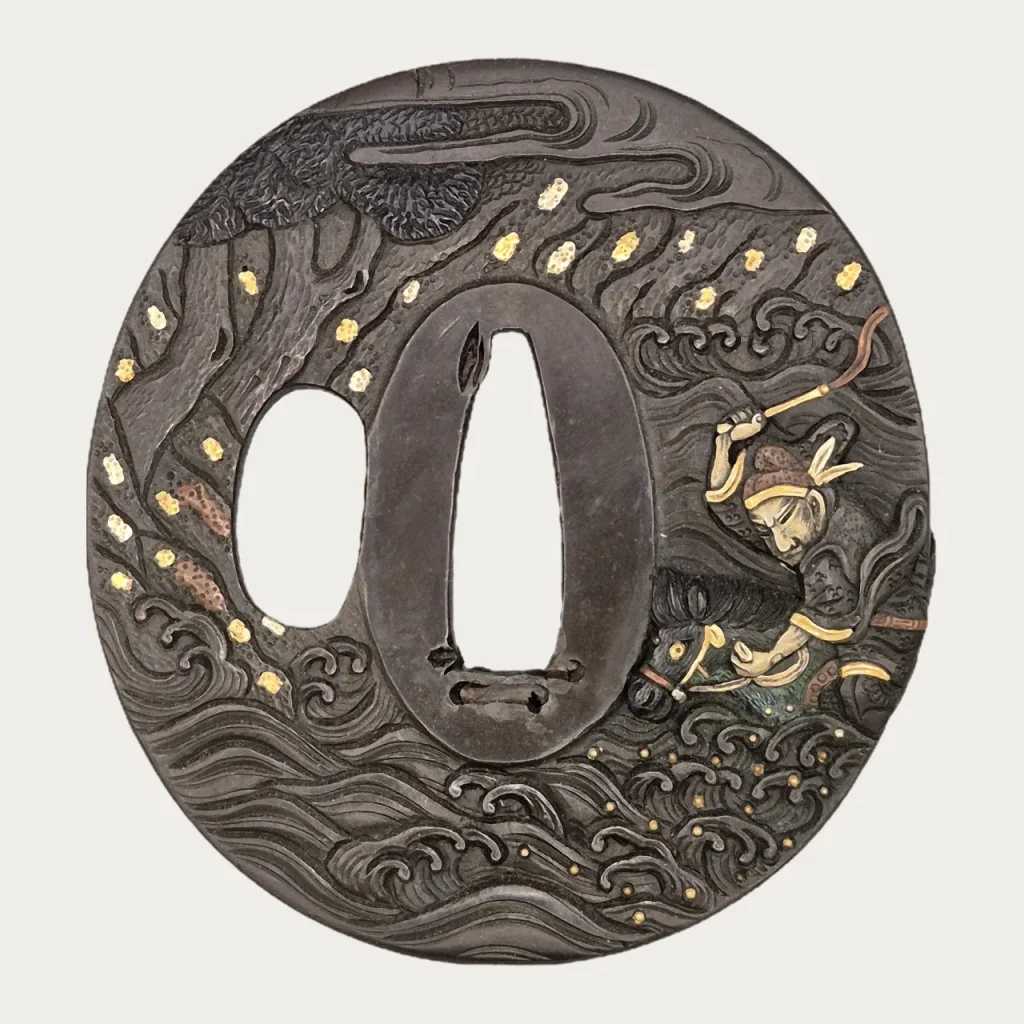
An oval tsuba by Hamano Naoyuki, dark shakudo, with the river taking up the lower half of the plate. The waves are cut deep and break against the right edge. Out of them a rider drives his horse forward, his arm raised, the horse’s head and chest just clear of the water. A pine leans in from the upper left, and flecks of gold spray fly up from the water across the field.
Das Objekt
The NTHK paper describes an oval plate with one hitsu-ana, polished shakudo, worked in taka-nikubori, high relief, with colour inlay. It dates the guard to the late Edo period. The signature is on the back, at the left: Hamano Naoyuki, with kao.
Die Szene
The paper calls the subject senjin-arasoi, the contest to be first into battle. The Metropolitan Museum of Art, describing a screen by Soga Shohaku, tells the story from the Tale of the Heike. Kajiwara Kagesue and Sasaki Takatsuna race to be the first across the Uji River, whose bridge the enemy has stripped to its frame. Takatsuna calls out that Kagesue’s saddle girth is loose. Kagesue stops to tighten it, Takatsuna passes him and reaches the far bank first.
The guard shows a single rider in the current. Which of the two he is, it does not say.
Hamano
A. J. Koop, in his catalogue of the A. H. Church collection for the Ashmolean Museum, records Hamano Shozui, 1696 to 1769, as a pupil of Nara Toshinaga I. Shozui and his successors, Koop writes, favoured war scenes and subjects with human interest, often in higher relief than the Nara work they came from. Naoyuki came to the Hamano name a generation later, and from outside the main line. Markus Sesko, in his study of the tōsō kinkō schools, gives his birth name as Tōyama Denzō, born in 1754. He trained first with Nakamura Naonori and then became a pupil of the first Hamano Noriyuki, who is said to have been a relative. Shōzui gave him permission to use the family name. The characters of his art name, 直随, have sometimes been read Chokuzui. Sesko reads them Naoyuki.
He did not stay in Edo. Sesko follows him to Kōfu in Kai province, to Echigo, to Fukushima and to Matsumoto. His last years he spent in the village of Katagiri in Shinano, where he died in 1827, at the age of seventy-four. Beside his own work he also served the main line of the school in a supporting role. He was not one of its masters.
The Naoyuki Tsuba
Tsuba. Signiert Hamano Naoyuki mit Kao. Shakudo migaki-ji, taka-nikubori, iroe. Naga-maru-gata, ein Hitsu-ana. Senjin-arasoi-zu, Wettstreit am Uji-Fluss. Späte Edo-Zeit. NTHK Kanteisho. Privatsammlung, erworben in Japan.
In the collection
- Type
- Tosogu › Tsuba
- School
- Hamano
- Period
- Edo-Zeit › Späte Edo-Zeit
- Material
- Shakudo
- Motif
- Mensch und Legende