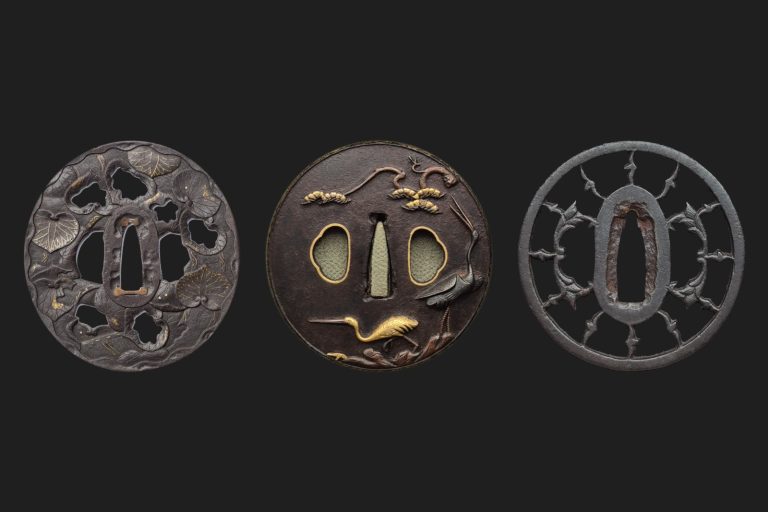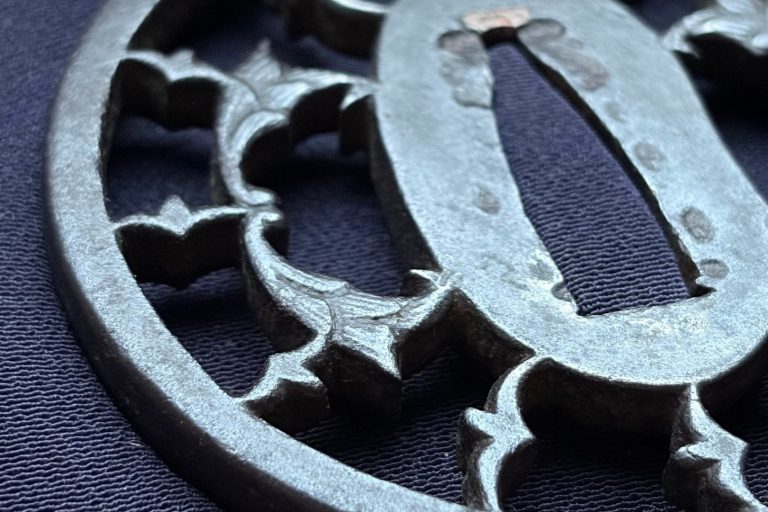
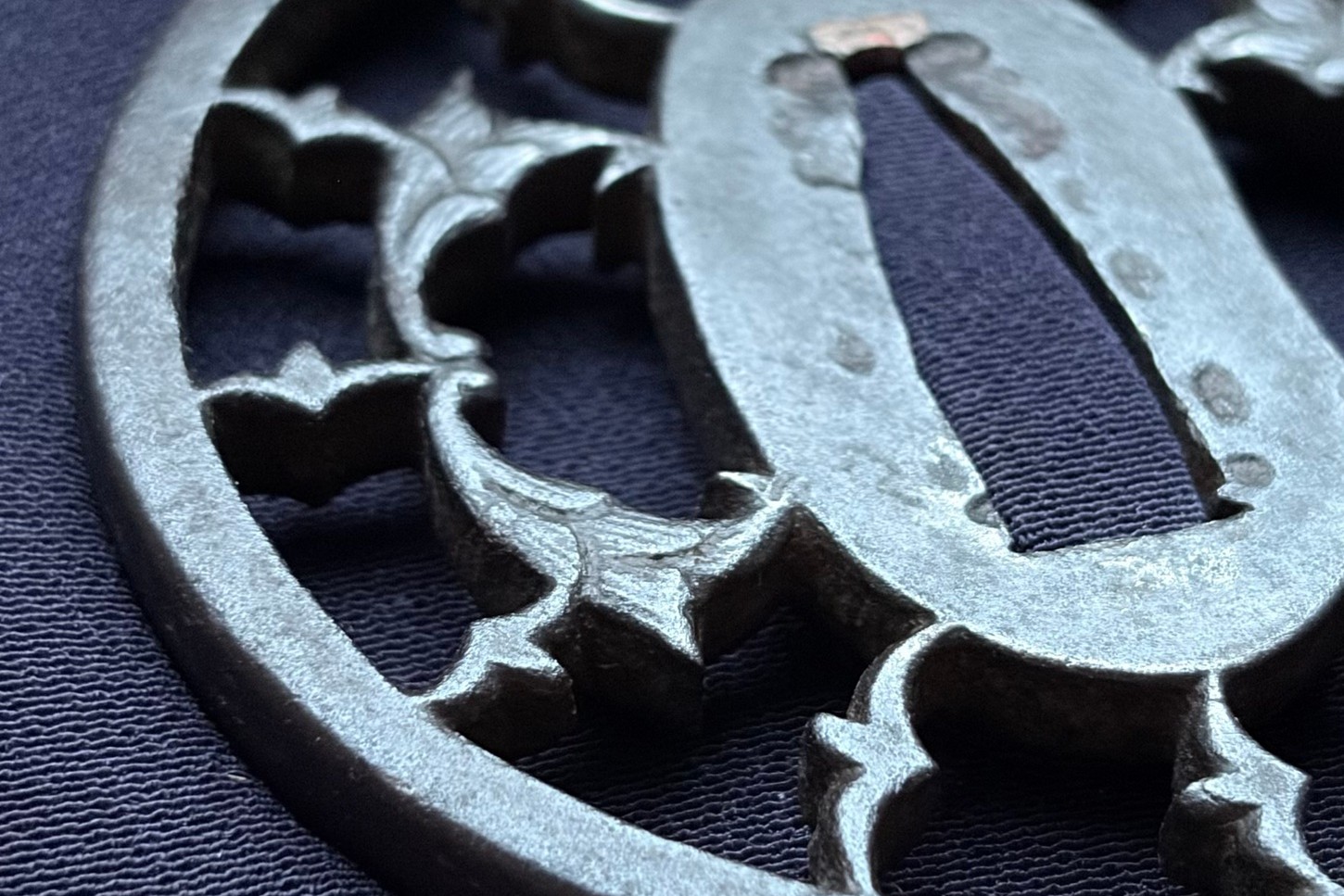
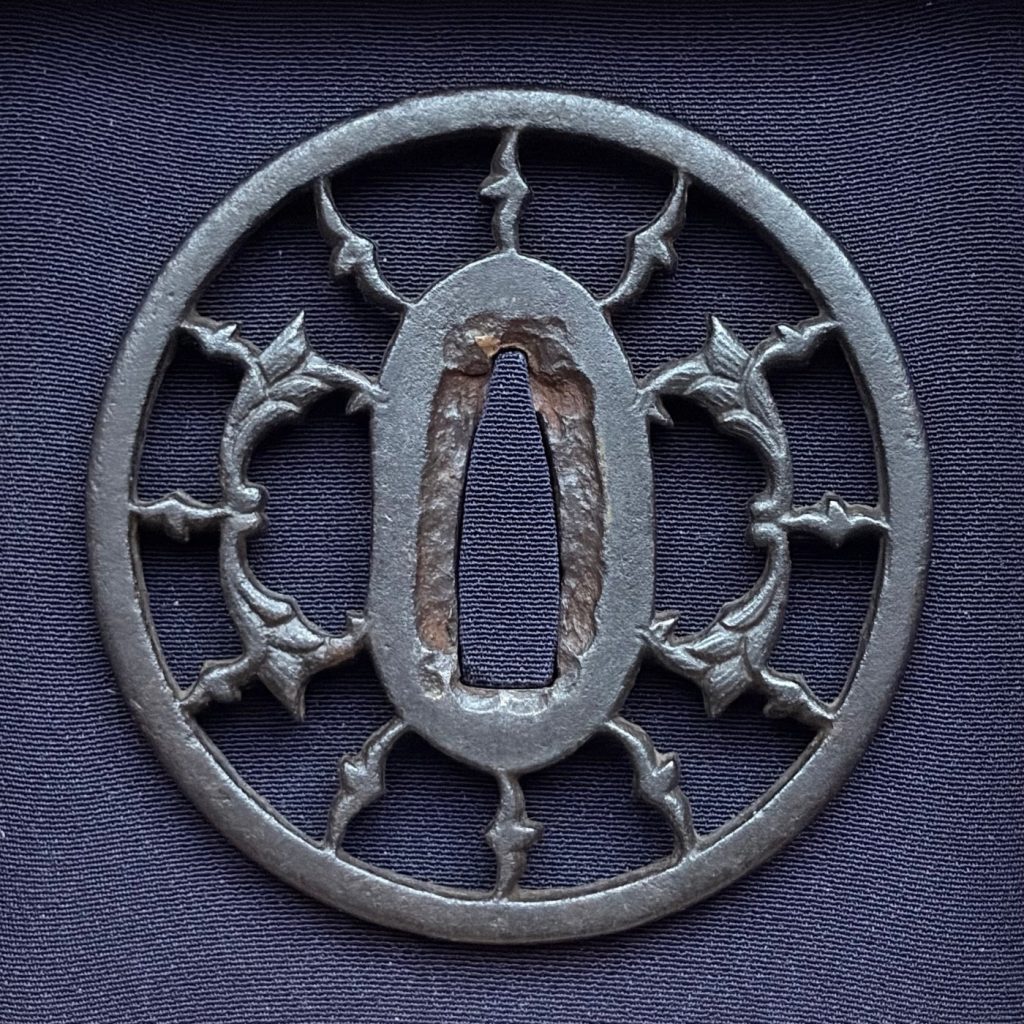
One of the three Shoami guards in this collection has almost no surface left to decorate. It is a round iron plate, and its design is cut right through it. A broad oval surrounds the opening for the blade. On either side of it, two buds of Japanese ginger, myoga, are joined at their stems and curve around an opening: the crest called daki-myoga, embracing ginger. Strips of iron tie the oval and the buds to the rim. Small wild geese in flight, karigane, sit on these strips, each reduced to a few angles. Both shapes come from family crests. Here they are the guard itself. The strips of iron that remain are the drawing.
Japanese calls this ji-sukashi, openwork in the ground of the plate. The paper gives the guard to the Shoami and names no branch. It belongs to the mounting of a katana in this collection, and it was taken off once, because the iron was too good to leave the question of its school alone.
How such guards began is the subject of a reading by Markus Sesko.
A gap of a century
The oldest record of the Shoami, from 1540, shows them as silversmiths of the shogun. Sesko sets it against another date. During the Onin era, 1467 to 1469, the high-ranking warriors are thought to have taken to wearing the uchigatana, the sword worn through the sash, more regularly. Between that change and the first record of the Shoami lies about a hundred years. Whether the Shoami already worked in the early and middle Muromachi period is unknown. The entry of 1540 says only that their service was a long one.
The advisers
Sesko turns to the other men whose names end in ami. Noami was painter, adviser on art and master of tea for the shoguns. Zen’ami, who lived from 1386 to 1482, designed gardens for the shogunate. Tosa Shirozaemon Michinaga, lacquer artist to the shogun Yoshimasa, took the name Koami when he became a priest and founded a school of lacquer that worked for the shoguns for nineteen generations. Such men did not always work with their own hands. The Koami gave work to other craftsmen.
Applied to the Shoami, Sesko suggests, this would make the first of the name an artist in metal who directed the metalworkers of the shogun’s circle, the makers of fittings and ornaments for the buildings and furniture of the Higashiyama culture under Yoshimasa. He may also have advised high-ranking warriors who now wore the uchigatana and trusted an ami artist in matters of taste. Sesko offers the second point as speculation. Both are given here as his reading.
Heianjo and Kyo
In that reading the role reached the first pierced iron guards, which appeared in Kyoto in the heyday of the Higashiyama culture. They are called Heianjo-sukashi today, after an old name of the city. Their designs are elegant and recall the motifs of folding screens and sliding doors. Sesko does not rule out that the Shoami took advice from painters of the capital, such as the san-ami, the three painters of the shogun’s circle whose names end in ami.
Heianjo-sukashi guards were made until about the Momoyama period. Their successors are called Kyo-sukashi. They follow a later fashion: the strips of iron grow thicker, and the design becomes more stylized and more geometric. The change from one to the other was gradual.
At the same time pierced guards were made outside Kyoto too. Owari-sukashi and Kanayama are names for groups of such work in other provinces.
The iron
The design is one half of such a guard. The iron is the other. Sesko notes that the first openwork guards were forged from exceptional iron, and that they are therefore thought to be the work of armourers, katchushi, who had made simple iron guards for the slung sword and the early uchigatana. Some writers see openwork in the ground as a development of the small piercings, ko-sukashi, in those armourers’ guards.
So in Sesko’s reading two crafts meet in the pierced guard: a design from the circle of the capital’s advisers, and a plate from the forge of an armourer. The name Shoami may stand at the point where they met.
Back to the guard
The guard in this collection is later than the early Kyoto guards. The collection dates it to the Edo period, like the other two. It has much of what Sesko describes for the later Kyoto work. The design is strictly symmetrical, left against right and top against bottom. The strips are thick, and seen at an angle their sides drop straight down through the plate. Only the ginger buds are modelled, with fine lines cut into them. The paper calls the technique nikubori ji-sukashi, carving in relief together with openwork. This is a description, not an attribution: the paper says Shoami, and no more.
Around the opening for the blade, on one face, the iron is rough and brown. On the other face a small plug of copper, a sekigane, sits at the top of the opening, to fit the guard to its blade. The rest of the surface is dense and even, and it was the iron that sent the guard to Japan for shinsa. The answer came back as a school, not a place.
That answer fits the story. Openwork in iron was where the Shoami name met the work of many hands. A paper that stops at the name may be describing exactly that.
The Shoami: all parts
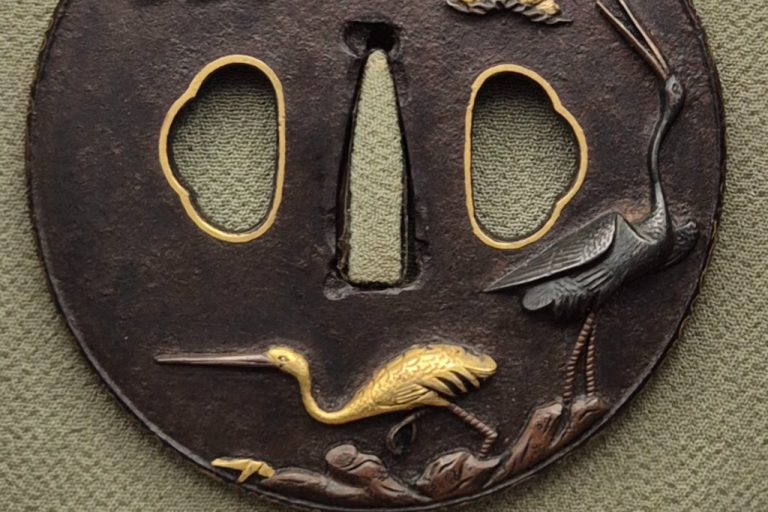
The three guards and their papers, side by side: The Shoami: Three Papers, One Name
Sources
- Markus Sesko, The Japanese Tōsō-Kinkō Schools, Kyoto volume, ch. 1.7 “The sphere of activity of the Shōami school and the emergence of the ji-sukashi-tsuba”, pp. 49–52.
- Collection: tsuba with daki-myoga and karigane, Shoami, NBTHK Hozon (no page yet).