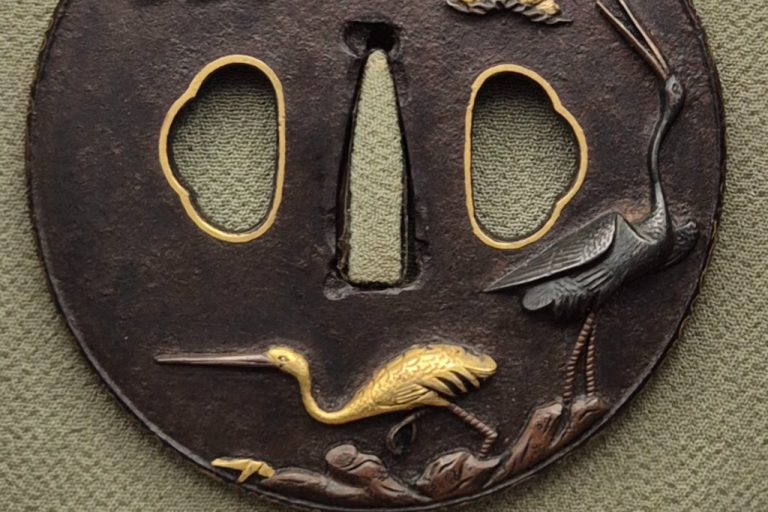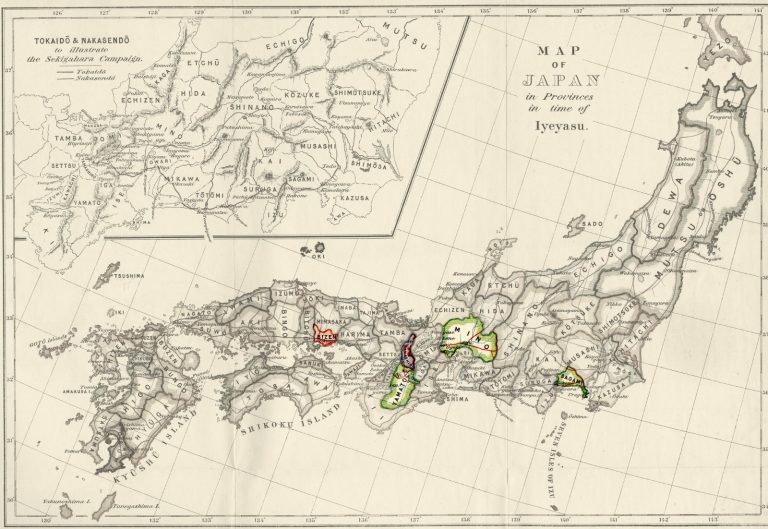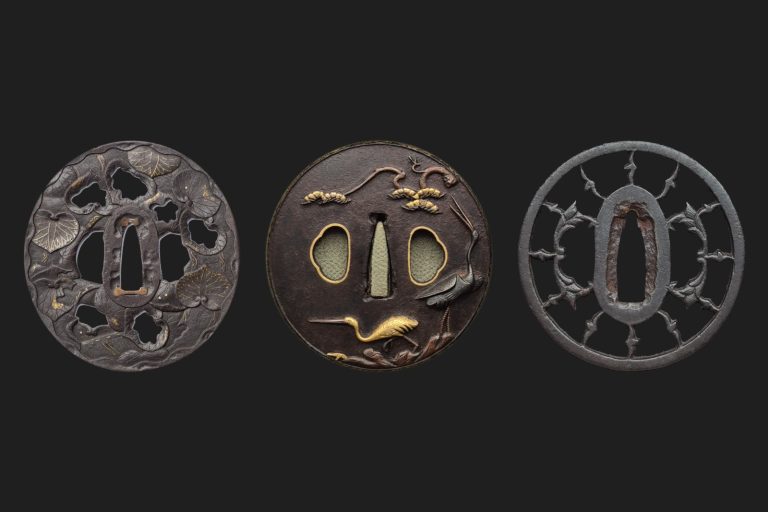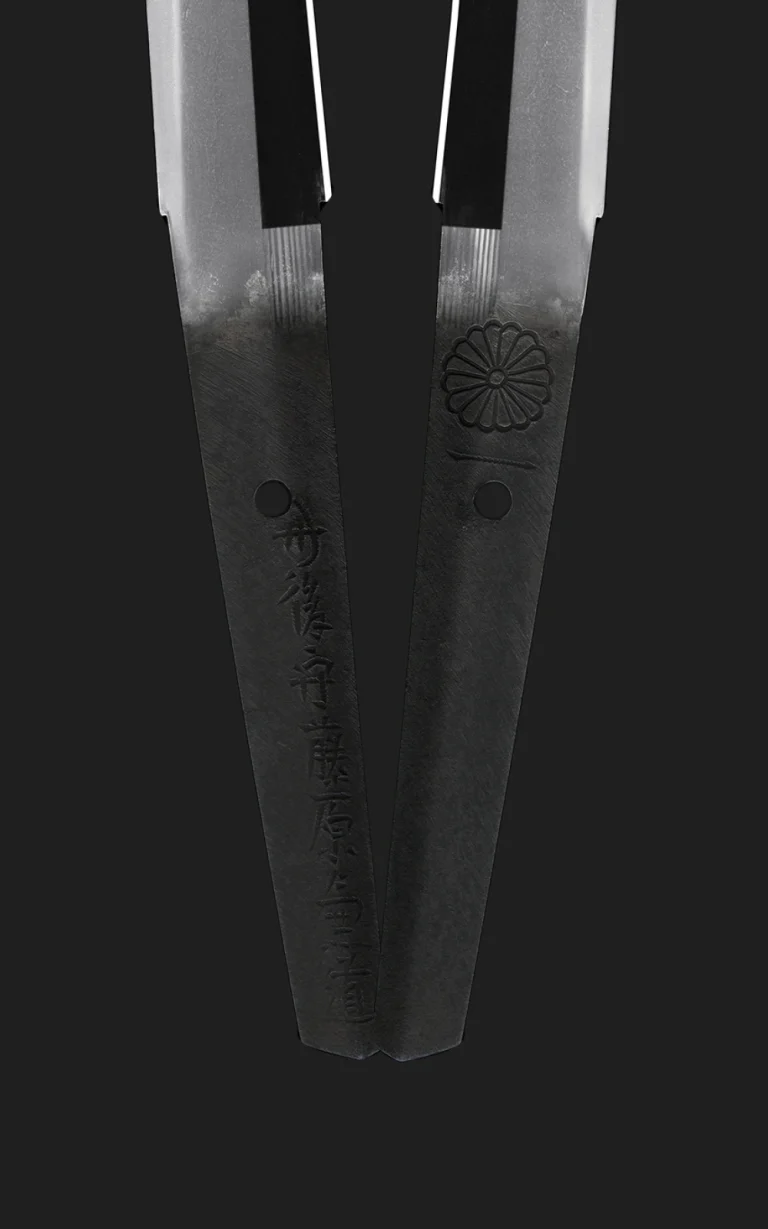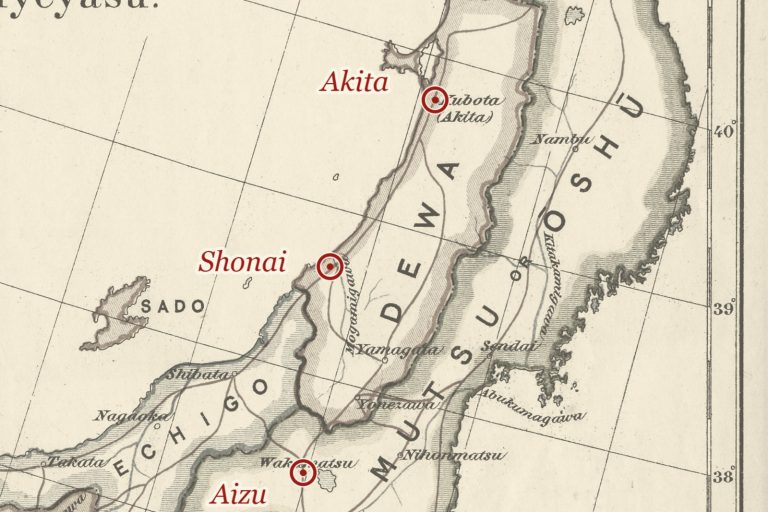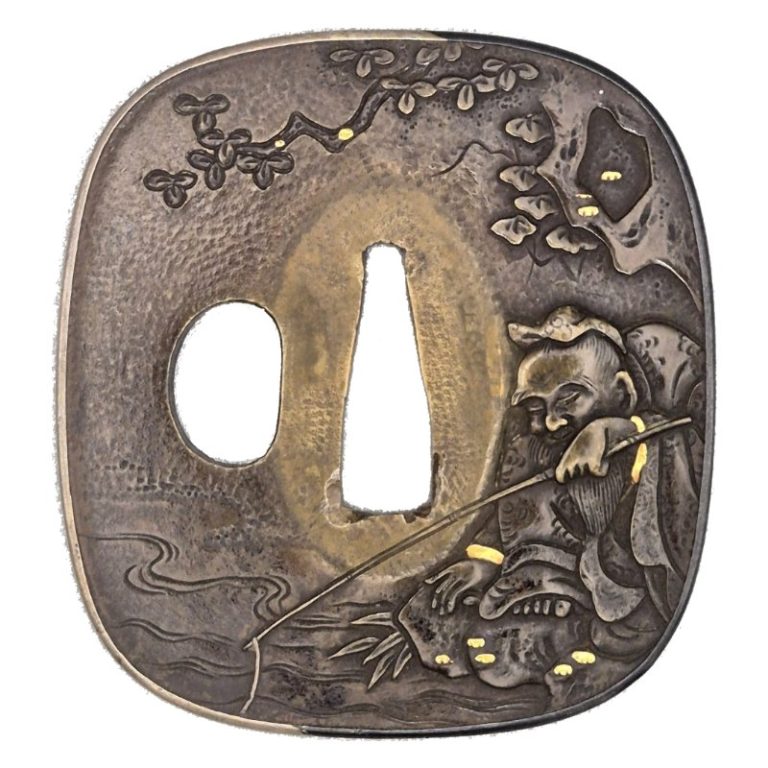
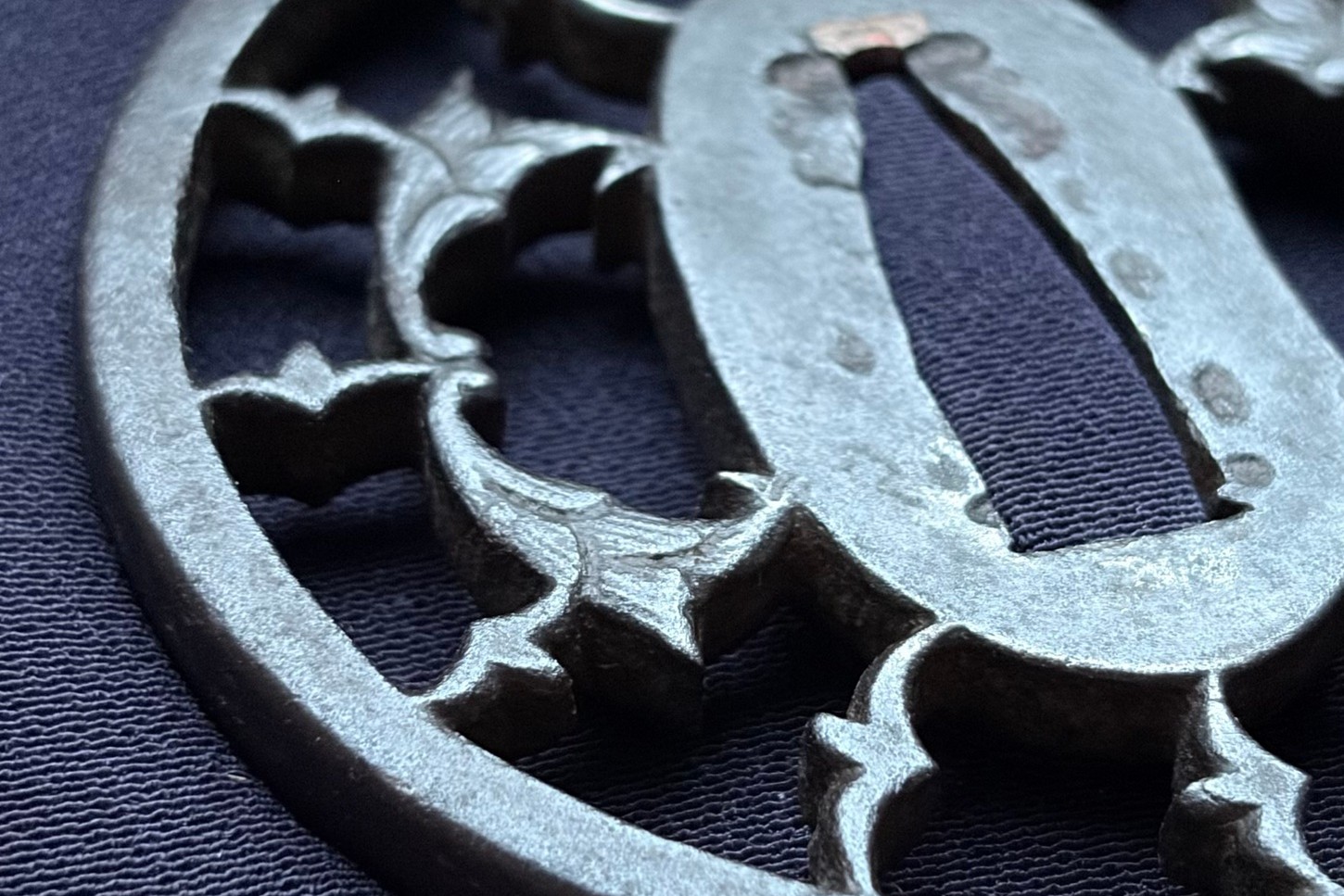
Three iron sword guards in this collection carry papers of the NBTHK, and each paper says Shoami. Two of them add a place. One guard, with leaves of aoi drifting on rafts, is given to Akita, in the far north of Honshu. Another, with a pine and a pair of cranes, is given to Aizu, further south. The third, an iron plate cut through with crest shapes of ginger buds and wild geese, carries the name Shoami and nothing more.
Three papers, one name, three degrees of precision. This series asks what the name holds.
A name with a long reach
Shoami is one of the names a collector meets most often on iron guards of the Edo period. It is written 正阿弥, and it stands on guards from Kyoto and from provinces at the far ends of the country. It stands on fine work in soft metals and on plain iron, on guards inlaid with gold and on guards cut almost entirely through.
Behind the name the record is thin. Markus Sesko, in the Kyoto volume of The Japanese Tōsō-Kinkō Schools, begins his account with a plain statement: no documents survive that describe the origins, the early phase or the genealogies of the Shoami artists. What survives are a few entries in the diaries of courtiers and officials, and the guards themselves.
An early European order
A. J. Koop catalogued the sword guards that the chemist A. H. Church had collected, for the Ashmolean Museum in Oxford. His catalogue, introduced in London in 1929, never went to print. The museum now publishes it online. Koop opens his chapter on the Shoami with a careful phrase: this school, if it may be so termed. He notes that no ordered chronology or genealogy of the Shoami workers had yet been made.
Then he sorts. Church’s Shoami guards stand under Kyoto, Iyo, Awa, Shonai, Bushu, Aizu and Akita. Seventy-seven guards in all. Thirty-nine of them, about half, stand under a last heading: unclassified Shoami guards. The name was clear to him. The place, in half the cases, was not.
That is the shape of the problem nearly a century later. The papers in this collection follow the same order. Two name the branch. One stops at the school.
What the series asks
The series follows the name in four steps.
The first part goes back to the beginning, as far as documents allow. The Shoami appear in the sixteenth century as silversmiths in the service of the Ashikaga shoguns, and once at a meal in the residence of an emperor. Sesko sets them beside the Goto, and the comparison says much about who wore what they made.
The second part follows a reading of Sesko’s on the first pierced iron guards of Kyoto, and on the role that artistic advisers of the shogun’s circle may have played in their design. The third guard in this collection, cut through the iron, belongs to that story.
The third part turns to the provinces. In the eighteenth and nineteenth centuries Shoami families settled in castle towns across Japan, from Aizu and Akita in the north to Iyo on Shikoku. Each branch worked for its own lord and its own market.
The last part returns to the three papers. It asks what a paper says when it names a branch, and what it says when it does not.
A note on method
The Shoami are a good test for a European collector. The school is known mostly from objects and from papers, much less from documents. Koop could see that the name gathered many hands and could not say how. The papers say more today, and they still stop at the same point when a guard is unsigned and its place cannot be read from its work.
The three guards in this collection are not a survey. They are three answers to one question, given by the same institution. Read together, they show how far the name reaches and where it ends.
The Shoami: all parts
The three guards and their papers, side by side: The Shoami: Three Papers, One Name
Sources
- Markus Sesko, The Japanese Tōsō-Kinkō Schools, Kyoto volume, ch. 1 “The Shōami school”, p. 38 (no documents on origins and genealogy).
- A. J. Koop, The A. H. Church Collection of Japanese Sword-Guards (Tsuba), unpublished catalogue, introduction dated London 1929, chapter “Shōami school (early 17th to 19th century)”, Ashmolean Museum, Eastern Art Online.
- Collection pages: Akita Shoami tsuba with aoi and rafts; Aizu Shoami tsuba with pine and cranes.