Das Blatt, das dem Herrn gehörte
Aoi Leaves and Rafts, Akita Shoami
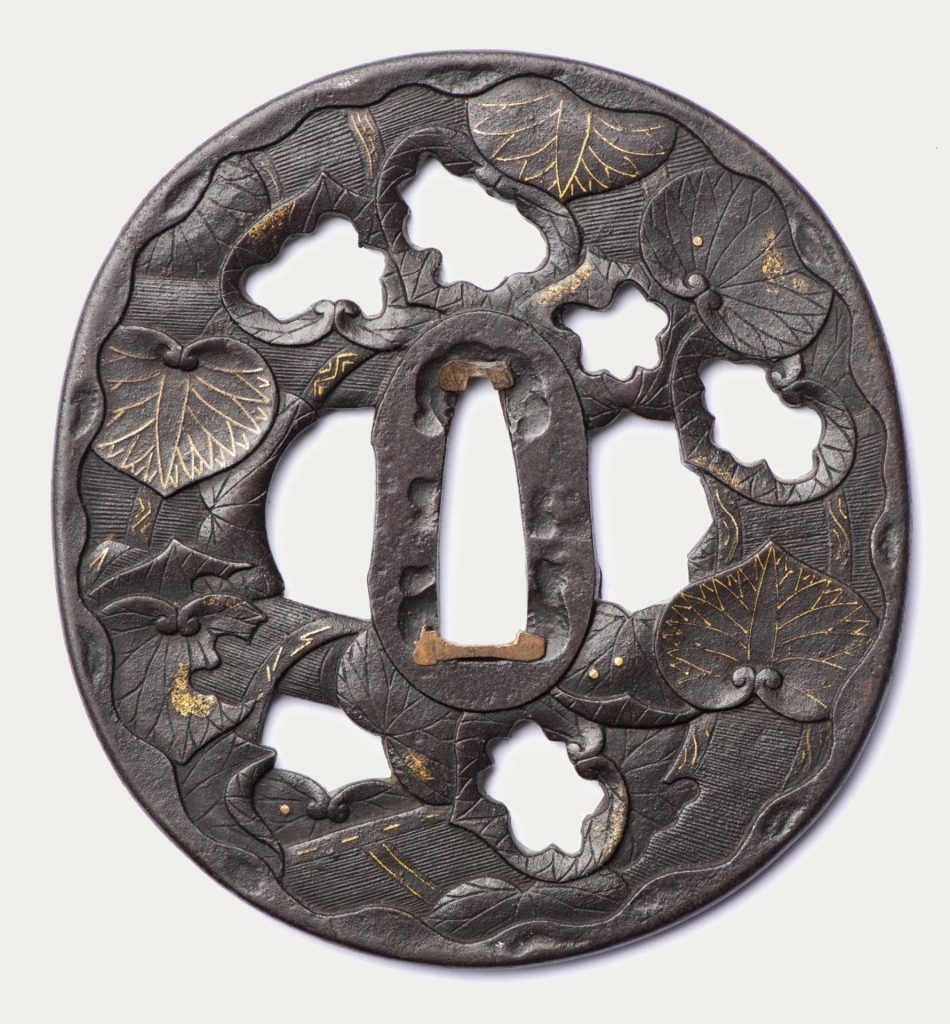
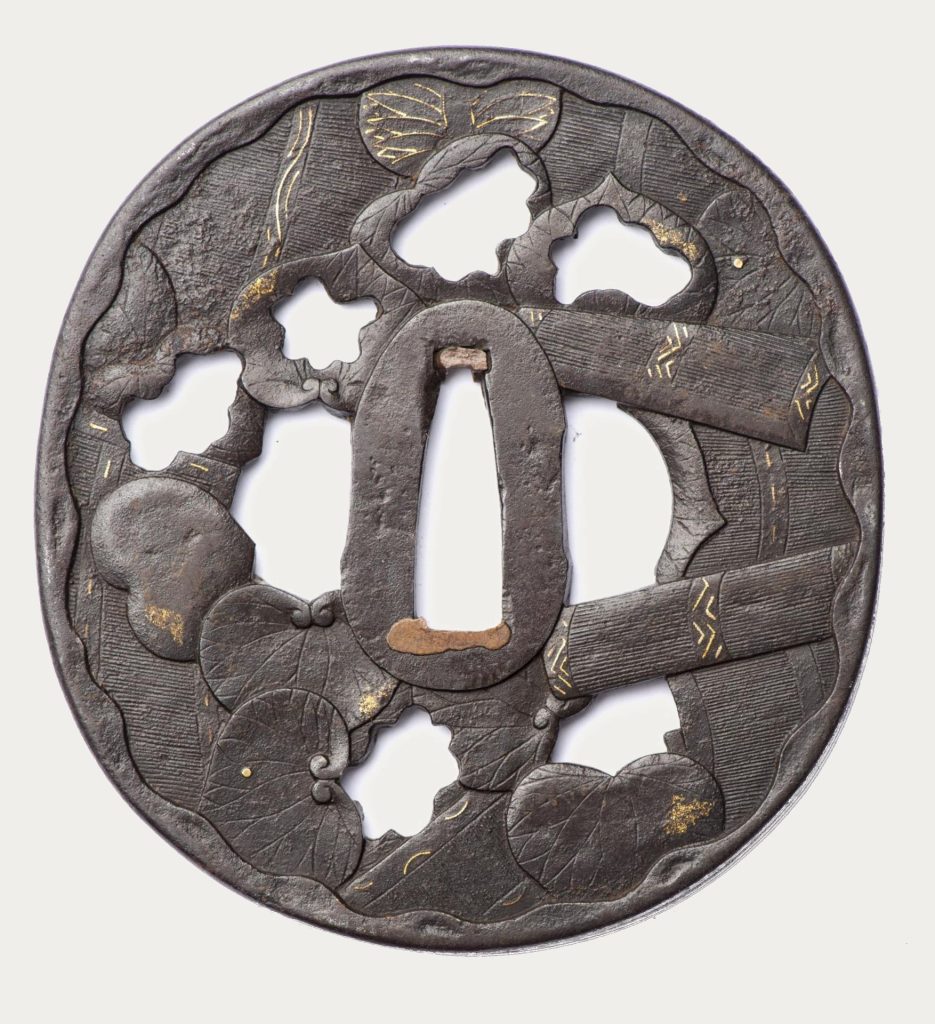
Leaves of aoi drift across an iron tsuba. Between and beneath them lie rafts, flat boards cut with parallel lines, their joints marked with small chevrons of gold. Openings with soft, cloud-like outlines let light through the plate.
Das Aoi
The leaf is futaba-aoi, wild ginger, with its heart-shaped base and fine radiating veins. The Walters Art Museum notes that the aoi crest was used by the Tokugawa family. On a guard of the Edo period the leaf could hardly be seen without that crest in mind.
Here the leaves are not set in a ring as a crest. They float loose, on rafts, wherever the water has carried them.
Akita
The NBTHK attributes the guard to the Akita branch of the Shoami. The Shoami name gathers many provincial workshops, and Akita, in the far north of Honshu, was home to one of them. A Japanese mokume-gane workshop, writing on the history of its craft, traces the branch to Shoami Denbei, who lived from 1651 to 1728. He trained in Edo and then served the Satake, the lords of Akita. The branch became known for guri-bori and for mokume grounds.
The Satake had not come north by choice. A historical guide published by Akita International University records that they were moved from Hitachi to Akita in 1602, a demotion that followed the Tokugawa rise to power.
Was das Blatt im Norden bedeutet
A Tokugawa leaf worked in the domain of a house the Tokugawa had sent north reads differently from the same leaf worked in Edo. Whether maker or owner meant anything by it cannot be known. Aoi appears on provincial work across the country, and it may have been chosen for its form alone. The reading is offered as a reading.
Eine Korrektur
This page first presented the guard as work of the Bushu Ito school and read the leaves as the emblem of a retainer in Edo. The Tokubetsu Hozon shinsa placed it in Akita. The earlier reading is noted here rather than quietly removed.
The Aoi Tsuba
Tsuba. Mumei, Akita-Shoami. Tetsu, nikubori, sukidashi-bori, kin-zogan. Maru-gata. Aoi ni ikada-zu. Edo-Zeit. NBTHK Tokubetsu Hozon. Privatsammlung, erworben in Europa.
In the collection
- Type
- Tosogu › Tsuba
- School
- Shoami › Akita-Shoami
- Period
- Edo-Zeit
- Material
- Tetsu
- Motif
- Pflanzen und Jahreszeiten