Der Löwe kennt die Pfingstrose
Shishi and Peony, Yokoya Soyo II
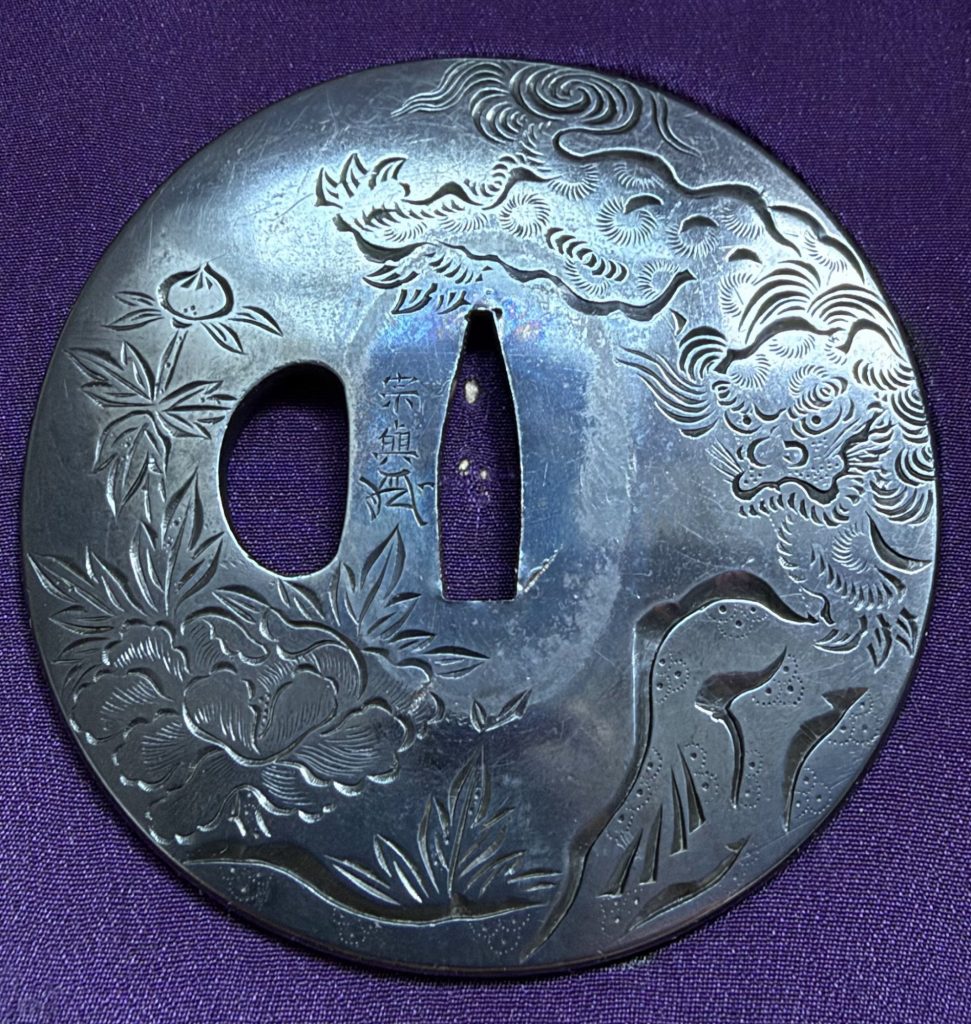
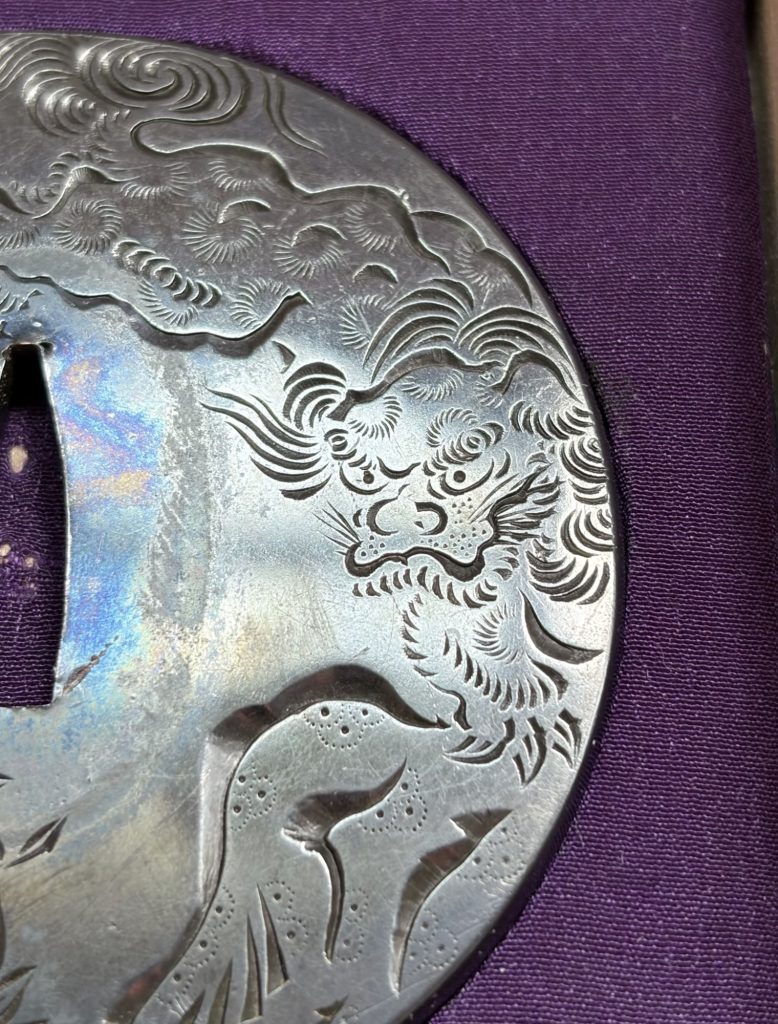
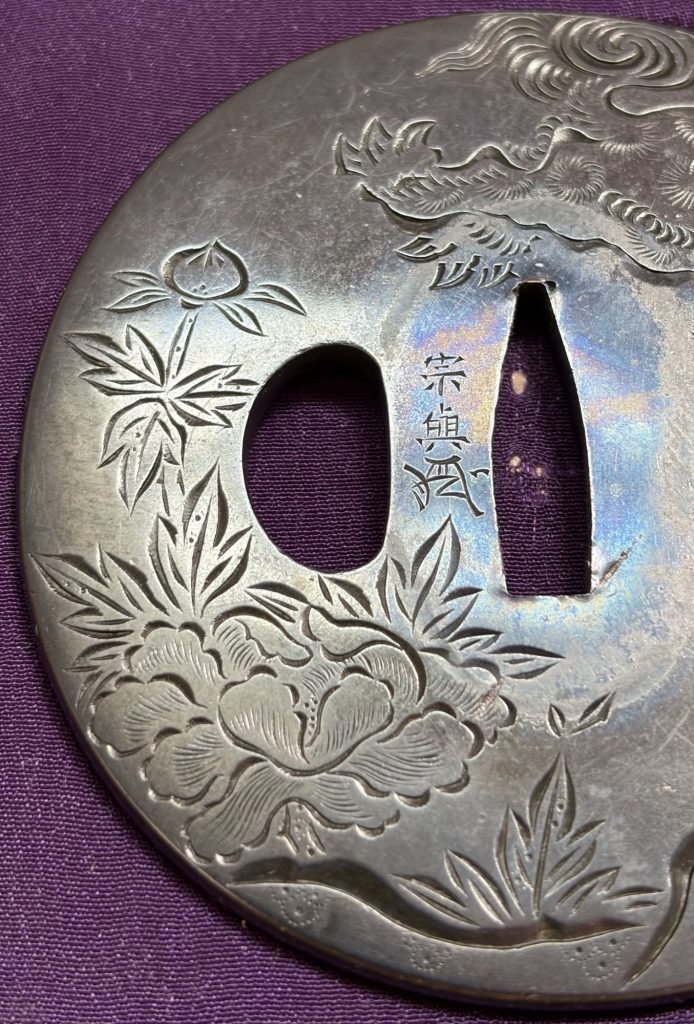
A round Yokoya Soyo tsuba, its front drawn entirely with the chisel. On the right a shishi turns its face toward the center, its mane in tight curls, while further curls run on along the upper rim. Rocks fall away beneath it. On the left a peony grows from the lower edge, one full blossom among broad leaves and a single bud near the top. There is no inlay and no gold. Every line is a cut.
Das Objekt
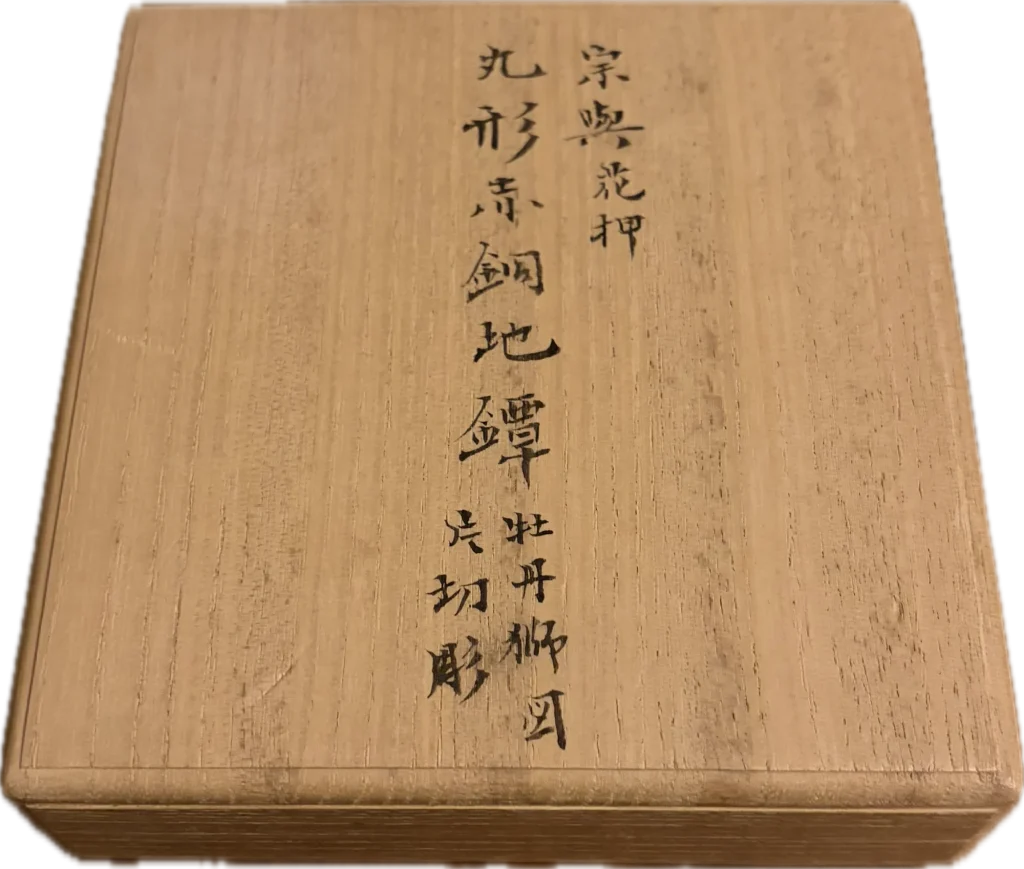
The plate is round, its square rim swelling slightly toward the edge: kaku-mimi ko-niku, in the words of the catalogue that published it. The catalogue gives the ground as 烏銅, polished. The term is another name for shakudo, the alloy of copper with a little gold, named for the black of a crow. The box agrees: a round tsuba on a shakudo ground, peony and shishi, katakiri-bori, Soyo with kao.
The shakudo is polished to a mirror. It is very dark, but it gives back so much light that it shimmers blue and looks paler than it is.
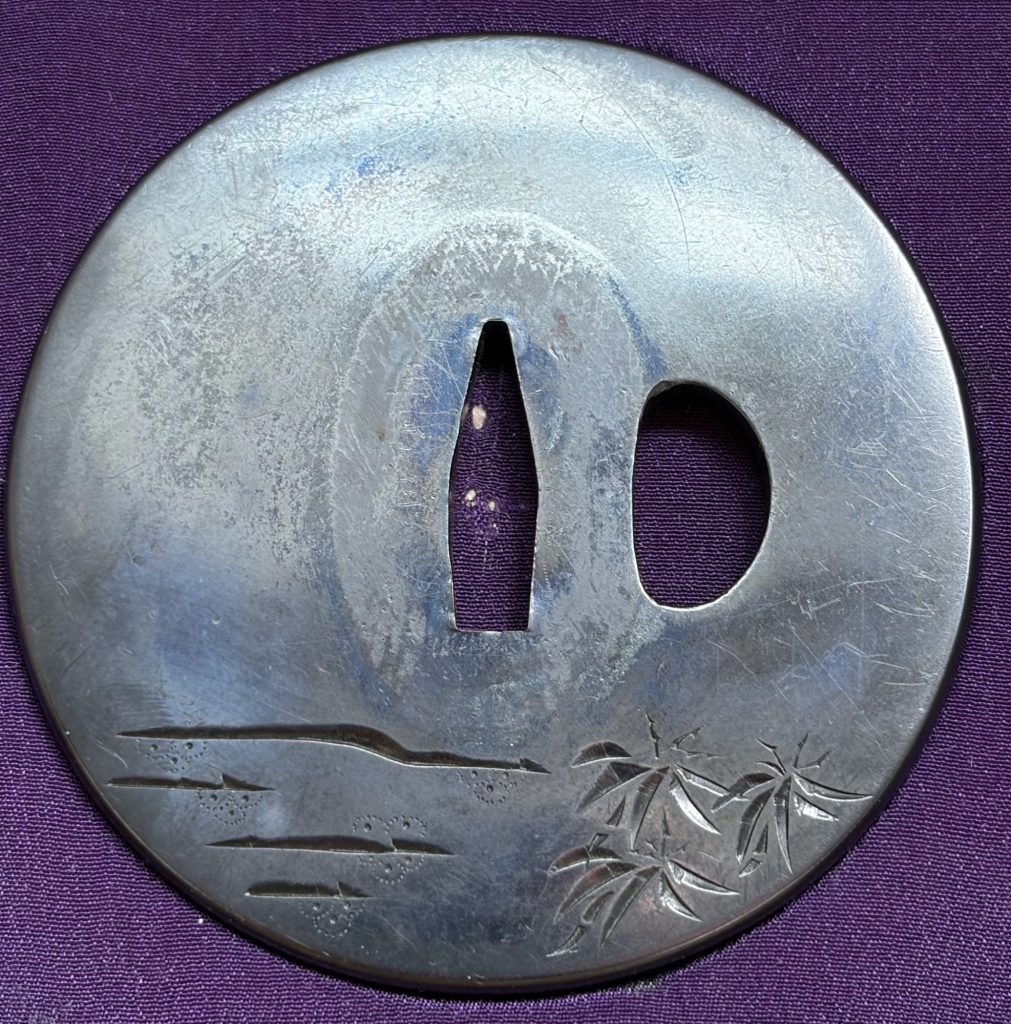
The back is left almost empty. A few long strokes cross the lower left, water or the edge of a shore, and a spray of bamboo leans in at the lower right.
Katakiri-bori
JAANUS, the dictionary of Japanese art terms, describes katakiri-bori as a line cut with a chisel that leaves one side deep, and credits the technique to Yokoya Somin, who lived from 1670 to 1733. Each line falls steeply on one side and shallowly on the other. It swells and thins like a stroke of the brush.
Die signierte Seite
The signature stands on the seppa-dai, to the left of the tang opening: Soyo, 宗與, followed by a kao. The catalogue reads it the same way. It dates the guard to the middle of the Edo period and does not say which Soyo made it.
Welcher Soyo
Two masters of the Yokoya school signed Soyo. A. J. Koop, cataloguing the A. H. Church collection of sword guards for the Ashmolean Museum, calls the first “Grandfather Soyo” and has him working for the shogunal court in the classical manner of the Goto. The Haynes Index names him a pupil of Goto Injo. Katakiri-bori, Koop writes, was the new style of his successor Somin.
The second Soyo was born in Edo in 1700, entered the family by adoption and headed it from 1733 until 1766. He died in 1779. The Haynes Index counts him as the third master of the school and singles out his katakiri-bori. A guard signed Soyo and cut in Somin’s technique belongs with the second Soyo, and this page gives it to him.
The Museum of Fine Arts, Boston, keeps a guard by Yokoya Soyo II with a shishi and its young, cut in katakiri-bori on a polished ground. Its metal is shibuichi, an alloy of copper and silver.
Das Buch
The guard is published as number 45 in Zabo Tsubasen, 坐忘鐔撰, edited by Kokubo Ken’ichi and Otsubo Kenzo and published by Token Shunju Shinbunsha in 1974. The title borrows zuowang, sitting and forgetting, a term from the Daoist classic Zhuangzi for a stillness in which the self falls away.
Eine Korrektur
An earlier version of this page described the plate as oborogin, a silver alloy, and named Goto Kenjo as the first Soyo’s teacher. The catalogue and the box both give shakudo, and the Haynes Index gives Goto Injo.
The Soyo Tsuba
Tsuba. Signiert Soyo (宗與) mit Kao, Yokoya Soyo II. Shakudo, migaki-ji, katakiri-bori. Maru-gata, kaku-mimi ko-niku. Botan shishi-zu, auf der Rückseite Bambus am Wasser. Mittlere Edo-Zeit. Publiziert in Zabo Tsubasen (1974), Nr. 45. Privatsammlung, erworben in Japan.
In the collection
- Type
- Tosogu › Tsuba
- School
- Yokoya
- Period
- Edo-Zeit › Mittlere Edo-Zeit
- Material
- Shakudo
- Motif
- Drachen und FabelwesenPflanzen und Jahreszeiten