Ein Drache ohne Wolken
A Crawling Dragon, Kaga Goto
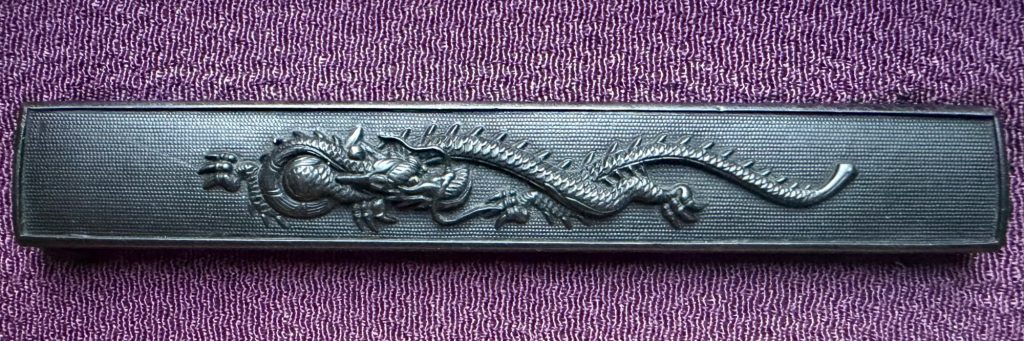
He does not fly. There is no cloud around him, no wave beneath him, no storm to announce him. The dragon lies stretched along this Kaga Goto kozuka, close to the ground, his body drawn into a long low curve, the tail running out toward the far end. The head leads, and before it lies the jewel. One forefoot reaches past it. This is a dragon at rest with the thing every other dragon is shown pursuing.
Die Szene
Japanese art usually shows the dragon rising. The ascending dragon belongs to temple ceilings and sword fittings alike, a creature of thunderheads and climbing water, its energy directed upward and out of the picture. The crawling dragon, hairyu, belongs to the ground rather than the sky. It stays on the surface it inhabits, more serpent than storm, and its power is held rather than spent.
The distinction matters for the man who wore the piece. A dragon in flight displays. A dragon at rest withholds. On an object worn at the side, seen by few and at close range, the second reading carries further than the first.
What is missing matters as much as what is there. There is no landscape, no water, no frame of cloud. The dragon occupies the nanako ground alone, and the ground stays empty around him.
Das Objekt
The ground is shakudo worked in nanako, fine raised granulation struck punch by punch across the whole surface, each dot set against the last until the plate reads as cloth rather than metal. The rows run straight and even. This is the ground most closely tied to the Goto. A raised rim encloses the field. Against it the dragon rises in takabori, high relief. The scales, the spine, the whiskers and the tendons of the limbs are modelled rather than drawn. Iroe picks out the eyes in gold.
Nanako is regular and patient, thousands of identical impressions without a visible break in rhythm. The dragon is the opposite: modelled, irregular, alive. One is discipline. The other is what discipline exists to carry.
Kaga Goto
The Kaga line of the Goto grew from Goto masters who entered the service of the Maeda in Kanazawa in the seventeenth century. Kakujo, born in Kyoto in 1589, became a retainer of the Maeda in 1625 and worked in Kanazawa in alternate years with Kenjo. Sources differ on who founded the line, and the question is not settled here. The same subject, a crawling dragon on fine nanako, appears on a kozuka attributed to Kakujo.
The attribution of this piece rests with the NBTHK, which judged it Kaga Goto at Tokubetsu Hozon level. It carries no signature. Attribution here is a judgement about manner, ground work and carving.
Was bleibt
A dragon without clouds is a decision, not an omission. The maker had the whole vocabulary at hand and used almost none of it. What remains is a creature, a jewel and an empty granulated field, on a surface no longer than a finger. Most of the effect comes from what was left out.
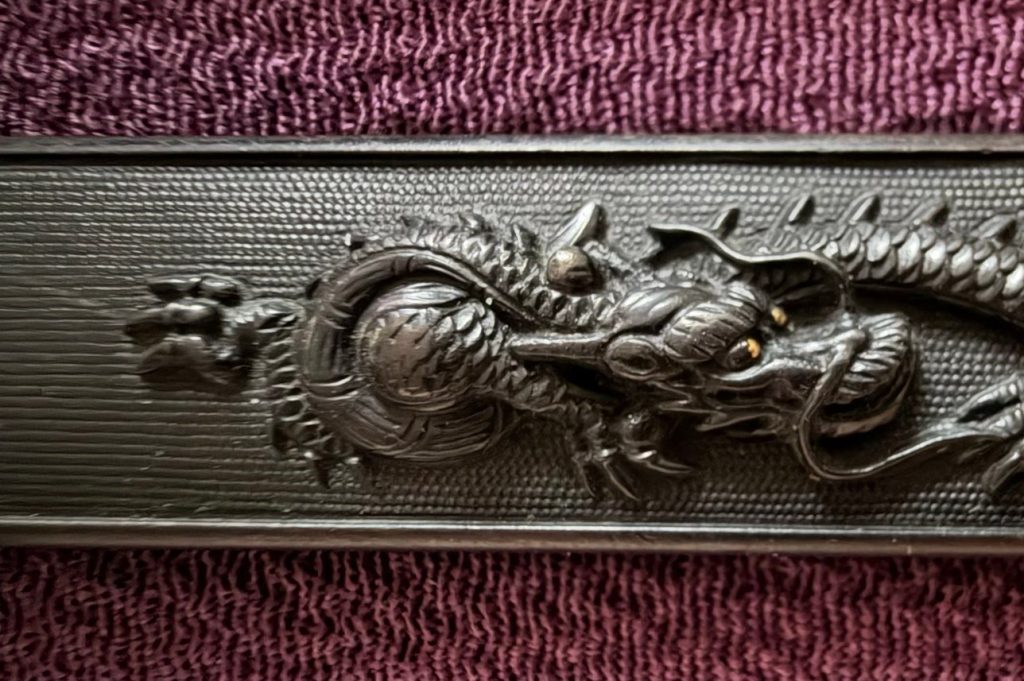
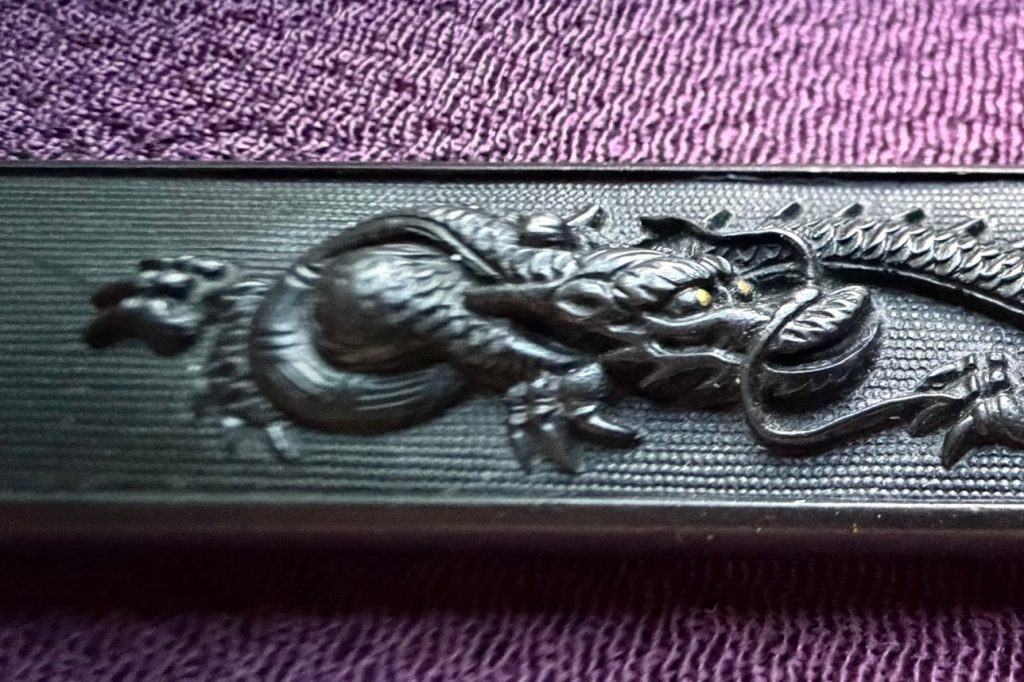
Kozuka Hairyu-zu
Kozuka. Mumei, Kaga Goto. Shakudo, nanako-ji, takabori mit iroe. Hairyu-zu. Edo-Zeit. NBTHK Tokubetsu Hozon. Privatsammlung, erworben in Japan.
In the collection
- Type
- Tosogu › Kozuka
- School
- Goto › Kaga-Goto
- Period
- Edo-Zeit
- Material
- Shakudo
- Motif
- Drachen und Fabelwesen