Zweierlei Maserung
A Wakizashi in Shirasaya
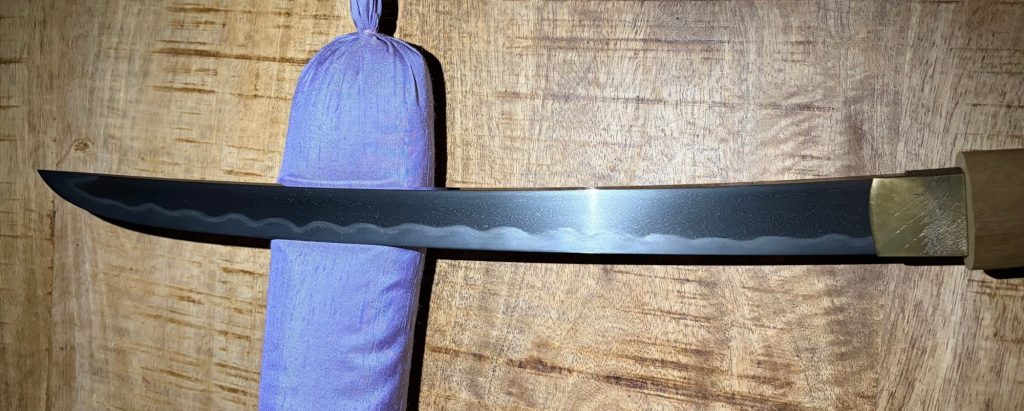
This hira-zukuri wakizashi rests across a cushion of violet silk. Look first just above the habaki. There the steel opens into rings and drifting lines, a grain close to that of the wooden table beneath it. Steel and wood share a texture they arrived at in very different ways.
Das Objekt
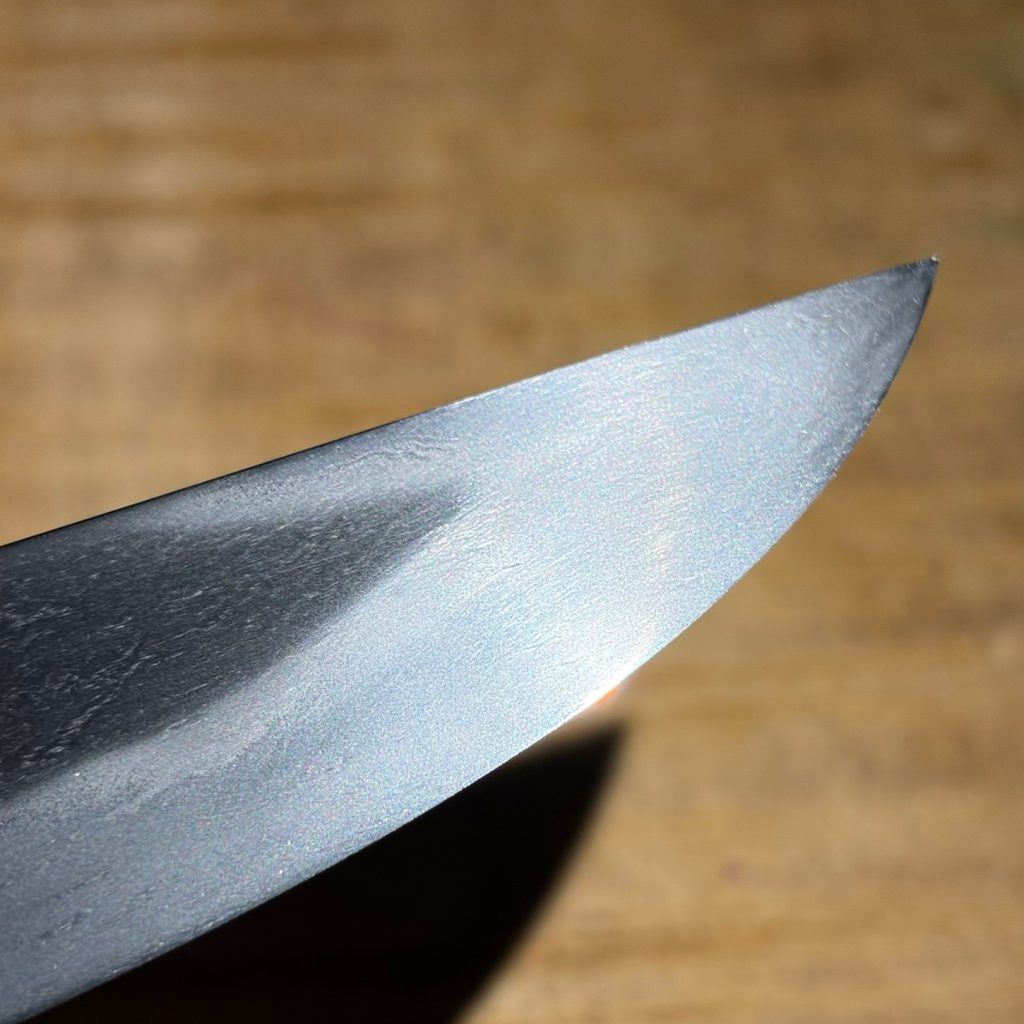
A wakizashi in shirasaya, the plain wooden scabbard in which a blade rests between mountings. The habaki is a single piece in a warm gold tone, its surface worked with fine diagonal file strokes that catch the light like slanting rain. The blade is hira-zukuri, flat-sided without a ridge line, and no yokote marks off the point. The curvature is gentle. Toward the point, the edge swells into a full fukura. In this collection it is one of four wakizashi in this form.
Hamon und Hada
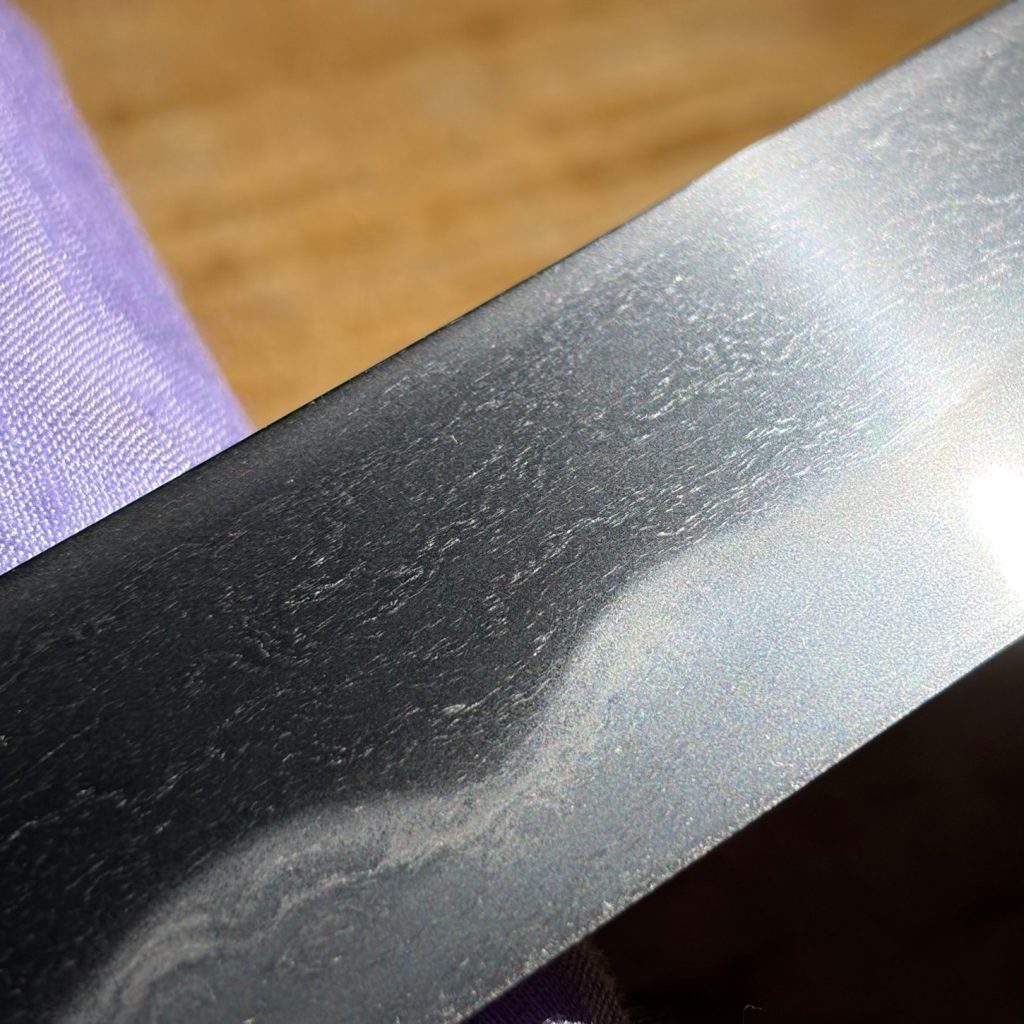
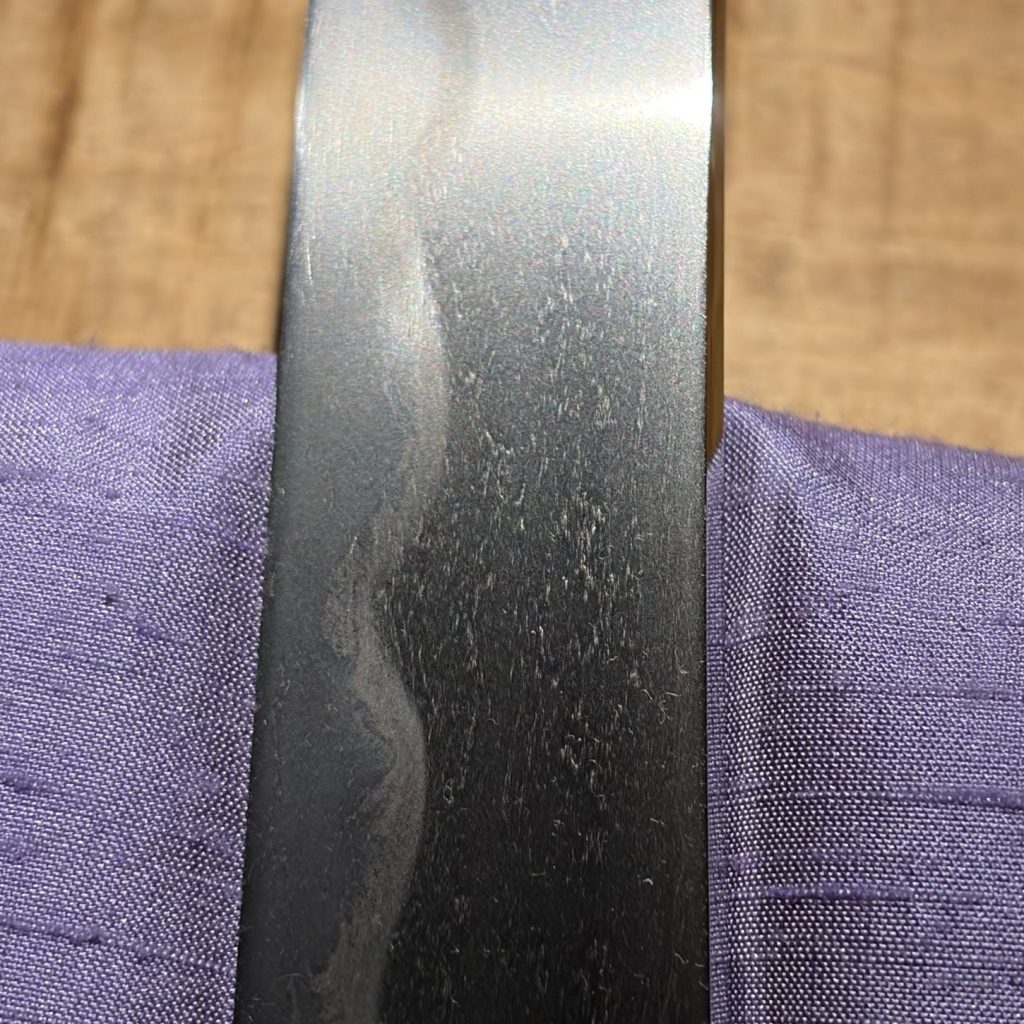
The hamon is a broad notare, a slow rise and fall that runs the length of the blade. Within it sit smaller rounded peaks, close to gunome. It is nie-deki. The line is built from nie, crystals large enough to be seen one by one, and in places it loosens into bright drifts toward the ji. The nie do not stop at the hamon. They lie scattered across the ji as well and flash as the blade moves.
The jihada is itame with clear mokume near the habaki, open enough to read at arm’s length.
Die Spitze
Toward the point the hamon keeps its rhythm and follows the curve of the fukura upward. In the boshi it stays irregular, midare-komi, runs to a point and turns back in a long kaeri.
Seen in moving light, the blade changes from one second to the next. The hamon appears and fades. The grain comes forward and recedes. A photograph keeps only one of these moments. Perhaps that is why the blade is taken out again.
Die Zuschreibung
The blade is unsigned. Two established Japanese dealers who examined it at the Japanese Art Fair in Utrecht placed it with the Fujishima school of Kaga province. It has not been to shinsa, and the attribution rests on their judgement, not on a paper.
By tradition the school goes back to a first Tomoshige. He is said to have moved to Kaga from Echizen in the early Nanbokucho period and to have studied under Rai Kunitoshi. The name was carried on through the Muromachi period, when the school was at its strongest in Kaga.
The Wakizashi in Shirasaya
Wakizashi. Mumei, zugeschrieben Fujishima (ohne Papiere). Hira-zukuri. Notare mit gunome-Elementen in nie-deki, ji-nie, itame mit mokume. Boshi midare-komi, spitz, mit langem kaeri. Shirasaya, einteilige Habaki. Koto. Privatsammlung, erworben in Europa.
In the collection
- Type
- Nihonto › Wakizashi
- School
- Fujishima
- Period
- Muromachi
- Blade period
- Koto