Zwei nach dem Wein
Shoki and Chokaro, after the Wine
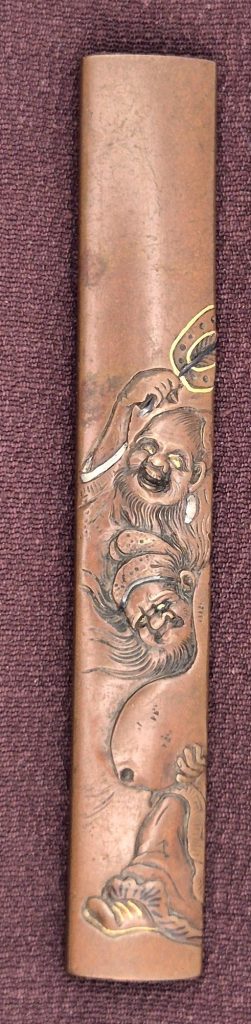
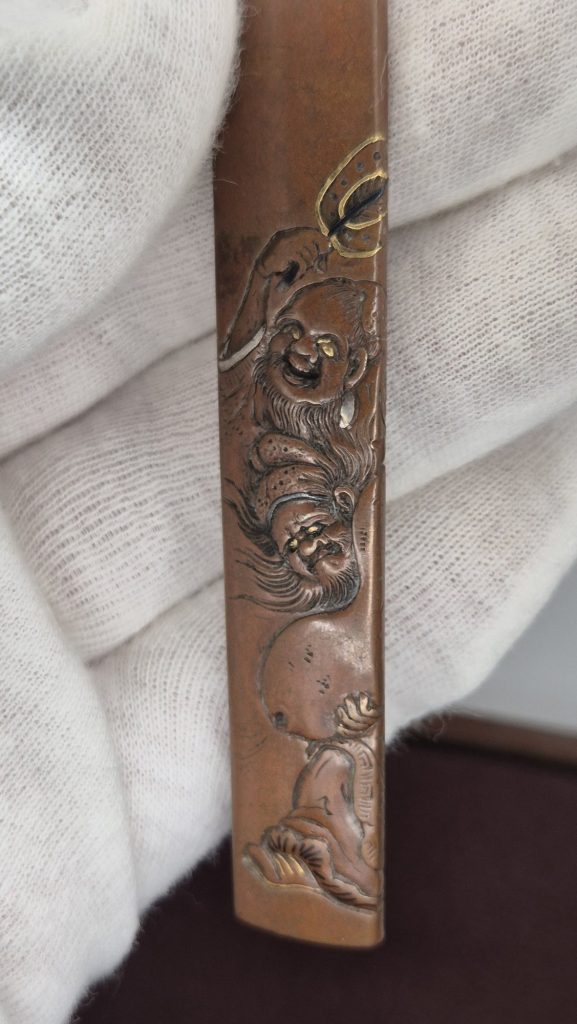
A copper kozuka with two figures carved one above the other. The upper one laughs with his whole face. He is bald and bearded, and he raises a stiff round fan, its rim inlaid in gold. Below him lies the second, wide-eyed under a heavy beard, the rim of a cap across his brow. He holds a large gourd against him, and faint lines curl from its mouth. Gold sits in their eyes, silver in the teeth.
Die Rückseite
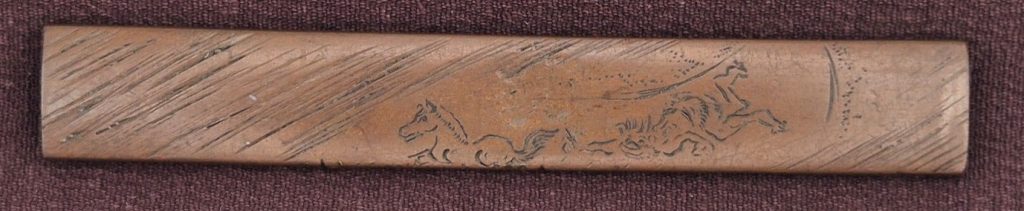
On the back the scene goes on in line. A horse gallops in from the left. Ahead of it a small, hairy figure leaps away with its arms flung wide. A long curve sweeps above them, slanting rain closes both ends, and a thin crescent stands at the right.
Die Szene
The gourd is the key. JAANUS, the dictionary of Japanese art terms, describes Chokaro, the Chinese Zhang Guolao, as one of the Eight Immortals of Daoism. He rode a white mule thousands of miles in a single day. When he rested he kept it in a small gourd, and to bring it back he sprayed water on it from his mouth. On the back of this kozuka the animal runs free.
The man holding the gourd, though, does not look like Chokaro. Large eyes, a bushy beard and an official’s cap are how JAANUS describes Shoki, the demon queller of Chinese legend. He failed the state examination and, after his death, appeared to the emperor in a dream, promising to protect the empire from demons. On the back a demon is running.
So Shoki holds Chokaro’s gourd, and the laughing old man above, by this reading Chokaro himself, waves a fan instead. The two seem to have swapped what they carry. Their faces suggest that wine had a part in it.
Eine Korrektur
An earlier version of this page named the two Kanzan and Jittoku, the laughing Zen eccentrics of Mount Tiantai. JAANUS shows them in ragged clothes, with a scroll and a broom. The two figures here wear robes that read as an official’s dress, and they carry neither. The reading as Shoki and Chokaro goes back to a friend from the NBTHK European Branch, with thanks.
Die Arbeit
The kozuka is suaka, copper left in its own warm colour. The figures are carved in relief, the back is cut in line. The kozuka is unsigned and has no paper. It reads as late Edo work and could come from any of the workshops of the time.
Was bleibt
An immortal and a demon queller, each holding what belongs to the other, and both laughing about it. The joke is small enough to fit a knife handle.
The Shoki and Chokaro Kozuka
Kozuka. Mumei. Suaka, takabori und kebori, iroe in kin und gin. Shoki und Chokaro; Rückseite Pferd und fliehender Oni. Späte Edo-Zeit. Privatsammlung, erworben in Europa.
In the collection
- Type
- Tosogu › Kozuka
- Period
- Edo-Zeit › Späte Edo-Zeit
- Material
- Suaka
- Motif
- Mensch und LegendeGötter und Glücksbringer