Der Dämon auf dem Rücken
Omori Hikoshichi and the Demon
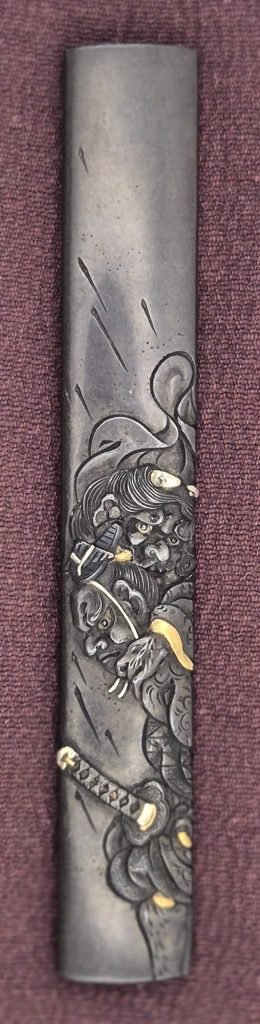
An Omori Hikoshichi kozuka of grey shibuichi. Rain falls across the upper end in short slanting strokes. Below it a warrior bends under a weight on his back, and the weight is a demon: horns and eyes in gold, wild hair, her teeth set into him. His own face turns aside beneath hers, a band tied across his brow. Further down the hilt of his sword shows, its wrapping cut in a fine lattice, and gold touches mark his armour.
Die Szene
The story comes from the Taiheiki, the war chronicle of the fourteenth century. The Art Institute of Chicago, describing a print of the subject by Katsukawa Shunsho from about 1772, retells it after book 23. Omori Hikoshichi, a retainer of Ashikaga Takauji, had fought against Kusunoki Masashige at Minatogawa in 1336. Travelling at night, he met a woman and carried her on his back. On the way she turned into a demon, the vengeful spirit of Kusunoki. He held out against it, but the haunting ended only when monks read the Great Wisdom Sutra for him.
The Walters Art Museum tells the version with a stream. Halfway across, Hikoshichi sees her reflection in the water and knows her for a demon. On the stage she later became Kusunoki’s daughter, a woman behind a demon mask.
On this kozuka the moment of recognition has passed. There is no woman left, only the demon, and she bites.
Die Arbeit
The figures are carved in relief out of the shibuichi, with gold set into the eyes, the horns and the fittings of the sword. The carving does not stop at the face of the handle. It runs over the long edge and across the whole side of the kozuka, as if warrior and demon were pushing out of their frame.
The inlay stays sparing. Most of the effect comes from the carving itself: the demon’s hair, the lattice of the sword wrapping, the rain cut in single strokes.
Die Einordnung
The kozuka is unsigned and has no paper. Style and material point to the late Edo period, perhaps around 1800, and to a workshop in one of the large cities, Kyoto, Edo or Osaka. The sparing inlay speaks against the Kyo-Kinko. The subject is typical of its time; the hand cannot be named.
Was bleibt
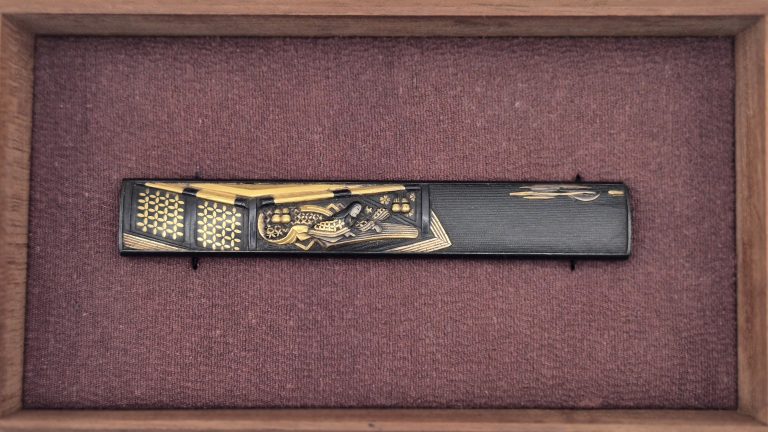
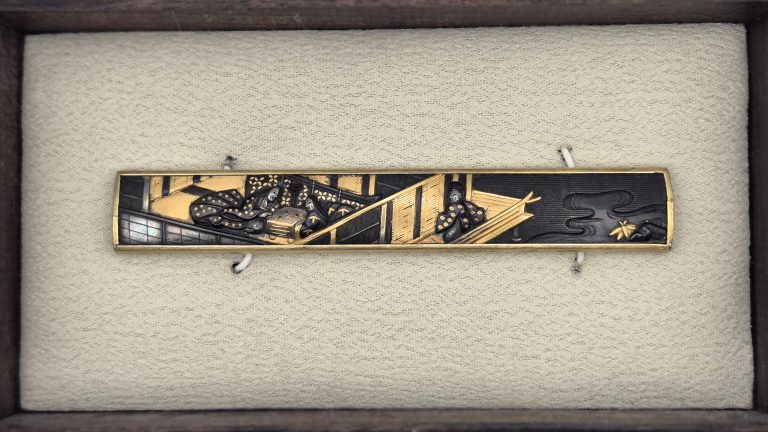
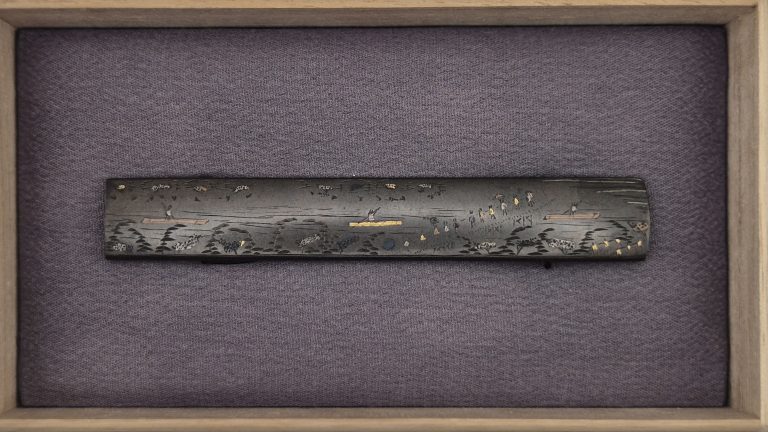
The legend lives on prints and on other sword fittings, as the two museum pieces above show. Here it is reduced to two heads, a sword and the rain, close enough to feel the weight on his back.
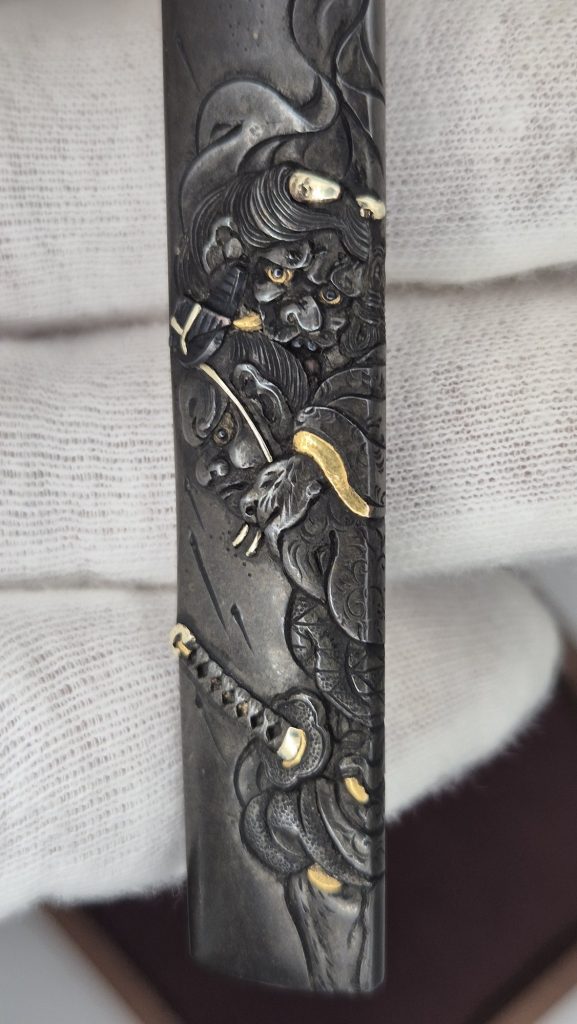
The Omori Hikoshichi Kozuka
Kozuka. Mumei. Shibuichi, takabori und kebori, iroe in kin. Omori Hikoshichi-zu. Späte Edo-Zeit. Privatsammlung, erworben in Europa.
In the collection
- Type
- Tosogu › Kozuka
- Period
- Edo-Zeit › Späte Edo-Zeit
- Material
- Shibuichi
- Motif
- Mensch und Legende