Das Meer, das nie aufhört
Waves inside a Chrysanthemum Rim, Ko-Kinko
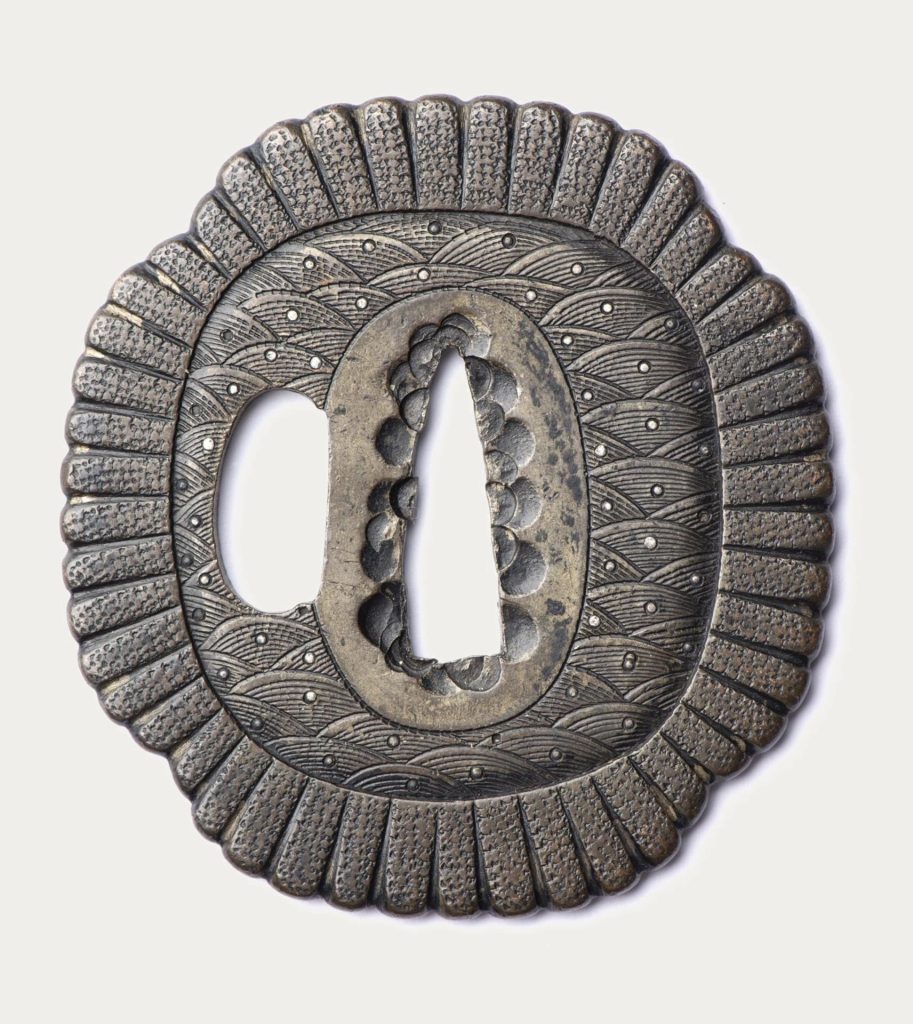
An oval Ko-Kinko tsuba of shibuichi, framed by a rim of chrysanthemum petals. Each petal is ribbed and covered with fine punch marks, and the petals run all the way round. Inside the rim the whole field, on both faces, is cut with waves. They run in rows of overlapping arcs, each drawn in fine lines, with a small silver dot set along the crests. There is no figure and no scene. The pattern is the subject.
Das Objekt
The plate is shibuichi, grey and quiet. The rim is kikka-mimi, the chrysanthemum rim. On one face the tang opening is lined with small plugs, sekigane, that once fitted the guard to a blade.
Seigaiha
JAANUS, the dictionary of Japanese art terms, describes seigaiha as a wave design made of arches of concentric circles laid one over another. In Japan it appears first on the clothing of a haniwa figure, then on court dress of the Heian period and on ceramics and lacquer. Later it covers temple roofs, garden sand and textiles.
Die Signatur
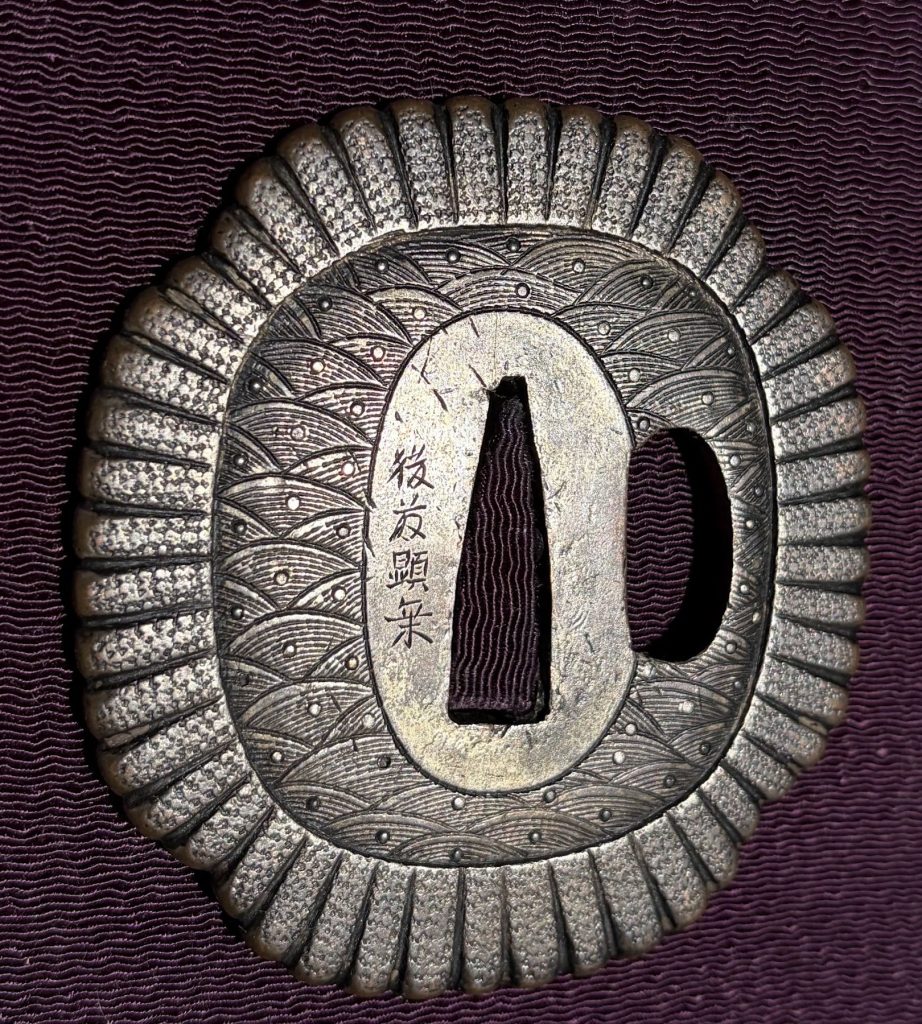
Beside the tang opening a signature is cut: Goto Kenjo, 後藤顕乗. The Metropolitan Museum of Art records Goto Kenjo as the seventh master of the Goto, 1586 to 1663. The collection holds this signature most likely to be a gimei, a false name, added to give the guard a famous one. It may also be an atomei, a name added later by someone who took the guard for Kenjo’s work. That cannot be ruled out.
Die Zuschreibung
The guard has no paper. Ko-kinko means the early work of the soft-metal makers, before the great schools took shape. The collection places it in the Momoyama period, the late sixteenth century, on the evidence of the piece itself. The attribution is its own.
Eine Korrektur
An earlier version of this page called the signature atomei without reservation. A later draft dated the guard to the early Edo period. The date stands at Momoyama. For the signature, gimei now seems the likelier reading.
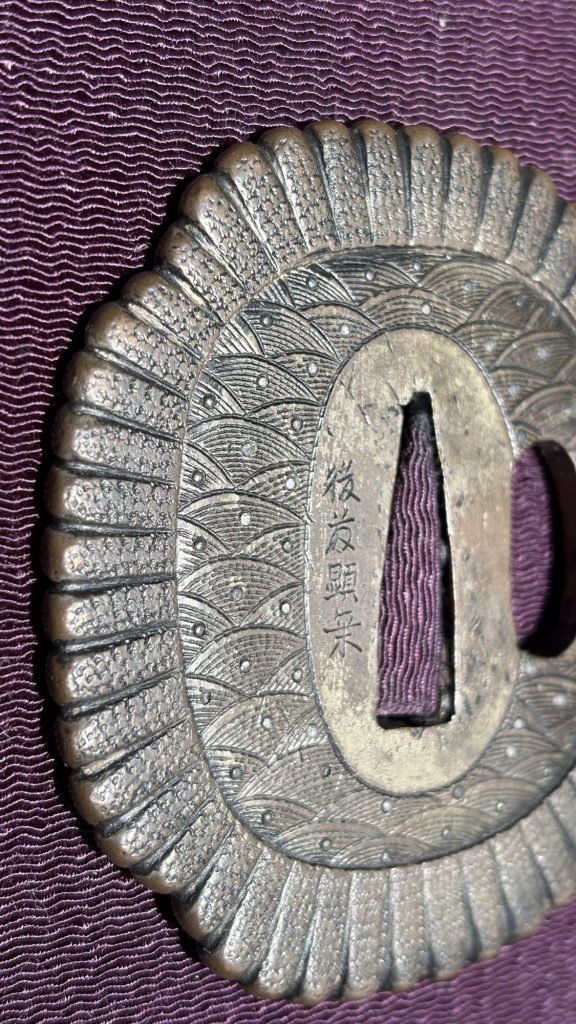
The Ko-Kinko Tsuba
Tsuba. Signiert Goto Kenjo, wohl Gimei, Atomei nicht ausgeschlossen. Ko-Kinko (eigene Zuschreibung). Shibuichi, seigaiha in kebori mit ten-zogan in gin, kikka-mimi, Sekigane. Naga-maru-gata. Seigaiha. Momoyama-Zeit. Privatsammlung, erworben in Europa.
In the collection
- Type
- Tosogu › Tsuba
- School
- Ko-Kinko
- Period
- Momoyama
- Material
- Shibuichi
- Motif
- Mon und Muster