Der Drache aus der Schale
Bowl and Dragon by Tsuneshige
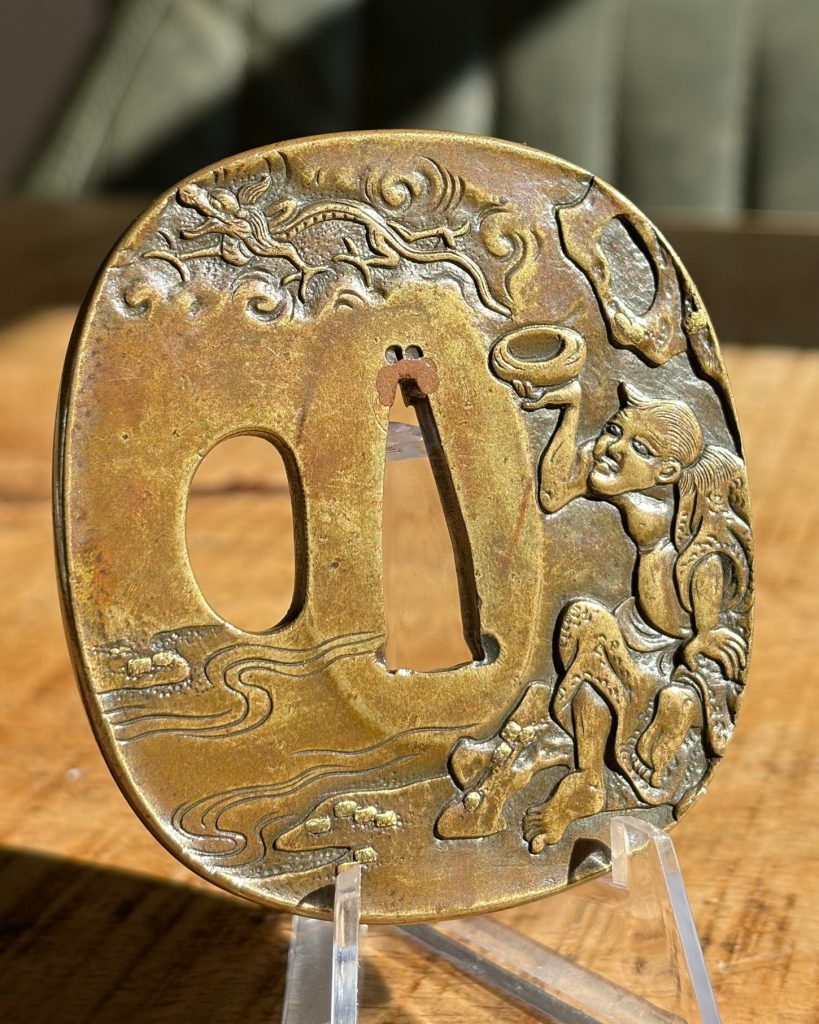
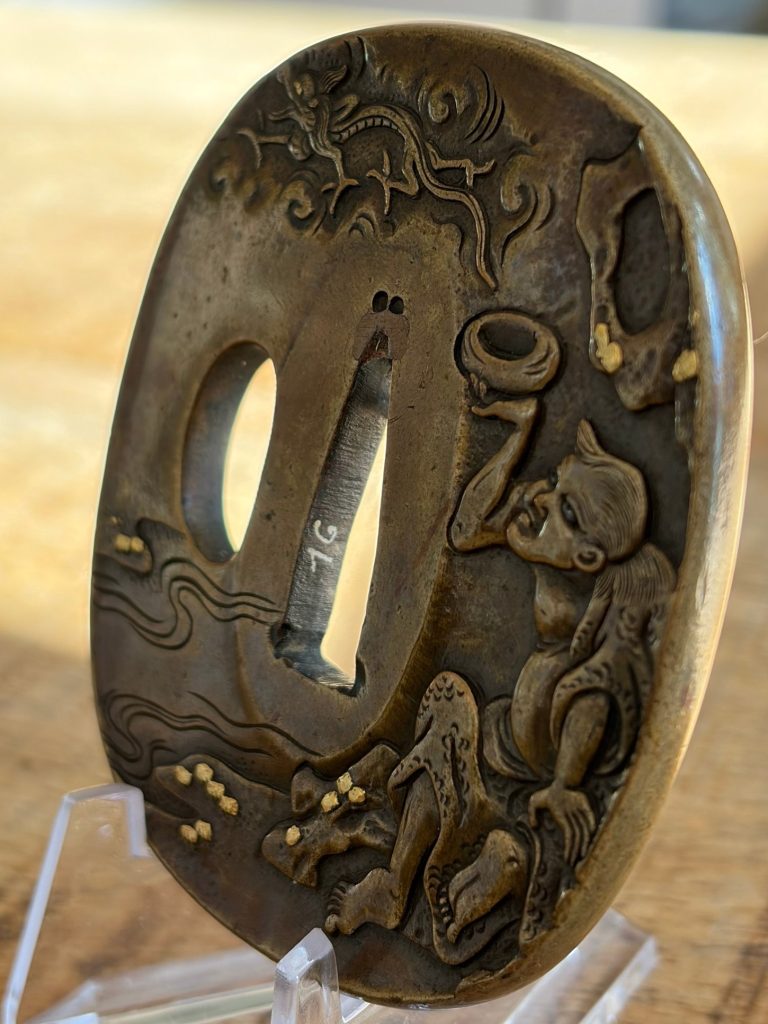
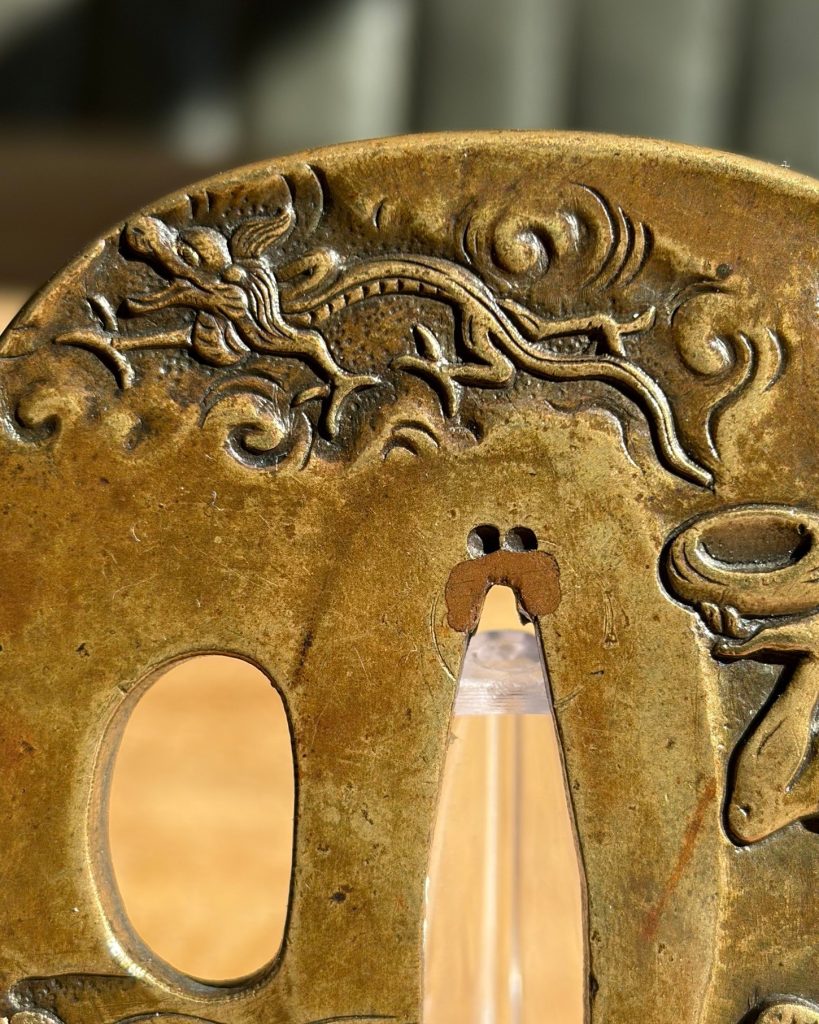
A man sits against a rock and lifts a bowl. Above him, along the whole upper edge of this tsuba by Tsuneshige, a dragon moves through cloud. Between the two lies the empty center of the tsuba, the opening through which the blade passes. The story is told on either side of it. The connection is left to the eye.
Das Objekt
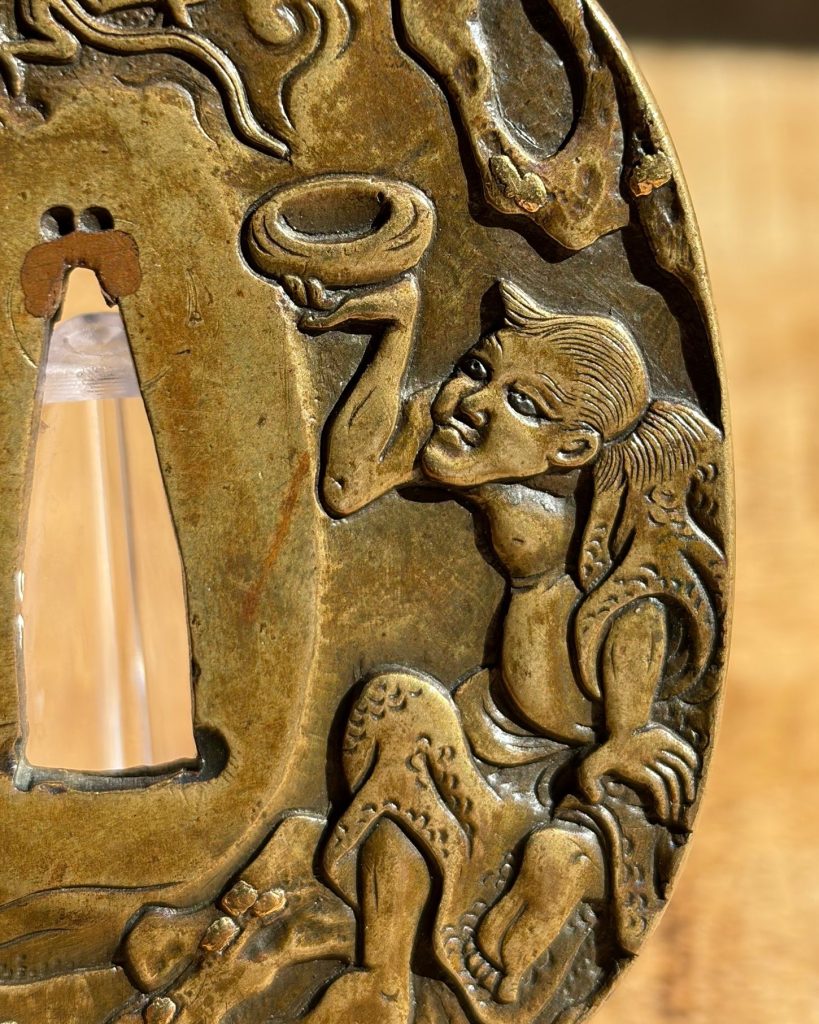
The plate is sentoku, a brass alloy that ages to a warm and uneven gold. The form is a rounded square, slightly taller than wide, with a softly thickened rim. The figure is carved in high relief and stands well proud of the ground: the raised arm, the fingers spread on the knee, the bare toes. Fine engraved strands give the hair its fall. The eyes are darker than the face, which gives the head a sudden alertness. Over one shoulder and across the legs he wears what reads as a garment of leaves.
The dragon is lower and flatter, closer to drawing than to sculpture, its body a long spine of small dots between scrolling clouds. Below the figure a stream crosses the plate in shallow cut lines. Along its banks small grains of gold, inlaid as kin-zogan, sit on the stones like moss catching the light. The same gold touches the rock behind him. It is used sparingly. A few points, nothing more.
Zwei Namen
Two figures in East Asian art keep a dragon in a vessel. Chinnan, the Chinese immortal Chen Nan, calls one out and sends it to bring rain to a country in drought. The Walters Art Museum, describing another tsuba, gives him a gourd. Handaka Sonja, one of the sixteen arhats who followed the Buddha, keeps a dragon as a pet, in a bowl or in a gourd. The Metropolitan Museum of Art notes this on a print by Hiroshige. The Museum of Fine Arts, Boston, uses both names for guards with this subject.
This piece has been read both ways. The figure here wears leaves rather than a monk’s robe, and his hair is long and tied back. That points toward the immortal more than the arhat. The guard itself does not say.
Die Szene
In both stories the dragon comes out of the vessel. Here the bowl is already empty. The dragon is far above and turned away. Only a trailing wisp of cloud leads down from its tail toward the rim of the bowl.
Dragons bring rain, and the stream below completes the thought. Water above, water below, and between them a man who has just released something he does not need to hold. His expression is not triumph. It is closer to curiosity, perhaps amusement.
Die signierte Seite
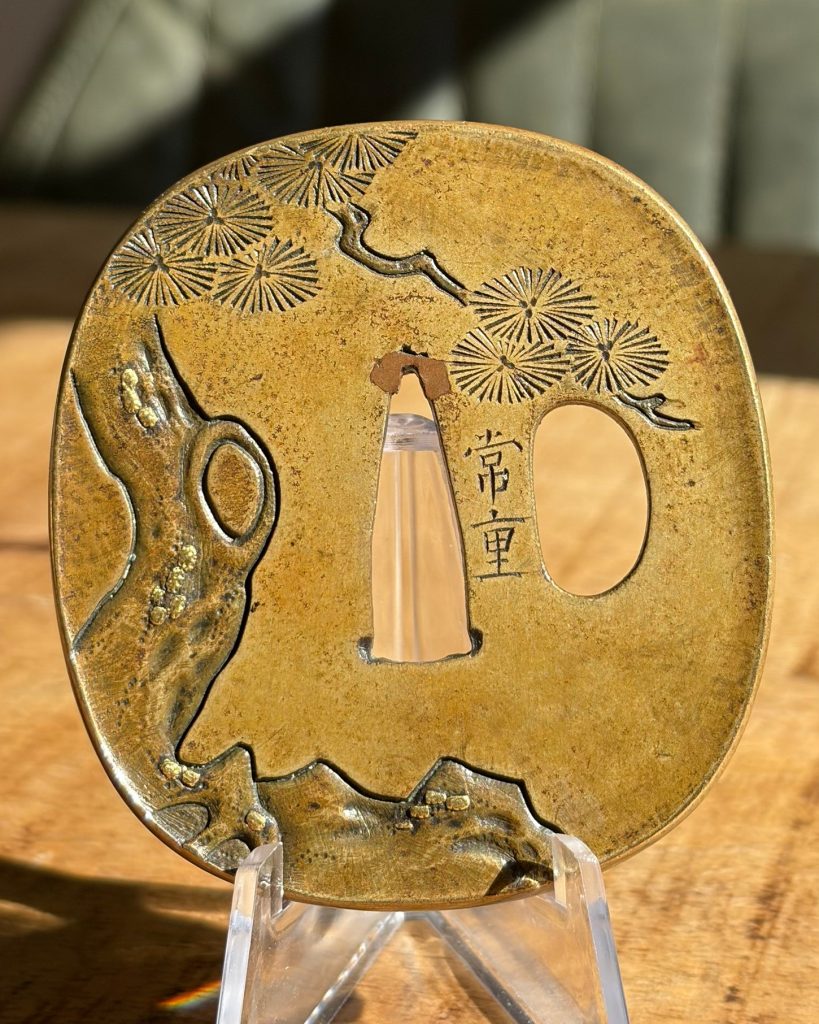
The other face is quiet. A pine branch reaches in from above, its needles cut as small radiating bursts. An old trunk rises along the left edge, hollowed by a knot. Low hills close the lower rim, again touched with gold. The rest is open ground. Between the nakago-ana and the hitsu-ana, cut in a clear hand: 常重, Tsuneshige.
One face holds the miracle, the other holds a tree. The pine keeps its needles through every winter and needs no legend. It simply endures. It is hard not to read the two sides as a pair: the sudden and the constant.
Museum catalogues know the name in two forms. The Metropolitan Museum of Art lists Kawamura Tsuneshige of the Nara school, active in the late eighteenth century. The Museum of Fine Arts, Boston, files a guard with a sennin and a tiger under a Tsuneshige sub-school of the Nara line. Haynes records a Tsuneshige as a pupil of Nara Tsunetsugu. Whether a given piece is the master’s own hand or the work of his circle is a question for the whole group, not for one guard.
Die Nummer 16
Inside the nakago-ana, in white paint, someone has written 16. It is an inventory number from an earlier collection, placed where no one would see it once the tsuba was mounted, and where it could not be lost. Who wrote it is not yet known.
The number stays. It belongs to the object now, as much as the wear on the rim. In this collection the tsuba is the sixth piece signed Tsuneshige. In the last one it was number 16. Both are ways of saying the same thing: someone looked closely and decided to keep it.
Tsuneshige’s Bowl and Dragon Tsuba
Tsuba. Tsuneshige. Sentoku mit takabori, kebori und kin-zogan. Kaku-gata mit gerundeten Ecken. Figur mit Drache und Schale (Chinnan Sennin oder Handaka Sonja), Rückseite Kiefer und Fels. Edo-Zeit. Signiert. Alte Sammlungsnummer 16 im Nakago-ana. Privatsammlung, erworben in Europa.
In the collection
- Type
- Tosogu › Tsuba
- School
- Nara › Tsuneshige
- Period
- Edo-Zeit
- Material
- Sentoku
- Motif
- Mensch und LegendeDrachen und Fabelwesen