Der Unsterbliche und seine Kröten
Gama Sennin, Nara School
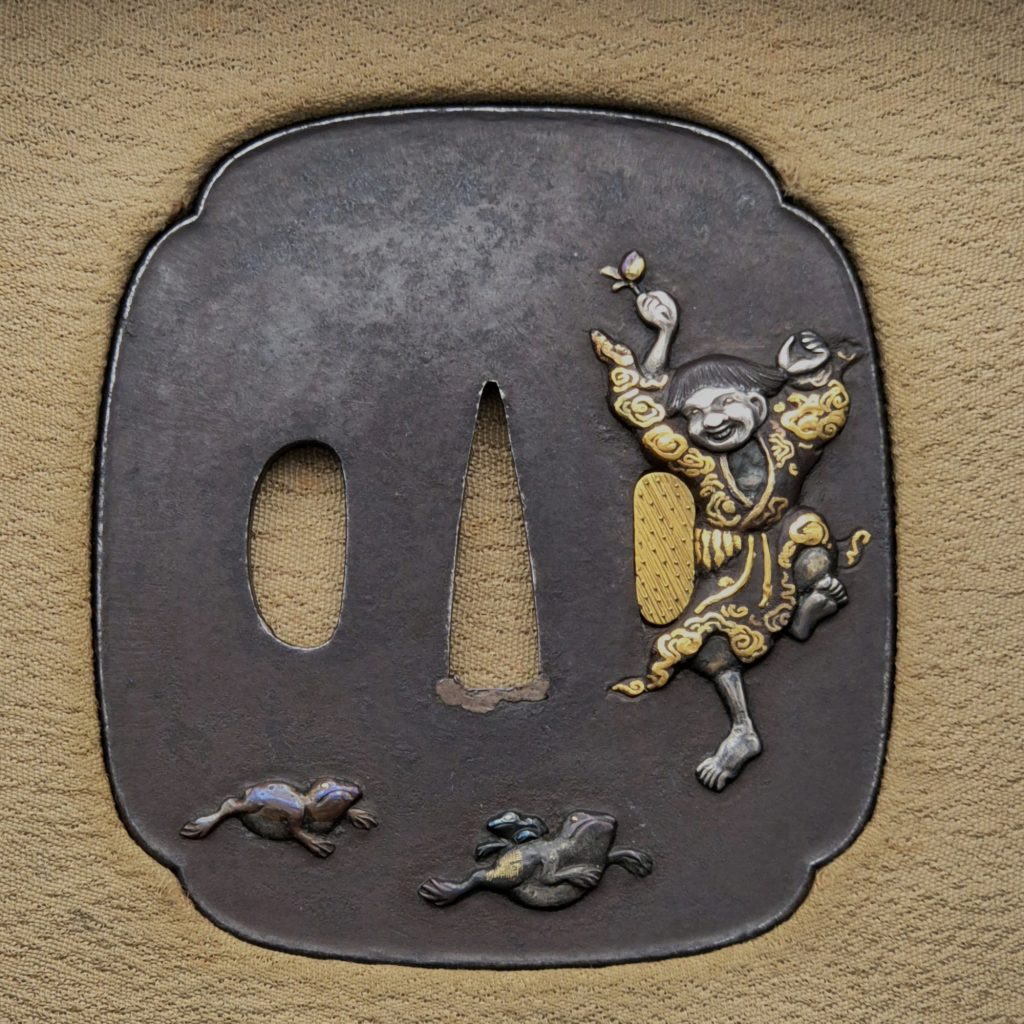
An iron Gama Sennin tsuba, almost square, its corners rounded and notched. On the right of the front the immortal dances on one leg, laughing, one arm thrown up with a small bell in his hand. His face and hands are silver, his robe gold with curling cloud scrolls. Two toads cross the lower edge, one dark, one red-brown with gold spots. One hitsu-ana is closed with gold, cut in fine diagonal lines. The other is left open.
Das Objekt
The ground is plain iron, left dark, and everything else is set into it in other metals: gold, silver, copper and shakudo, in relief. On the back the immortal appears again at the left. He stands bent over a staff, his robe gold, with a toad at his feet. Above him the maker has cut three fine lines into the iron. He turns his head away from them, and they may be meant as spittle.
Gama Sennin
JAANUS, the dictionary of Japanese art terms, describes Gama as a high official of the state of Jin who retired to Nanshan to learn Daoist magic. He is known in China as Liu Haichan. He is recognised by the large three-legged toad that perches on his shoulder. In one account the toad lived in a swamp until Gama lured it out with gold coins strung on a stick, and he could fly riding on its back.
Here the toad is not on his shoulder. There are two of them, and they keep to the ground while he dances.
Nara
The guard has no paper, and the attribution to the Nara school is the collection’s own. A. J. Koop, cataloguing the A. H. Church collection for the Ashmolean Museum, writes that the early Nara style favours inlay of the soft metals on iron grounds, in realistic designs. This guard is built in that way.
Eine Korrektur
An earlier version of this page named iron at the head of the page and shibuichi in its closing line. The plate is iron.
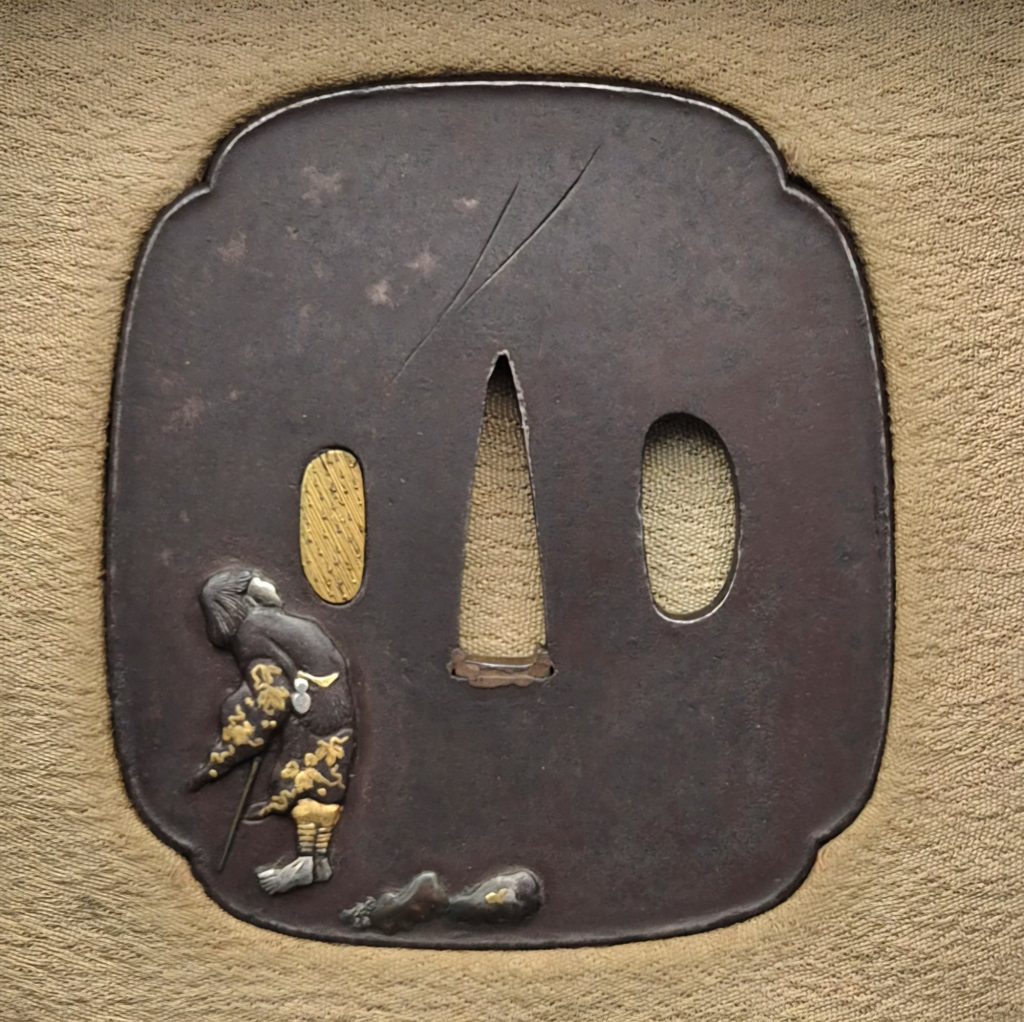
The Gama Sennin Tsuba
Tsuba. Mumei, Nara (eigene Zuschreibung). Tetsu, iroe-takazogan in kin, gin, akagane und shakudo, ein Hitsu-ana mit Gold verschlossen. Kaku-gata mit gekerbten Ecken. Gama sennin-zu. Edo-Zeit. Privatsammlung, erworben in Europa.
In the collection
- Type
- Tosogu › Tsuba
- School
- Nara
- Period
- Edo-Zeit
- Material
- Tetsu
- Motif
- Mensch und Legende