Die Gänse kommen herab
Descending Geese, Toryusai School
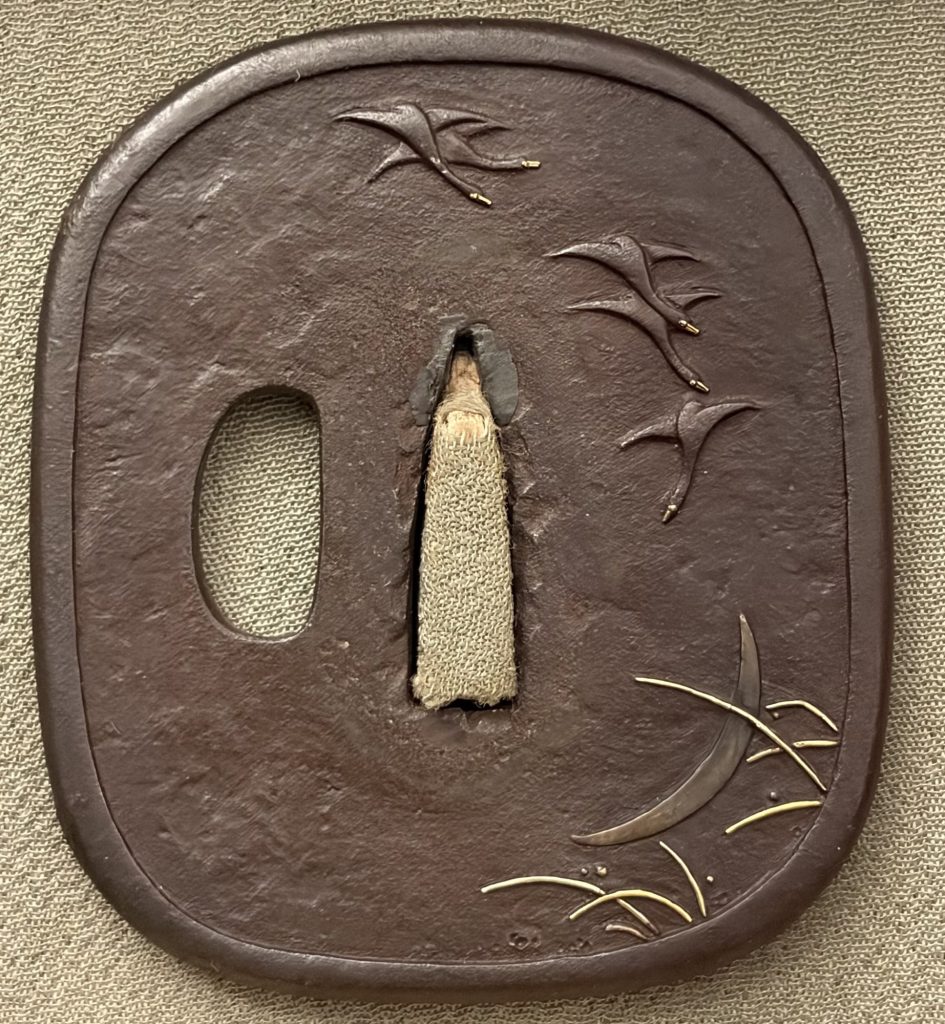
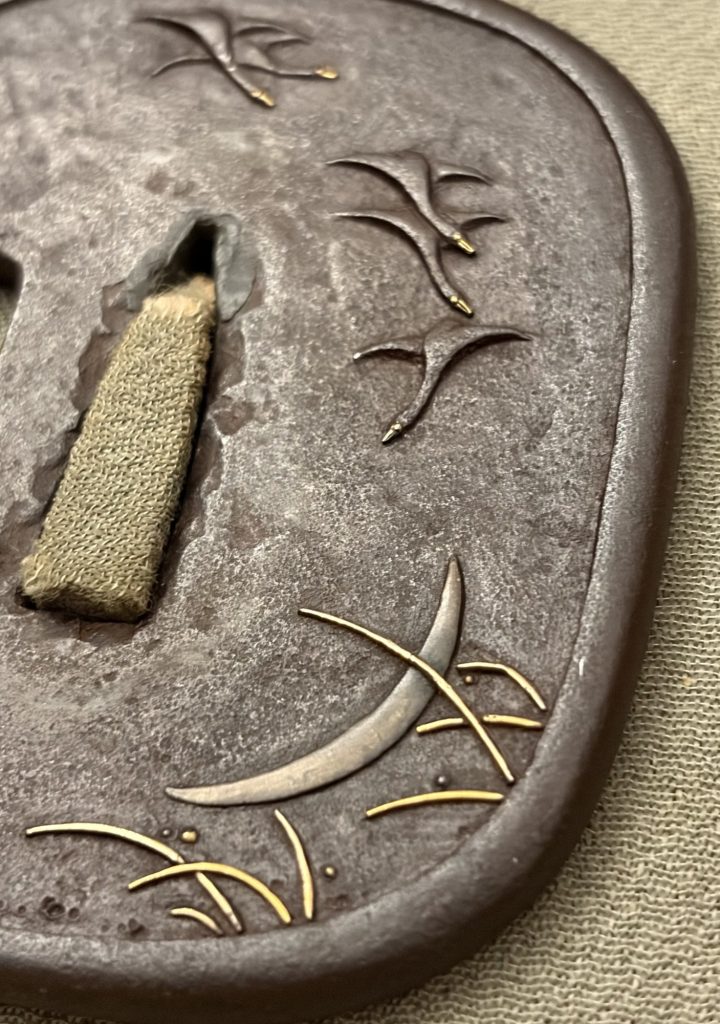
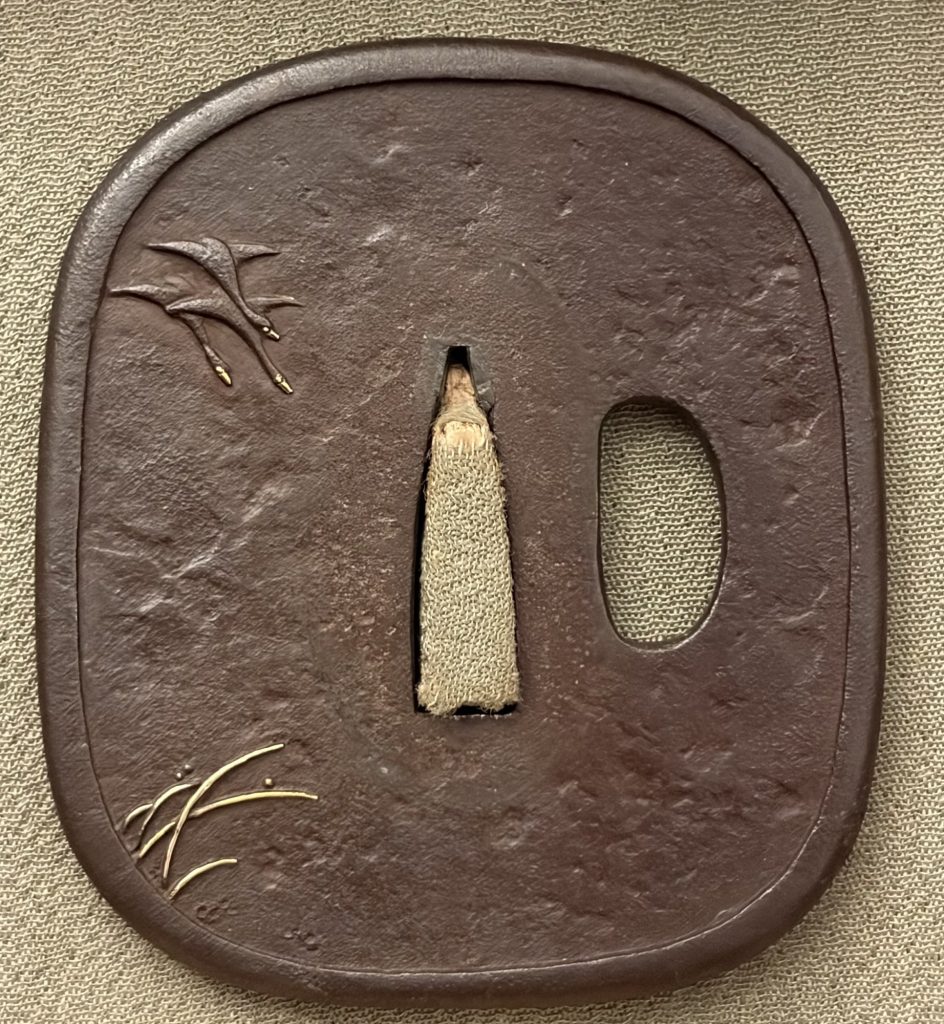
Wild geese come down toward the water. The paper calls the subject rakugan, descending geese. The plate is iron with a hammered surface, a rounded square with a thick, rolled rim. On the omote five geese fly in from the upper right, and below them a thin crescent moon lies among reeds. On the ura three more geese cross the upper left, and a tuft of reeds answers them below.
Das Objekt
The paper reads nade-kaku-gata, iron in tsuchime-ji, takabori with iroe, dote-mimi. The hammered ground is not decoration in the usual sense. Each blow leaves a small facet, and together they catch the light unevenly, the way water does in wind. Against this restless field the geese stand out in relief, carved from the iron, their beaks touched with gold. The reeds are laid in gold, the moon in silver. The heavy rim closes the scene like the frame of a window.
Das Motiv
Descending geese are one of the Eight Views of Omi, the classical sequence of scenes around Lake Biwa: the geese settle at Katata. Prints from that series by Nishimura Shigenaga in the Honolulu Museum of Art carry the title Katata no rakugan. Whether this guard points to Katata or simply shows the birds coming in to land, the plate does not say. The crescent moon reads as evening: the geese come down at dusk. It is the moment just before arrival, when the flight is over and the ground is not yet reached.
Die Schule
The NBTHK attributes the guard to the Toryusai school. The name belongs to Tanaka Kiyotoshi of Edo. The Museum of Fine Arts, Boston holds an iron guard dated 1864 and signed Toryusai with the seal Kiyo, and files his work under a Tanaka school. In the catalogue of the Church collection at the Ashmolean Museum, the group of the Tanaka (Toriusai) school includes two mokko guards with wild geese, one among clouds and one in flight. The subject belonged to the school’s repertoire. Who cut this guard, the paper does not say.
Was bleibt
The guard came to this collection on the mounting of a Muromachi wakizashi by Tsunahiro, where another guard has since taken its place. A nineteenth-century guard on a sixteenth-century blade: mountings changed as their owners changed. The geese have moved on as well. They are still coming down.
The Toryusai Rakugan Tsuba
Tsuba. Mumei, Toryusai-Schule. Tetsu tsuchime-ji, takabori mit iroe in Gold und Silber. Nade-kaku-gata, dote-mimi. Rakugan-zu mit Mondsichel und Schilf. Späte Edo-Zeit. NBTHK Hozon. Ehemals an der Tsunahiro-Wakizashi dieser Sammlung. Privatsammlung, erworben in Europa.
In the collection
- Type
- Tosogu › Tsuba
- Period
- Edo-Zeit › Späte Edo-Zeit
- Material
- Tetsu
- Motif
- Tiere und Vögel