On a Danish doctor, 1,719 tsuba, and the act of giving something away before it could be taken.
“He never went to Japan.”
This is worth stating at the outset, because the assumption runs deep in this field: that a collection of any depth must have been built, at least partly, through proximity — through time spent in Tokyo or Kyoto, through relationships with dealers and scholars cultivated over years on the ground, through the particular education that only comes from handling objects in the country that made them. Georg Oeder spent seven years in Tokyo. Walter Fahrenhorst made the journey more than once. Henri Vever sent letters to Hayashi Tadamasa from Paris, asking to be first to see whatever arrived.
No Question: A truely European Journey
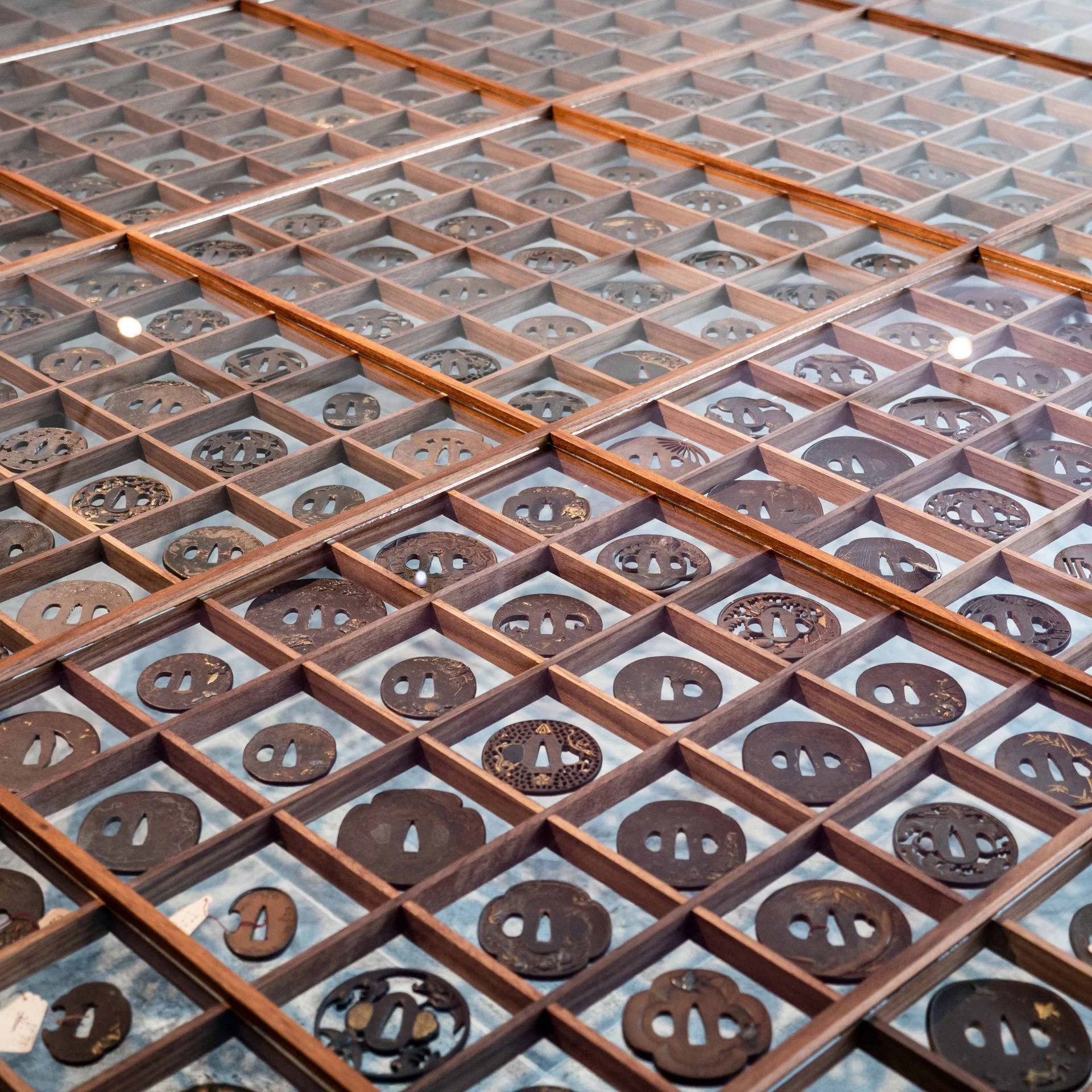
Hugo Halberstadt acquired 1,719 tsuba without leaving Europe. He did it through auctions — moving across the continent, attending sales, looking hard at what was offered, and buying what he judged to be worth having. What resulted from this process is described today by Designmuseum Danmark, which has held the collection since 1943, as one of the finest in the world. Possibly the finest, full stop.
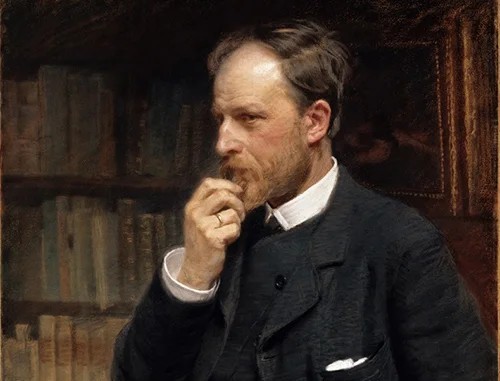
The biography is not richly documented. Halberstadt was born on 11 February 1867 in Berlin, into a family engaged in wholesale trade. He came to Copenhagen, studied medicine, and practised there for the bulk of his adult life. His collecting ran in parallel with his profession — a private pursuit, conducted without institutional support, without the scholarly networks that shaped the German and British collectors of his generation, and apparently without any particular wish for recognition. There is no large-scale published catalogue of his collection that he himself produced. The catalogue that exists — Hugo Halberstadts Samling af Japanske Sværdprydelser, published by the Designmuseum in 1953 with a preface by Erik Zahle — appeared eight years after Halberstadt’s death, as a posthumous act of documentation. He collected; someone else wrote it up.
What he did produce was the Halberstadt Notes. Every time he purchased a tsuba, he recorded it — in his own hand, occasionally accompanied by Japanese characters he had taught himself to reproduce, occasionally with a small sketch. The museum has kept these notebooks with the collection. They are, in their way, as interesting as the objects they describe: evidence of a man working without a teacher, building his own vocabulary for things that had arrived in Europe without their interpretive framework intact. The Japanese characters he wrote down were not decoration. They were an attempt to hold on to something that the auction catalogue could not supply.
The auction circuit he moved through was the same one that had been forming since the 1880s — the dispersal of European collections as their first-generation owners aged and died, supplemented by the continuing outflow of objects from Japan. Halberstadt was operating in the 1920s and 1930s, which meant he had the advantage of working at a moment when the great Edwardian collections were beginning to come apart. What Gilbertson, Behrens, and Hawkshaw had assembled in London, what the French and German collections had accumulated in the decades around the turn of the century, was beginning to flow back into the market through exactly the kind of sale that Halberstadt was attending. He was, in a sense, a second-generation European collector — someone who acquired not from the primary dispersal out of Japan, but from the secondary dispersal out of European hands.
This gave his collection a particular character. A doctor who attended European auctions, reading objects without the benefit of direct instruction in Japan, would have selected differently from a connoisseur trained in Tokyo — or from a dealer’s client shaped by the fashions of the London or Paris market. What he chose, and how consistently he chose well, is attested by the judgment of those who subsequently examined the collection. The quality of the holding, across 1,719 pieces drawn from the major schools of the Edo period, speaks to an eye that was not merely acquisitive but genuinely discriminating — an eye trained not by tradition but by sustained, attentive looking at a very large number of objects over a long period of time.
The Time of War
Then came 1943. Denmark had been under Nazi occupation since April 1940. By 1943 the climate for Jewish Danes had become actively dangerous. The German decision to proceed with deportations was in preparation, though it would be forestalled in October of that year by the extraordinary organised rescue that transferred most of Danish Jewry to Sweden by fishing boat. Halberstadt did not wait for October. He deposited his entire collection — all 1,719 pieces — with the museum, and then made his way to Sweden independently, without the assistance of the fishing network.
The act of deposition was not, or not only, a practical decision. It was a judgment. He knew the objects were safer in an institution than in his possession. He knew, also, that an institution could outlast whatever was coming in a way that a private individual in flight could not. The collection, which he had spent decades assembling piece by piece, was given away before it could be taken. He survived; the collection survived. He remained in Sweden after the war and died there in 1945, at 78, without returning to Copenhagen.
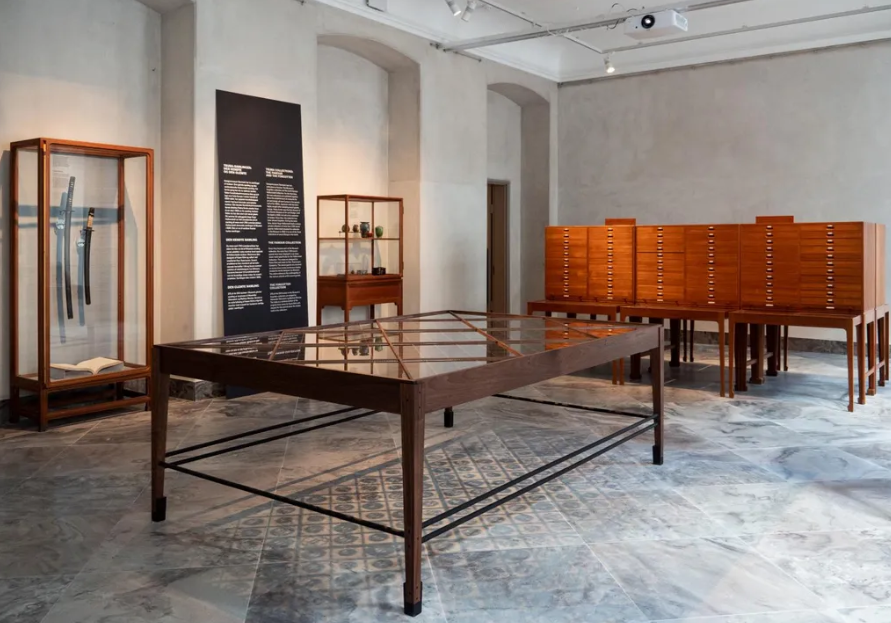
What happened to the objects in the years between the donation and his death belongs to the institutional history of the museum rather than to Halberstadt’s own story. The collection was first housed in a cabinet built by Johan Rohde — the Arts and Crafts designer who had collaborated with Georg Jensen, whose lemon wood and ebony construction was as formally precise as anything Rohde produced for the silversmith’s workshop. In the 1950s, when the cabinet proved too small for proper display, it was transferred to a larger drawer cabinet designed by Kaare Klint, the architect who had redesigned the museum building in the 1920s and whose influence on Danish furniture design was then at its height. Two names that define the lineage of modern Danish craft — Rohde and Klint — built the furniture that held a collection of Japanese sword guards assembled by a Copenhagen doctor at European auctions.
The Renovation in Copenhagen
The chain is precise. It connects Halberstadt to Pietro Krohn, whose Japonisme had helped establish the museum’s initial engagement with Japanese decorative culture. Krohn’s much smaller tsuba collection, gathered during his directorship, had ended up in storage when Halberstadt’s donation arrived — overshadowed by the sheer scale and quality of what a private collector, working alone and without academic support, had assembled. When the museum reopened in 2022 after a two-year renovation, a new cabinet by the Copenhagen studio of Mathias Mentze and Alexander Ottenstein — drawing on the materials of the Rohde cabinet and the formal vocabulary of Klint’s — was built to house Krohn’s collection alongside Halberstadt’s for the first time. The two collections, separated by nearly eighty years, were finally shown together.
The Halberstadt collection raises a question that none of the other collectors in this series quite poses: what does it mean to understand objects you cannot trace to their origin? He had no Japanese teachers. He had no correspondence networks like Vever’s or Fahrenhorst’s, no institutional backing like Brinckmann’s. He had the auction catalogues, his own eyes, and the notebooks he kept afterwards. The quality of the collection is an answer to the question, of a kind — but it is not a comfortable answer for those who believe that serious engagement with Japanese art requires proximity to Japan. Halberstadt achieved something that most of his contemporaries in the field, with their greater resources and institutional connections, did not: a holding recognised by the museum that received it as among the finest anywhere in the world.
He collected what he could not keep, and kept it by giving it away.
Sources
- Embassy of Japan in Denmark. “Letter from Ambassador — Dr. Hugo Halberstadt and the brims (‘Tsuba’) of Japanese swords.” 26 February 2021. (dk.emb-japan.go.jp) — The most detailed publicly available account of Halberstadt’s life, the donation, and his escape to Sweden.
- Zahle, Erik (preface). Hugo Halberstadts Samling af Japanske Sværdprydelser. Copenhagen: Designmuseum Danmark, 1953. — The primary catalogue of the collection; 61 pages, 12 plates, 50 tsuba illustrated.
- Wallpaper. “Copenhagen’s Designmuseum Danmark reopens after two-year renovation.” October 2022. (wallpaper.com) — Documents the Rohde cabinet, the Klint transfer in the 1950s, and the Mentze/Ottenstein cabinet for the 2022 reopening.