On a Hamburg merchant, a year in Japan, and the moment before anyone knew what tosogu was.
He was not, in any conventional sense of the word, a collector.
This matters as a starting point, because the figures who appear elsewhere in this series — Oeder, Jacoby, Fahrenhorst, Halberstadt, Baur — were collectors in the full meaning of the term: people who assembled objects for the long term, who kept what they found, who built holdings that grew more coherent over time. Siegfried Bing assembled, distributed, dispersed, and moved on. His private collection — the one he kept for himself rather than sold — was broad and substantial and was eventually sold at the Galerie Durand-Ruel in Paris in 1906, the year after his death, in one of the largest orientalia sales of the period.
He was, at the core, a dealer
But to describe Bing only as a dealer is to miss what made him singular. He was the man who, more than any other, created the conditions in which European collecting of Japanese art became possible at all. Without Bing’s gallery on the Rue de Provence, without his periodical Le Japon Artistique, without his network of dinners and exhibitions and introductions and carefully staged encounters between objects and the people who would eventually buy them, the collecting world that produced Vever and Goncourt and Hayashi and, downstream, the whole German and British tradition documented in this series, would have looked entirely different. He was not the first European to notice Japanese art. He was the first to make noticing it a systematic operation.
He was born on 26 February 1838 in Hamburg, into a prosperous family with deep roots in the ceramics trade. His father had established a porcelain manufacturing business in Paris, and it was to manage the French end of this enterprise that Bing relocated at the age of sixteen — in 1854, twelve years before most Europeans had heard of the Meiji Restoration, fifteen years before the opening of Japan to Western commerce had produced the first significant flow of objects westward. He became a naturalised French citizen in 1876. He spoke German at home and thought in commercial categories shaped by a Hamburg mercantile upbringing. He was, throughout his Parisian career, the German in Paris — and the tension between these two identities, the Hamburg merchant’s instinct for volume and distribution and the Parisian aesthete’s concern with quality and presentation, is visible in everything he did.
The 1878 Exposition Universelle was the moment that crystallised his direction. Japan was exhibited prominently; the French public’s appetite for Japanese objects, already significant after two decades of selective exposure, turned into something closer to obsession. Bing had been trading in Asian objects since the mid-1870s through his shop at 19 Rue Chauchat. After 1878, he understood that what he was doing could be done at a different scale, with different ambition, and with a different claim on the attention of the serious collector.
In 1880 he went to Japan
He went with his brother-in-law Michael Baer, who served as Germany’s Honorary Consul in Tokyo — a connection that opened doors unavailable to most European visitors. His younger brother August had already been in Yokohama since 1879, managing the family’s trading operations there: sourcing objects, handling shipments, maintaining relationships with Japanese dealers and collectors. The Bing family operation in Japan was not a single trip but a sustained commercial presence. Siegfried was the intelligence behind it; August was the man on the ground. Between 1879 and 1889, when August finally returned to Germany, the Yokohama office functioned as a systematic pipeline from the Japanese market to Paris.
What Bing found when he arrived in Japan in 1880 was precisely what Moslé, arriving four years later, would also find: the Meiji dispersal at full flood. The sword prohibition of 1876 had been in effect for four years. The samurai class was being dissolved into a new social order that had no institutional use for the objects that had defined it. Into this situation walked a Hamburg-born merchant with commercial instincts, an eye trained on the ceramics trade, a brother already embedded in the Yokohama market, and a consul brother-in-law with access to the Tokyo collecting world that most foreigners could not reach.
He bought everything he considered worth carrying. The phrase comes from an account of the trip and is worth taking seriously as a description of method. He was not a systematic collector in the Jacoby sense, mapping a field and filling its gaps. He was a trader making selections under time pressure — but a trader whose taste was already formed, whose eye had been sharpened by years of handling objects in Paris, and who understood better than almost any European alive what the French market would respond to.
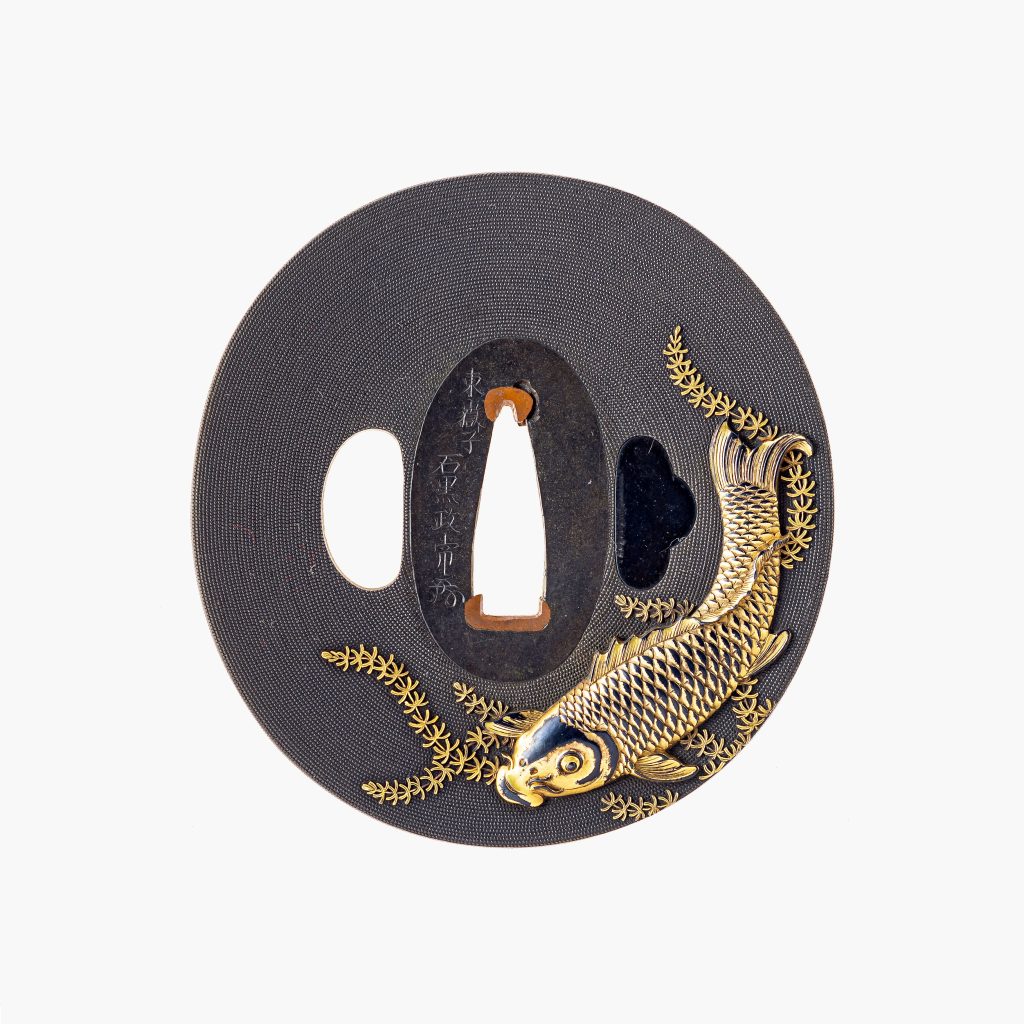
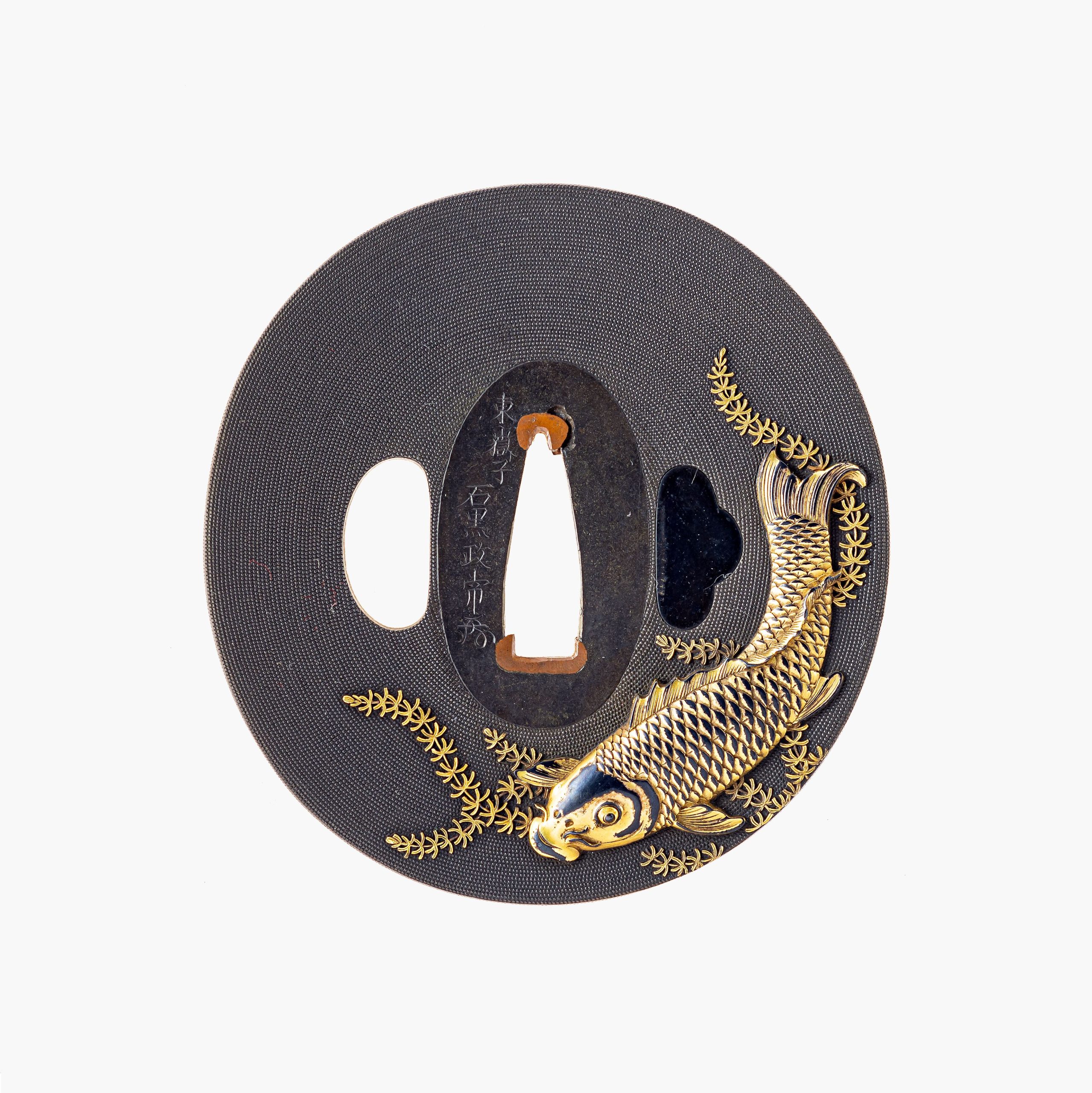
The metalwork he acquired in 1880–81 included what the period would have called bronzes and lacquers and what we, with more precision, would identify as including tosogu — sword fittings, guards, kozuka, fuchi-kashira — the portable, non-weapons-law-constrained metalwork of the sword tradition that was flooding the market as samurai households liquidated their heirlooms. The 1887 sale catalogue of the S. Bing collection, held in Paris and New York, lists “Metalwork” among the categories alongside porcelains, jades, bronzes, lacquers, crystals, and ivories. The 1883 Gonse exhibition — the first large scholarly survey of Japanese art in Europe — featured “Collection M.S. Bing” with 659 works. Bing was not marginal to these events; he was their primary supplier.
Le Japon Artistique, the monthly periodical he founded in 1888 and published until 1891, is the document that most precisely captures his understanding of what he was doing. Published in French, English, and German editions simultaneously — an act of commercial internationalism that was itself characteristic — the periodical ran 36 issues over three years and covered, in its own words, “documents d’art et d’industrie.” The third year, according to AbeBooks listings for the original French edition, included dedicated articles on swords and tsuba alongside its coverage of ceramics, bronzes, and lacquers. This was not incidental. Bing understood that tosogu were part of the Japanese decorative tradition he was trying to make legible to European eyes — that the sword guard was as much a document of Japanese artistic thought as the woodblock print or the lacquer box, and that it would interest the same audience.
The Paris Dining Society
The Amis de l’Art Japonais, the dining society he founded in 1892, was the social infrastructure of the collecting world he had spent two decades building. Its members included Edmond de Goncourt, Vever, Hayashi Tadamasa, Rodin, Monet, Clemenceau, and a rotating cast of collectors, critics, dealers, and artists who had come to Japanese art through Bing’s shop, his publications, his exhibitions, or his personal introductions. The dinners were held monthly at a restaurant in the Palais Royal and were organised around the examination of objects brought by members. This was how taste was formed and transmitted in the Paris of the 1890s: not through academic seminars or museum catalogues, but through a group of serious people looking hard at things together over dinner, with someone who knew the field better than anyone else in the room to guide the conversation.
Bing was that person. He was not the most refined collector at those tables — Vever’s depth in tosogu was eventually greater than Bing’s, and Goncourt’s intimacy with Japanese lacquer more sustained. But he was the man who had been to Japan and come back with objects; who had a brother in Yokohama for a decade; who had published the only comprehensive European periodical on Japanese art; who had shown the field what it might look like if taken seriously. His authority was not the authority of the connoisseur — it was the authority of the founding act.
The Maison de l’Art Nouveau, which he opened on the Rue de Provence in December 1895, is the moment for which he is most generally remembered. The gallery’s name gave a movement its name — which was not quite his intention, since he conceived of it as a space for international contemporary design rather than a particular style. But the logic that produced the gallery was continuous with the logic that had produced the import business, the periodical, and the dining society: the conviction that Japan had something to teach Europe about the relationship between craft and art, between the decorative and the fine, between the small well-made object and the large gesture of the exhibition hall.
The tosogu that passed through Bing’s hands — in the 1880 Japan trip, in the sustained Yokohama operation, in the 1887 Paris and New York sales — were not the focus of his activity in the way they were for Vever or Halberstadt or Baur. He was a distributor as much as a keeper. Objects moved through his gallery; some stayed with him, many went to the collectors who built the great private holdings documented in this series. The precise flow is difficult to reconstruct — the Bing archives, discovered in Montevideo in 2004 and now partially published through the Journal of Japonisme, contain business correspondence and inventory records that scholars are still working through.
What can be said with confidence is that Bing arrived in Japan before the collectors who followed him, bought at scale before the field had developed the vocabulary to classify what he was buying, and returned to Paris with a quantity and variety of metalwork — including tosogu — that no European had assembled before. He then spent twenty-five years making other people care about what he had found. The collectors who appear elsewhere in this series — the Germans, the British, the French, the Scandinavians who built the holdings that museums now preserve — were, in one way or another, working in the conditions that Bing created. He did not collect for posterity. He collected for the market, and in doing so, he made posterity possible.
He died on 6 September 1905 at Vaucresson, near Paris, aged 67, following surgical complications. The American journal Brush and Pencil, then among the most widely read art publications in the United States, published a long obituary that described Bing as the man to whom a large number of collectors in Europe and America owed many of their Japanese art treasures, and a great part of their passion for Oriental art. The word treasures is inexact. What they owed him, more precisely, was the framework within which treasures could be recognised as such — the vocabulary, the context, the network of attention without which Japanese metalwork, however fine, remains simply an unfamiliar object in a stranger’s hands.
That is not a small thing to have built.
Sources
- Weisberg, Gabriel P., Edwin Becker, and Évelyne Possémé, eds. The Origins of L’Art Nouveau: The Bing Empire. Amsterdam: Van Gogh Museum; Cornell University Press, 2004. — The standard scholarly treatment; the 2004 Van Gogh Museum exhibition catalogue.
- Bing, Dov. “Revisiting the Past: How the Bing Archives Came to Light in Montevideo.” Journal of Japonisme, vol. 2, no. 2 (2017). — The account of the Montevideo archive discovery; primary source for the August Bing Yokohama operation (1879–1889) and Siegfried’s 1880 Japan visit.
- Bing, Siegfried. Le Japon Artistique: Documents d’Art et d’Industrie. 36 issues, 3 vols. Paris: Marpon et Flammarion, 1888–91. Published simultaneously in French, English, and German. — The primary publication; the English edition (Artistic Japan) is digitised on the Internet Archive.
- INHA Agorha. “Bing, Siegfried (26/02/1838 – 06/09/1905).” agorha.inha.fr — The most comprehensive prosopographical record of Bing’s gallery activities, exhibition history, and collector relationships; includes full list of sale catalogues.
- Freer Gallery of Art / Arthur M. Sackler Gallery Archives, Smithsonian Institution. “Siegfried Bing 1838–1905: Dealer in Art Nouveau and Japanese Art.” [asia-archive.si.edu] — Institutional overview drawing on Weisberg’s research; confirms Hayashi relationship, Legion of Honour, and 1890 ukiyo-e exhibition scope.