On a painter who became a museum director, a heron service that anticipated everything, and a tsuba collection that disappeared into a drawer.
Pietro Krohn arrived at Japanese art the way most things happened in his life: through form rather than through fascination. He was not a collector driven by the romance of the samurai, not a scholar pursuing a field, not a diplomat with access to Japan. He was a painter, an illustrator, a theatre designer, and — when the moment came — a museum builder. What Japan gave him was not an object to possess but a language to think with. And what he made of that language, over two decades of sustained engagement, quietly shaped Danish design more profoundly than almost any other individual of his generation.
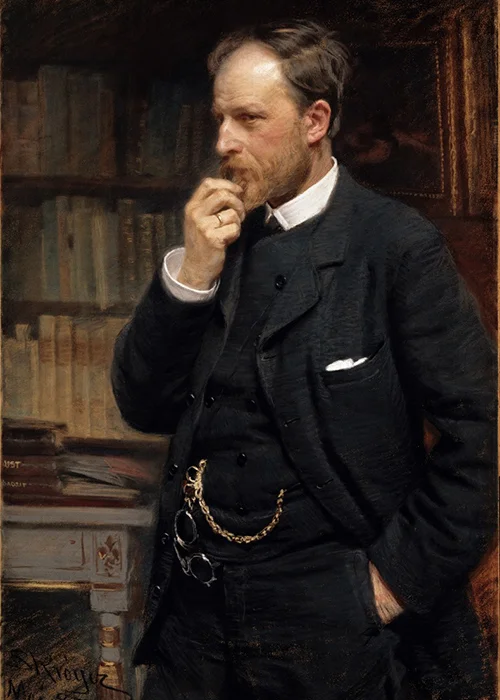
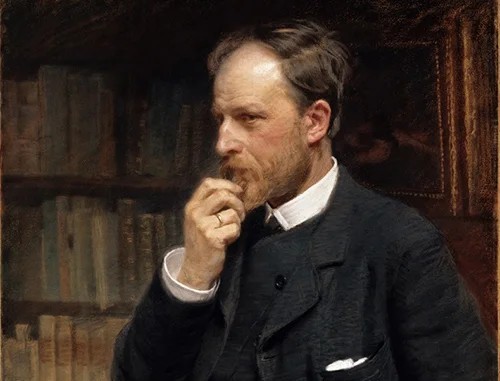
Pietro Krohn was born in Copenhagen in 1840, the son of a sculptor and the nephew of the distinguished Golden Age painter Christen Købke. He trained at the Royal Danish Academy of Fine Arts, spent years in Rome as part of the Danish artists’ colony, and worked his way through a succession of roles that would have defined several ordinary careers: painter, book illustrator, costume designer at the Royal Danish Theatre, opera director. He was, in the vocabulary of his time, a multi-talented cultural figure: Someone whose connections ran deep into the artistic institutions of Copenhagen without being tied to any single one of them.
The decisive turn came in 1885, when he was appointed artistic director of Bing & Grøndahl, the Copenhagen porcelain manufacturer. He developed the underglaze porcelain process there. And the Heron Service was among the first dinnerware produced using this technique. An instant success. But what matters here is not the technique. It is what the technique was used to make.
Japanese Art and Danish design
Designed between 1886 and 1888, the Hejrestellet — Heron Service — was inspired by Japanese art and anticipated the Art Nouveau style. It was launched in 1888 at the Scandinavian Exhibition in Copenhagen. The service is extraordinary: blue underglaze and gold on white porcelain, with herons in flight, stylised trees, the compressed visual language of East Asian decoration applied to Danish tableware with complete formal confidence. It is not imitation. It is translation — the result of someone who had absorbed a set of principles and applied them to a different material, a different culture, a different purpose.
The decoration of the service was executed by the porcelain painters Effie Hegermann-Lindencrone and Fanny Garde in their early years. Both of whom had studied under Krohn at the drawing school for women. The Hejrestellet was shown at the Nordic Exhibition in Copenhagen in 1888 and at the Expositions Universelles in Paris in 1889 and 1900. By the time Krohn left Bing & Grøndahl for the museum directorship, the service had made Danish Japonisme visible on the international stage.
The Nordic Exhibition of Industry, Agriculture and Art held in Copenhagen in 1888 was the moment at which Japonisme formally entered Danish cultural life. Siegfried Bing, the Hamburg-born Parisian dealer who was the central node of the European Japan network, was invited to contribute Japanese artefacts to the exhibition, and subsequently donated around a hundred objects to the planned Danish Museum of Art and Design. Krohn was at the centre of this: connected to Bing, connected to the exhibition, already producing the work that demonstrated what Japanese aesthetics could become in Danish hands.
Three figures were key to promoting Japanese art in Denmark: art historian Karl Madsen, whose 1885 Japansk Malerkunst was the first book on Japanese painting published in a Scandinavian language; Pietro Krohn, who headed the design museum from 1893 until his death; and Siegfried Bing, who was an important international connection for Danish Japan enthusiasts. Of the three, Krohn is the most interesting precisely because his engagement was neither scholarly nor mercantile. He was an artist turned institution-builder, and what he understood, what the Hejrestellet demonstrates, is that the value of Japanese art was not in its objects but in its way of seeing.
In 1893, he became the first director of what would eventually become Designmuseum Danmark. Together with the librarian and curator Emil Hannover, he was responsible for building the museum’s first collection — including extensive acquisitions at the Paris Exposition Universelle of 1900. He ran the museum until his death in 1905. And during those years, quietly and without institutional fanfare, he collected tsuba.
The Tsuba that were almost forgotten
The museum’s first director collected these sword mountings until his death in 1905. In time, this collection ended up in storage. The sentence is almost comically understated. A museum director collects objects that belong to his field of expertise, that connect directly to the Japanese influence which had shaped the institution from its founding, that represent some of the finest small-scale metalwork in the entire craft tradition. And they end up in a drawer.
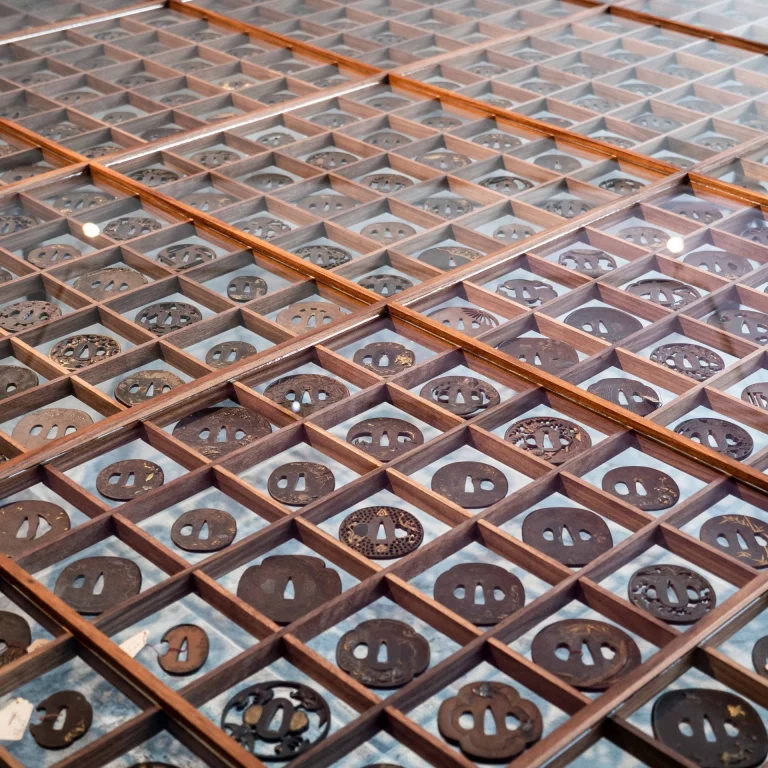
The reason is not hard to understand. At the same time, a Danish doctor called Hugo Halberstadt was privately collecting more than 1,700 tsuba, which he donated to the museum in 1940. His collection is one of the finest in the world, if not the finest. Halberstadt’s donation was so significant, so overwhelming in scale and quality, that it eclipsed Krohn’s more modest holding entirely. The Halberstadt collection was originally housed in a cabinet made by Arts and Crafts designer Johan Rohde in lemon wood and ebony; in the 1950s it was transferred to a larger drawer cabinet by Kaare Klint. Two of the great names of Danish design — Rohde and Klint — built the furniture that housed a collection of Japanese sword guards. The chain of connection is precise and unbroken: from Krohn’s Japonisme to the museum, from the museum to Halberstadt, from Halberstadt to Rohde’s cabinet, from Rohde to Klint.
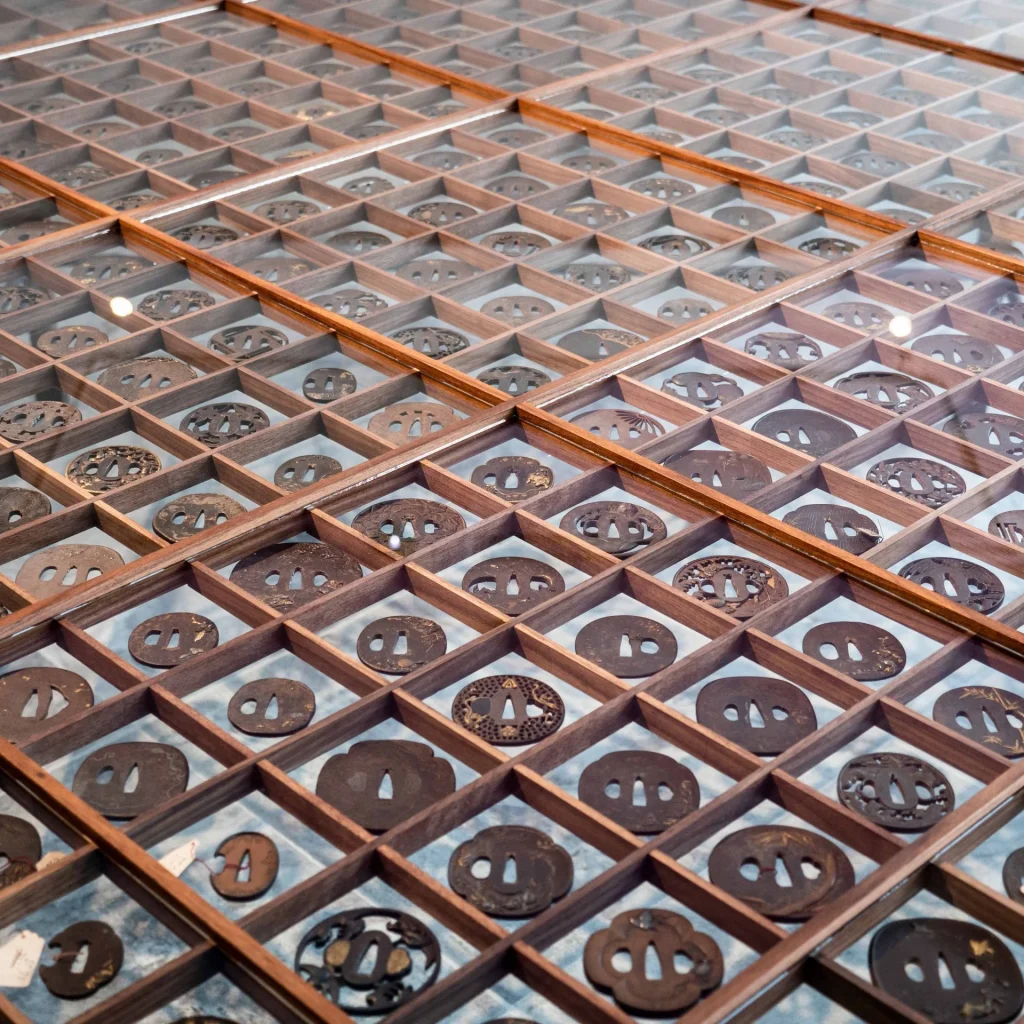
In 2022, when the museum reopened after a two-year renovation, a highlight was a room dedicated to tsuba. A new cabinet was created by Copenhagen-based Mentze Ottenstein to house a second, never-exhibited collection: Krohn’s, brought out of storage at last, shown alongside Halberstadt’s for the first time.
The pairing is instructive. Halberstadt’s 1,700 pieces represent one model of collecting: exhaustive, systematic, built around a single category pursued with maximum depth. Krohn’s smaller holding represents something different: the intuition of a generalist, the choices of someone who collected not as a specialist but as a designer — who picked up tsuba because they were precisely the kind of objects that demonstrated what he most valued. Small. Formally exact. Conceptually concentrated. Made with total command of material and a complete indifference to display for its own sake.
That is, of course, exactly what the Hejrestellet is too. And exactly what Danish design would become, over the century that followed Krohn’s death: In the furniture of Klint, the lamps of Henningsen, the chairs of Jacobsen. A tradition of making things that are formally precise, materially honest, and quietly extraordinary. Krohn did not invent that tradition. But he was among the first to understand where it could come from, and to bring the evidence home.
Sources
- Designmuseum Danmark. Press Room: “WONDER.” (designmuseum.dk/en/press-room-wonder/)
- V&A Collections. “Heron service (Hejrestellet), designed by Pietro Krohn.” (collections.vam.ac.uk)
- Sotheby’s. “A Bing & Grøndahl porcelain ‘Heron’ pattern (Hejrestellet) japonaiserie part dinner service.” Noble & Private Collections, 2024.