Der Glücksgott lacht
Hotei Washing His Feet, by Hamano Toshihiro
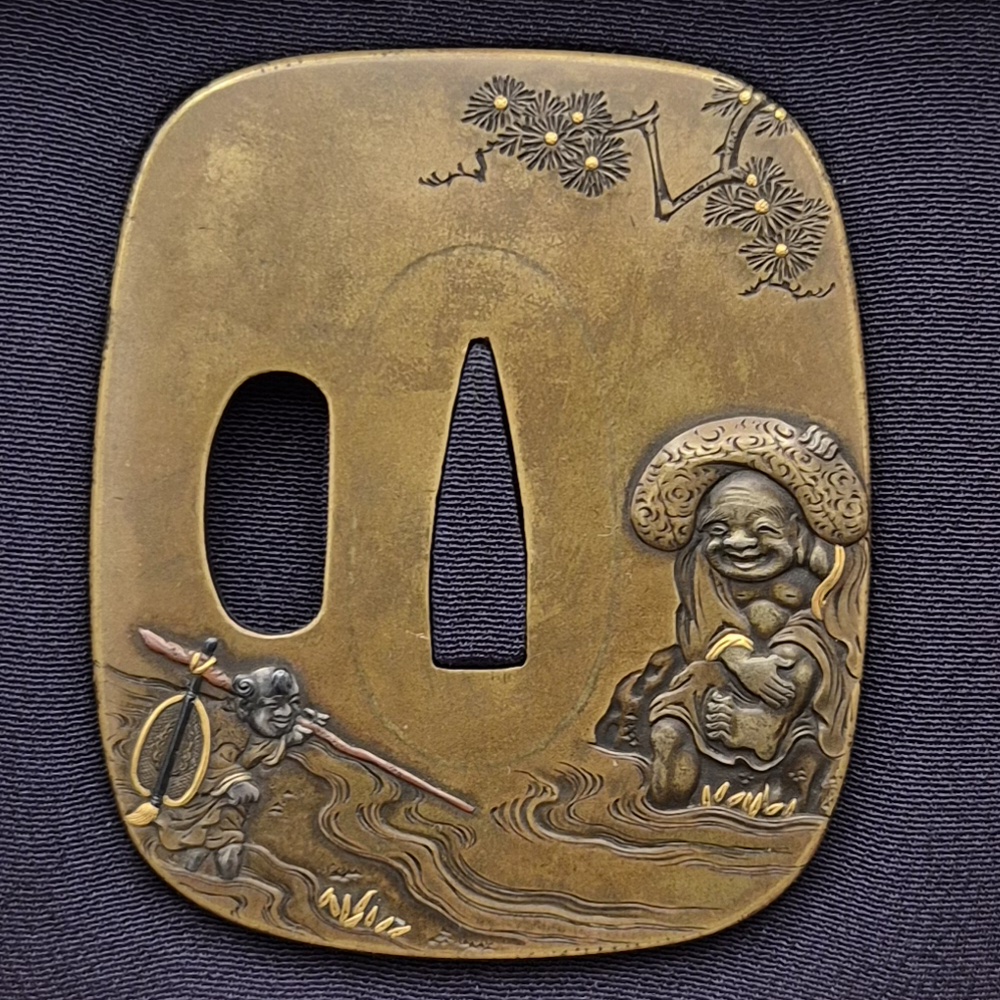
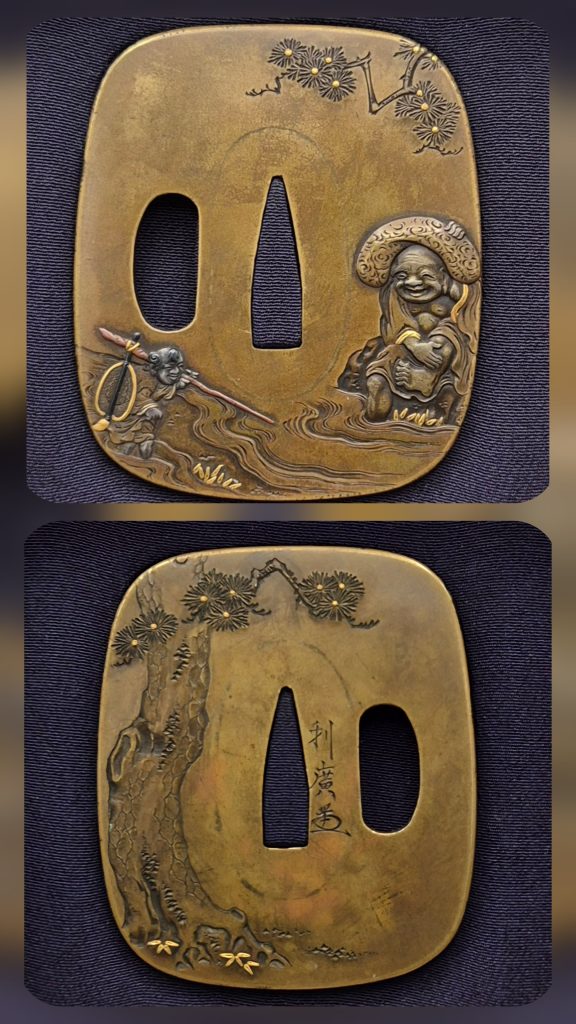
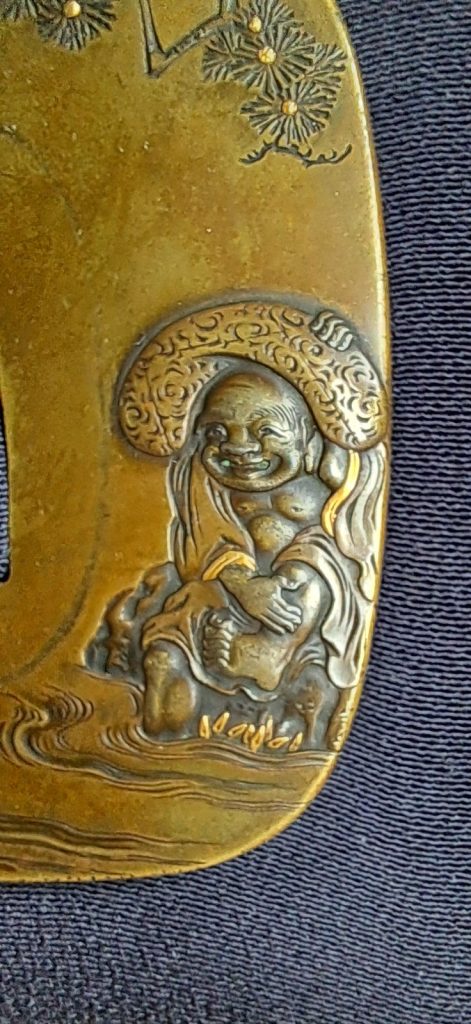
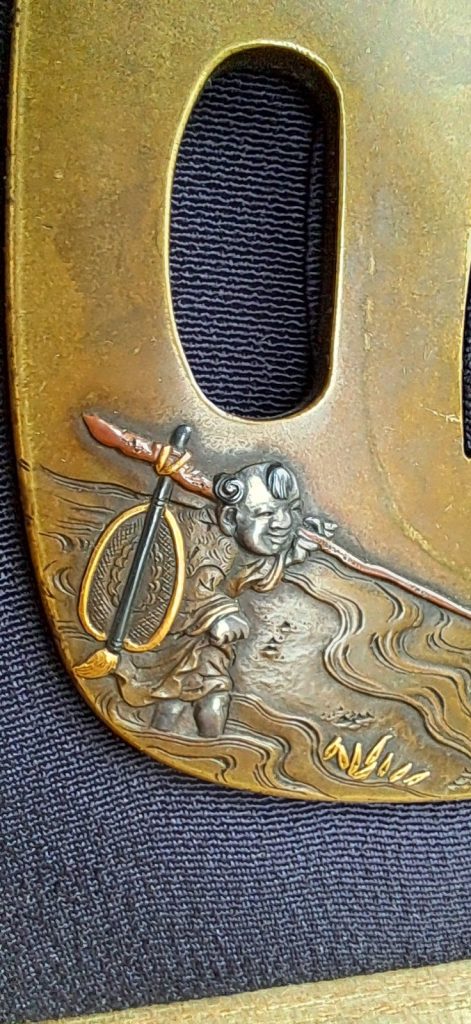
On this tsuba, Hotei sits on the bank at the right, laughing with his whole face. Behind him rises his great sack, patterned with scrolls. At the left a boy wades through the stream, a pole across his shoulder and a round net hanging from it. He looks back toward Hotei. A pine branch reaches in from the upper right.
Das Objekt
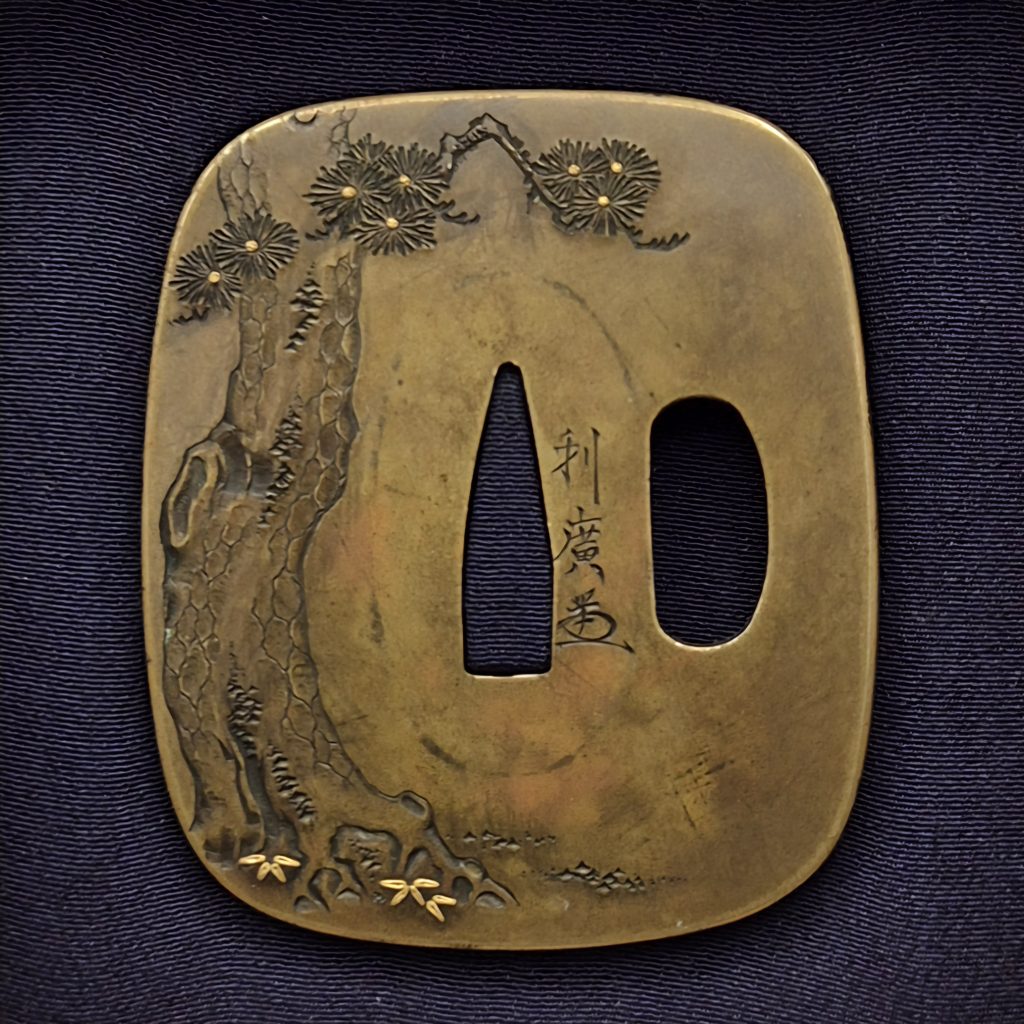
The NBTHK describes a polished brass plate in aori-gata, the outline of a saddle flap. The figures are carved in high relief from the ground, with inlay and color. The rim is square in section and gently rounded. Gold lies in the pine needles and in the grasses at the water’s edge, and the rim of the boy’s net is gold.
Hotei
The paper names the scene Hotei senzoku-zu, Hotei washing his feet. JAANUS, the dictionary of Japanese art terms, describes Hotei as the Japanese name of Budai, a wandering Buddhist monk of the tenth century, half historical and half legend. He carried a large cloth bag, and his round belly and contented face brought him into the Seven Gods of Good Fortune. In Edo painting, JAANUS adds, he often appears with children at play.
Here there is one child, and he is busy. Hotei has stopped at the water and is laughing. Nothing more happens, and nothing more is needed.
Die signierte Seite
The back carries an old pine. Its trunk rises along the left edge, the bark carved deep, and gold touches the needles at the top and the grasses at the foot. Beside the central opening the guard is signed 利廣, Toshihiro, followed by a kao, the maker’s written monogram. The paper confirms both.
Toshihiro
The Haynes Index of Japanese sword fittings lists Hamano Toshihiro, who died in 1861 (H 10358.0). The name places him in the Hamano school of Edo.
Eine Korrektur
An earlier version of this page gave the plate as sentoku. The paper names brass.
The Hotei Tsuba
Tsuba. Signiert Toshihiro mit Kao, Hamano. Shinchu, migaki-ji, sukidashi-takabori, zogan-iroe. Aori-gata, kaku-mimi ko-niku. Hotei senzoku-zu; Rückseite Kiefer. Späte Edo-Zeit. NBTHK Hozon. Privatsammlung, erworben in Europa, zuvor in einer europäischen Sammlung.
In the collection
- Type
- Tosogu › Tsuba
- School
- Hamano
- Period
- Edo-Zeit › Späte Edo-Zeit
- Material
- Shinchu
- Motif
- Götter und Glücksbringer