Der Kriegsgott hält still
Guan Yu at Rest, by Tsuneshige
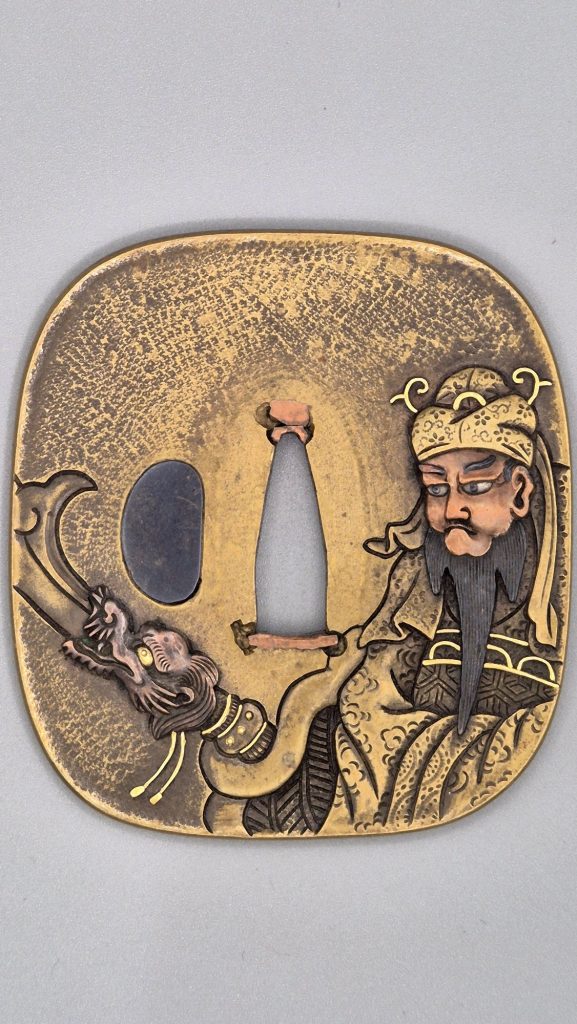
A Guan Yu tsuba by Tsuneshige, an upright rounded square with a warm, pitted ground. At the right edge stands Guan Yu, cut off by the rim at the shoulder. His face is copper, his eyes look sideways, and a long black beard falls over his chest. The headdress and the robe are gold, the robe patterned with small hexagons. At the left the blade of his halberd rises out of the open jaws of a dragon. He holds it, but he does not raise it.
Das Objekt
The ground is sentoku, the Japanese brass alloy, worked all over with a fine pitted texture. The figure is built up in high relief and colour inlay: copper for the face, shakudo for the beard and the dragon, gold for the headdress and the robe. The single hitsu-ana is closed with an oval plug of shakudo, and the tang opening is lined with copper.
Die Rückseite
A pine trunk runs up the left edge, with an oval knot-hole in the bark and touches of gold like moss. Its needles open in round clusters across the top. Below stands a copper post with a gold finial, the end of a fence or a gate, and small plants grow at its foot. Beside the tang opening the guard is signed 常重, Tsuneshige.
Die Szene
JAANUS, the dictionary of Japanese art terms, describes Kan’u, Guan Yu, as a Chinese general who served Liu Bei, Lord of Shu, and died in 219. After his death he was deified as a god of war and protector of warriors. He is shown with a red face and a jet-black beard, and with the blue dragon sword he usually wields. JAANUS adds that he appears in Japan in illustrated books, in paintings of the late Edo period and on the kabuki stage.
On this guard the weapon is there and the battle is not. The face is calm, and the blade stands upright behind the tang opening.
Tsuneshige
The Metropolitan Museum of Art lists Kawamura Tsuneshige of the Nara school as active in the late eighteenth century. The back follows a pattern that returns on other guards signed Tsuneshige in this collection: a trunk with a knot-hole at the left, radiating needles above, the signature between the openings.
Eine Korrektur
An earlier version of this page called the shape mokko-gata, read the gold finial on the back as a stone lantern and gave the general a book in its title. The plate is an upright rounded square, the gold sits on top of a post, and there is no book.
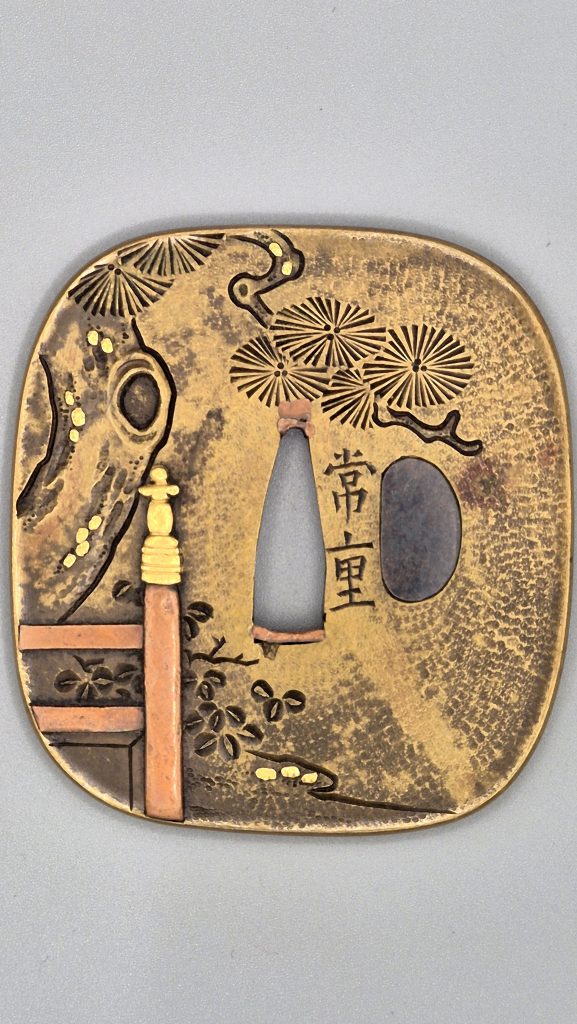
Tsuneshige’s Guan Yu Tsuba
Tsuba. Signiert Tsuneshige. Sentoku, ishime-ji, takabori mit iroe in kin, akagane und shakudo, Hitsu-ana mit Shakudo verschlossen. Tate-nade-kaku-gata. Kan’u-zu; Rückseite Kiefer und Pfosten. Edo-Zeit. Privatsammlung, erworben in Europa.
In the collection
- Type
- Tosogu › Tsuba
- School
- Nara › Tsuneshige
- Period
- Edo-Zeit
- Material
- Sentoku
- Motif
- Mensch und Legende