Netze am Strand
Drying Nets and Plovers, Hamano
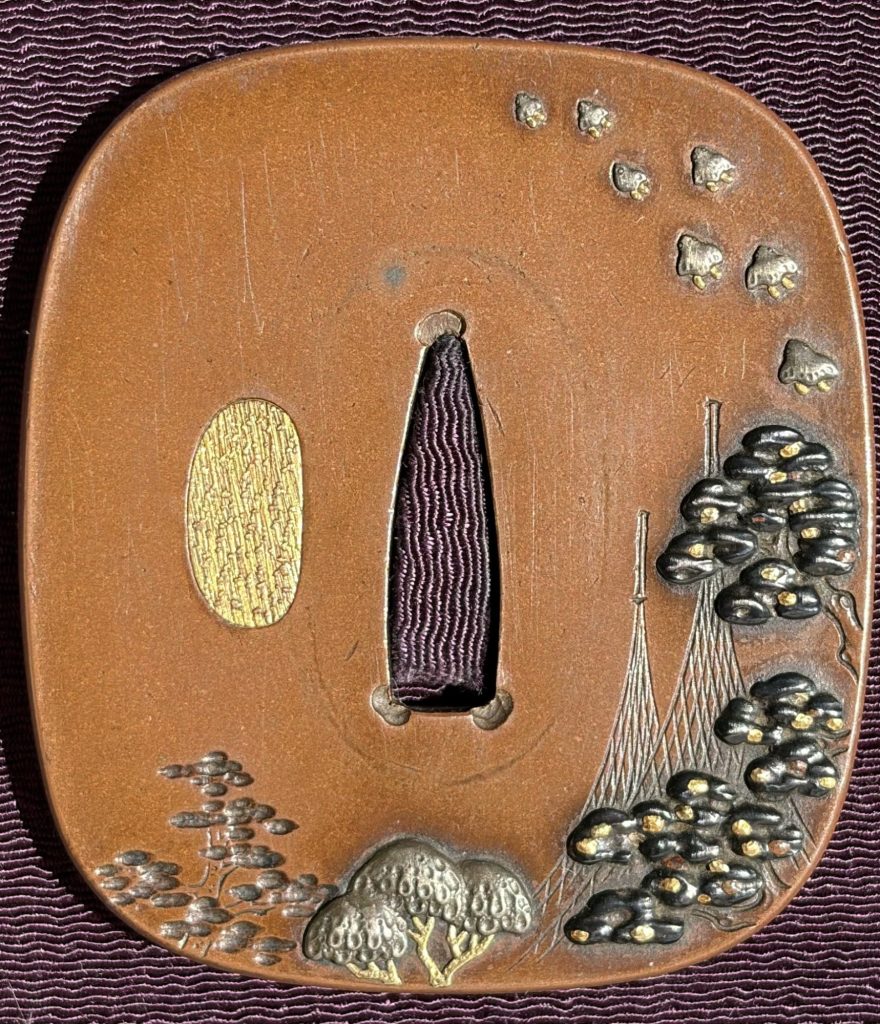
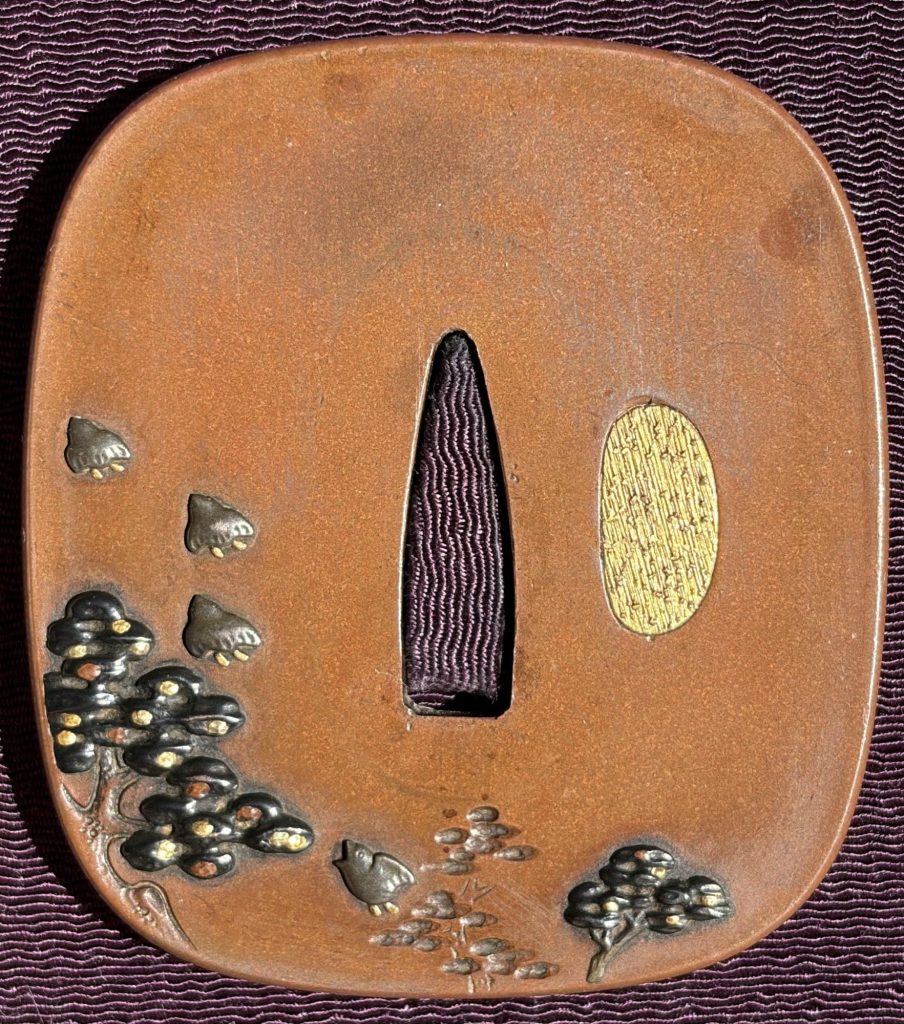
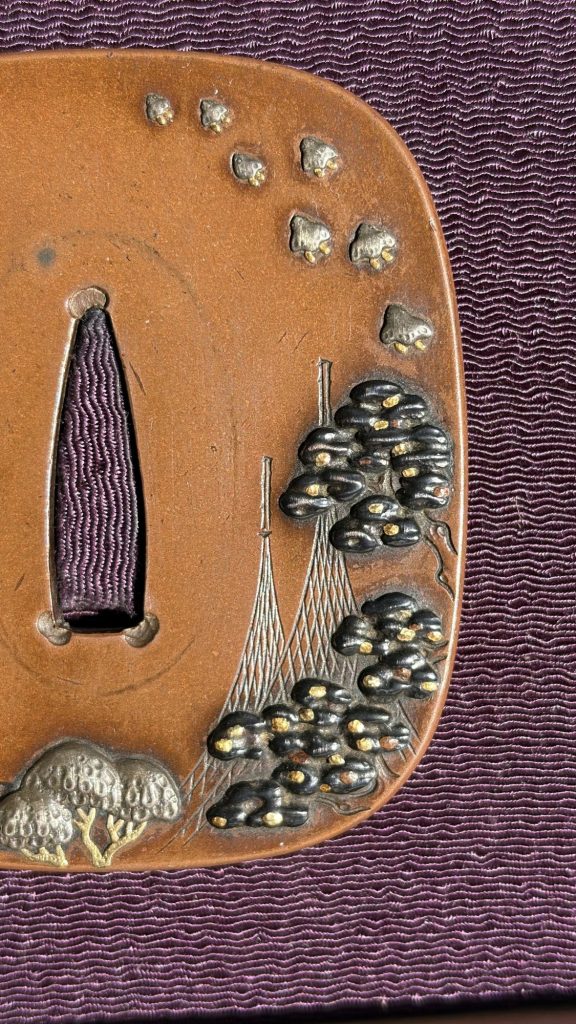
A Hamano tsuba of copper, a rounded square, warm and bare. On the right of the front a pine leans in from the edge, and beside it two fishing nets hang from their poles to dry, drawn as tall cones of fine lines. A flock of plovers crosses the upper corner. Small pines and a rounded shrub sit along the lower edge. On the back the pine returns at the left, three plovers rise beside it, and the rest of the plate is left empty. The single hitsu-ana is closed with gold, cut in fine lines.
Das Objekt
The NBTHK describes polished suaka, plain copper, in nade-kaku-gata. The technique is sukishita-kebori: the design is set slightly below the surface and drawn with fine engraved lines, with touches of colour inlay in three metals, shakudo, gold and silver. The rim is folded back on itself, uchikaeshi-mimi. The pines are dark shakudo, their needles touched with gold, and the birds and the shrub are pale silver.
Die Szene
The paper names all three things in the picture: hoshiami, drying nets; matsubara, a pine beach; gun-chidori, a flock of plovers. JAANUS describes plovers as small shorebirds living in flocks near water, a motif in Japan from the tenth century onward. Their cry was heard as chiyo, a thousand generations, and the bird came to carry a wish for long life. The Metropolitan Museum of Art describes a later kimono with plovers above shapes that may be waves or drying fishnets, nets found along the shores where plovers were plentiful.
No fisherman is shown. What is left of him is his equipment, hung up to dry, and the birds have the beach to themselves for the moment.
Hamano
The NBTHK attributes the guard to the Hamano school and names no maker. The Metropolitan Museum of Art records Shozui, 1696 to 1769, as a pupil of Nara Toshinaga and the founder of the Hamano line. The name covers several generations and many hands. A mumei guard can be placed in the manner without being placed in a workshop.
Was bleibt
The scene shows an hour between two tasks. The nets have been used and will be used again. The birds will rise when someone comes. On a sword guard, an object made for the moment of drawing, the maker chose the pause.
The Hamano Hoshiami Tsuba
Tsuba. Mumei, Hamano. Suaka migaki-ji, sukishita-kebori mit iroe in shakudo, kin und gin, Hitsu-ana mit Gold verschlossen. Nade-kaku-gata, uchikaeshi-mimi. Hoshiami matsubara gun-chidori-zu. Edo-Zeit. NBTHK Hozon. Privatsammlung, erworben in Europa.
In the collection
- Type
- Tosogu › Tsuba
- School
- Hamano
- Period
- Edo-Zeit
- Material
- Suaka
- Motif
- Tiere und VögelLandschaft