Der Frosch, der nicht aufgibt
Ono no Tofu and the Frog, by Naoshige
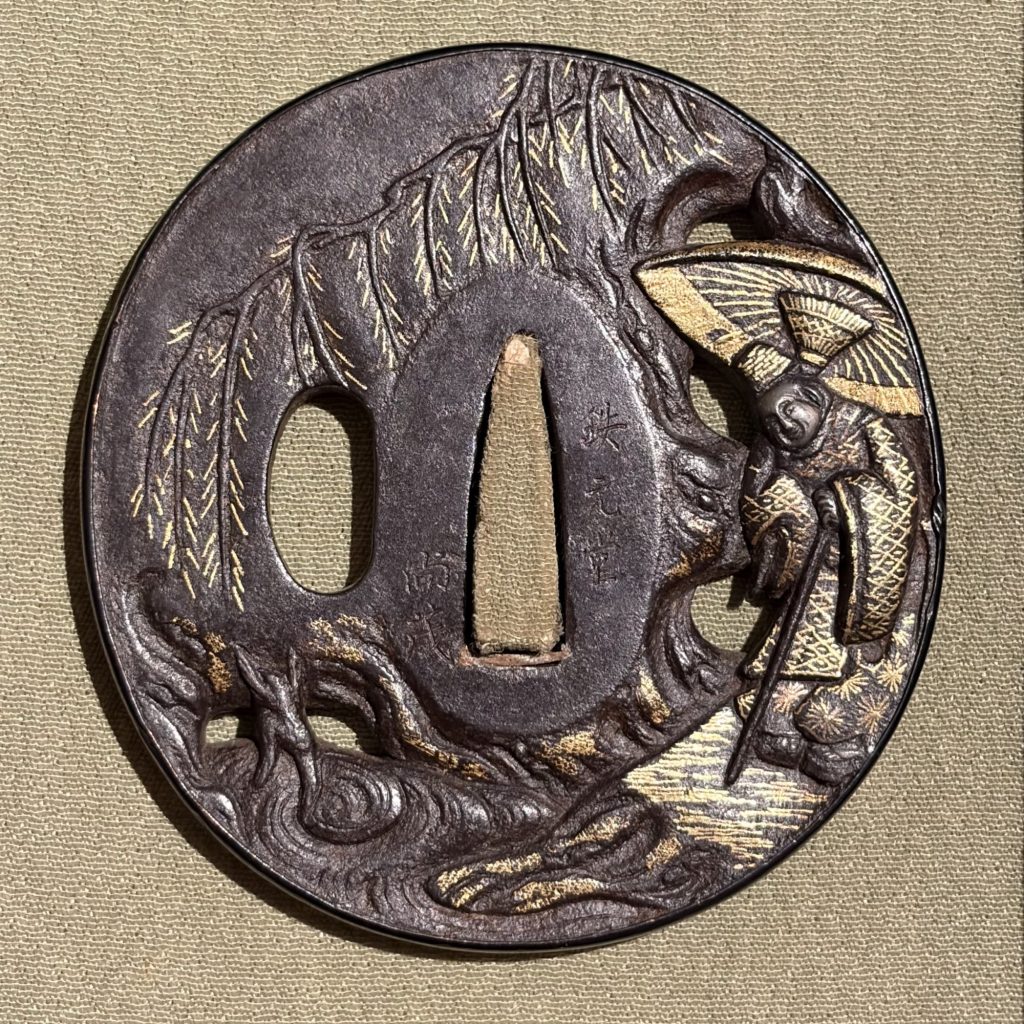
A round iron tsuba by Naoshige, signed Tetsugendo. A willow leans in from the right and lets its branches hang across the whole upper half, each leaf a short stroke of gold. At the right edge a courtier stands among the roots, his face silver, a court cap on his head, his robe gold with a lattice pattern. He holds a large umbrella, its gold ribs spread behind him. Below, a stream turns in eddies, and at the lower left a frog leaps up out of the water, cut in the black iron itself.
Das Objekt
The plate is iron, carved in high relief and pierced where the trunk and the roots stand free. The figure, the umbrella, the willow leaves and the light on the water are inlaid in gold, the face in silver. A rim of shakudo closes the plate. The back keeps the story going. The willow branches return at the top, the umbrella and the patterned robe show through the openings at the left, and low hills with gold grass lie along the right.
Die Szene
The Metropolitan Museum of Art, describing a print by Totoya Hokkei, tells the story. Ono no Tofu, 894 to 964, a calligrapher at court, walks by a stream and thinks of resigning. He stops to watch a frog trying to leap onto a willow branch. The frog fails again and again, and finally reaches it. Tofu takes the lesson and stays.
On the guard the frog is still in the air. Iron against gold, it is the plainest thing on the plate, and the whole scene turns on it.
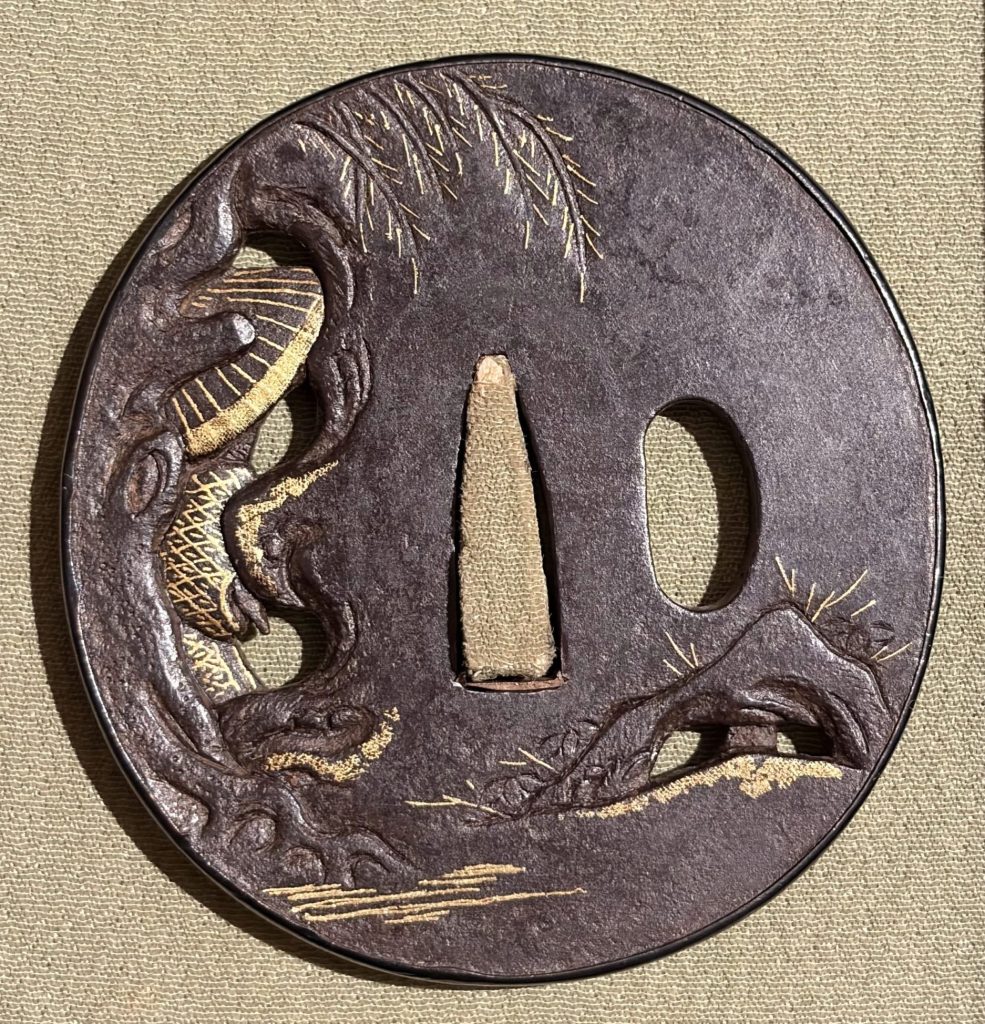
Die signierte Seite
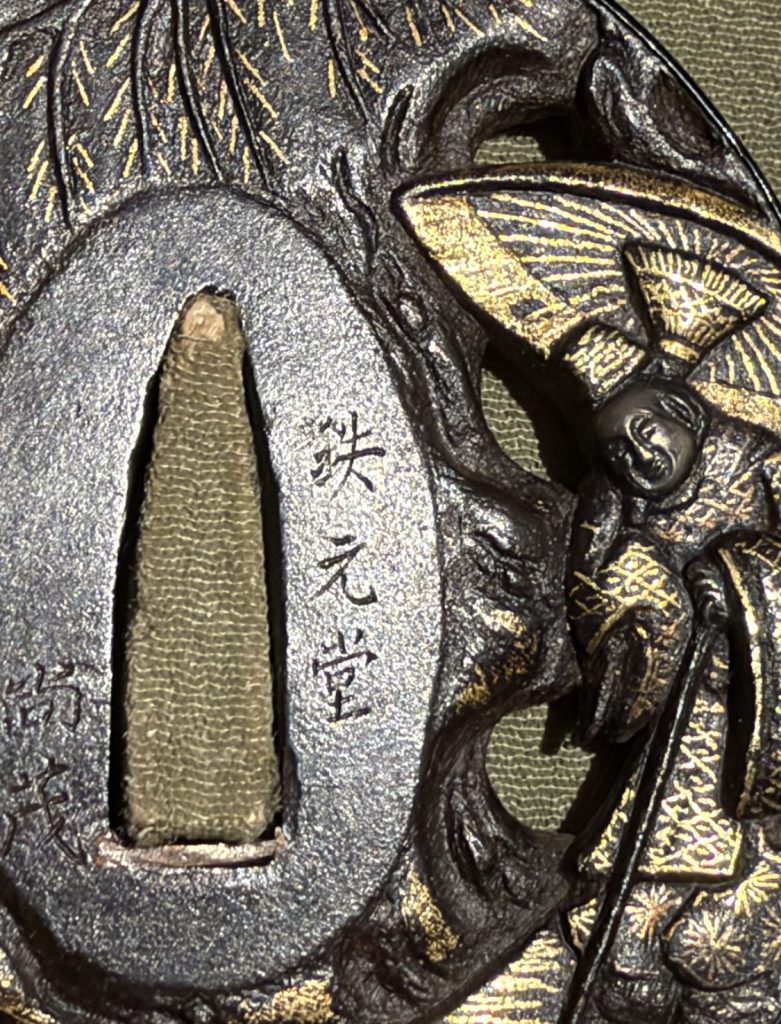
The signature is cut beside the tang opening in two columns: Tetsugendo, the art name, on the right, and Naoshige, 尚茂, on the left.
Naoshige
A. J. Koop, cataloguing the A. H. Church collection for the Ashmolean Museum, writes that Okamoto Naoshige signed as Tetsugendo. Born in Choshu, he settled in Kyoto around 1750 and died in 1780. His teacher was Tetsua Kuniharu of the Nara school, and he worked chiefly in iron, with figures in bold relief or in the round and inlays after the Nara manner. Koop adds that he also used the name Shoraku, and that this name appears on most imitations of his work. The Museum of Fine Arts, Boston, holds an iron guard by Tetsugendo Naoshige worked in the same way, with figures caught in a storm.
Naoshige’s Ono no Tofu Tsuba
Tsuba. Signiert Tetsugendo Naoshige. Tetsu, takabori und sukashi, iroe-zogan in kin und gin, Shakudo-Fukurin. Maru-gata. Ono no Tofu-zu. Mittlere Edo-Zeit. Privatsammlung, erworben in Japan.
In the collection
- Type
- Tosogu › Tsuba
- School
- Tetsugendo
- Period
- Edo-Zeit › Mittlere Edo-Zeit
- Material
- Tetsu
- Motif
- Mensch und LegendeTiere und Vögel